3,500 Buka Islanders Pose
pp. 60-61 · Read in the full issue
A Cargo Cult Problem
By a Staff Writer
When 3,500 native New Guineans refuse to “conform” to the social tenents; when 3,500 New Guineans want to set up a state within a state and run it independently of everybody else, what do you do about it?
THAT’S a question which has been posing many problems for many people in New Guinea in the last year or two, and the solution has not been found yet.
The 3,500 independent-minded islanders are from the island of Buka, Bougainville. They live in a series of eight villages in the Hahalis area, stretching along 30 miles of coast line. The Hahalis people take up an area of about one-third of North Buka.
Before the war, the people of Hahalis village itself—which is one of the eight—were noted for their independent attitude. There were whisperings of a cargo cult but nothing very much came into the open.
During the Japanese occupation in the Pacific War the Japanese met with cargo cult troubles in the Buka area including Hahalis itself. Some natives were executed and the cult appeared to end.
New Development
But it didn’t. In 1959 a new development began to come to public notice. The Hahalis people wanted to be independent.
Their leaders said they wanted to run their own affairs in their own fashion. They did not want anything to do with the established missions— Methodist and Catholic—and they broke away from them.
The missionaries were not welcome in the villages, although the church buildings remained and the Hahalis people began to run their own church services, which they conducted rather like prayer meetings without the benefit of clergy.
They told the Administration they were against Local Government Councils and that they would not have one.
About two years earlier, they had established the machinery of their own organisation, called the Hahalis Welfare Society, and this developed as a communal organisation for the benefit of everyone.
Money from village copra and other produce was put into a general fund, and the society leaders decided how it would be spent for the com munity welfare.
The leaders also decided that the bride price was unnecessary in the Hahalis villages. Women could be married to the village. One special village was put aside for selected women to live in. Any man could go to the women there, and any children born were to be the property of the society and were to be brought up on a community basis.
As the laws of the Government were not Hahalis laws, the society reasoned, there was also no reason for Hahalis to pay taxes. They thus refused to pay them.
But here for the first time the Hahalis Welfare Society struck trouble, for the Administration in 1962 sent police along to collect the taxes.
When the Hahalis villagers again refused to pay them there, fighting broke out and 600 village people were arrested and taken to Sohano, the Administration headquarters on Bougainville.
They were charged on various counts, most on charges of riotous behaviour. Some were released; some were fined; but many were given gaol sentences ranging from two months to 10 months.
Sent to Gaol They were sent to the gaols on Sohano, to Rabaul, Lae, Wewak and Port Moresby, but not all of them served their full sentences because appeals were lodged by the Admini stration on behalf of the Hahalis people and most of their convictions were quashed.
Since then, the Hahalis people have paid their taxes and there has been no more trouble of that kind with the Administration.
But today the Hahalis Welfare Society is as strong as ever, and the “baby farm” is still operating. A special “club house”, with 20 rooms,
has recently been built and it now has about 30 girls. Several babies have been born. Other “club houses” are also suspected of being in the area.
The Hahalis leaders will not agree with the mission and Administration view that “baby farming” is against all Christian principles.
The leaders of the movement are the headmen of the Hahalis villages.
Some of the leaders, but not all of them, are office bearers in the Hahalis Welfare Society.
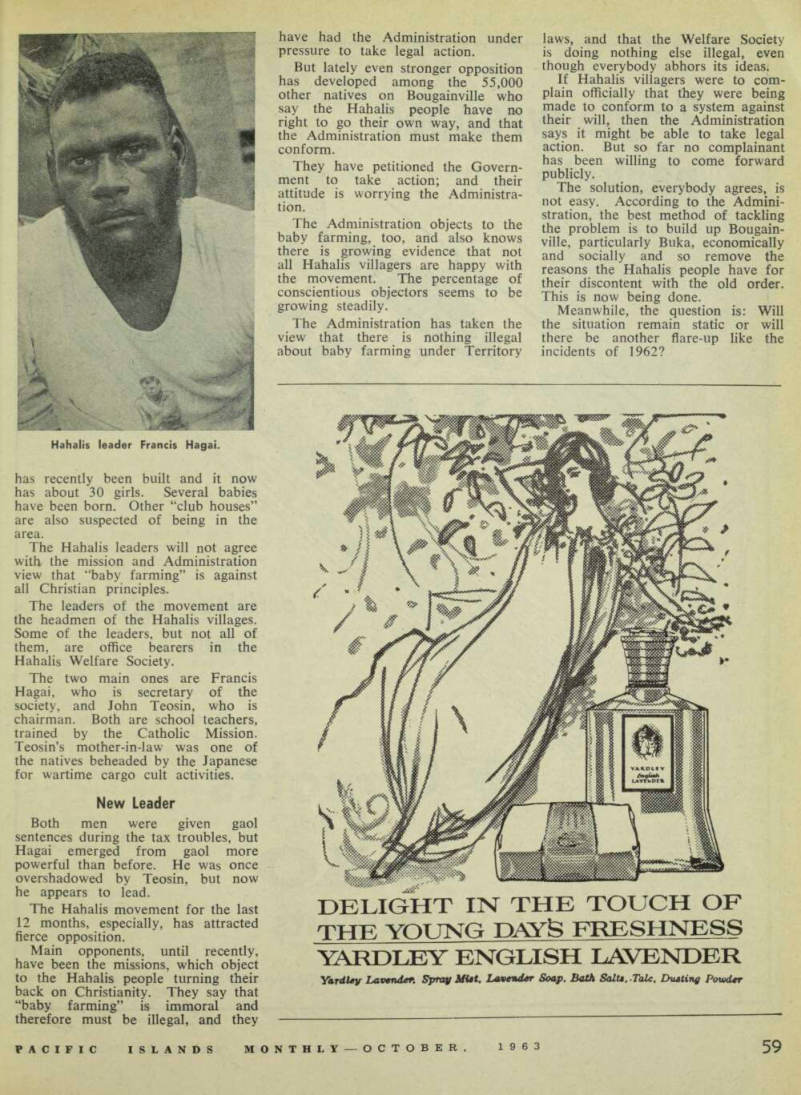
The two main ones are Francis Hagai, who is secretary of the society, and John Teosin, who is chairman. Both are school teachers, trained by the Catholic Mission.
Teosin’s mother-in-law was one of the natives beheaded by the Japanese for wartime cargo cult activities.
New Leader Both men were given gaol sentences during the tax troubles, but Hagai emerged from gaol more powerful than before. He was once overshadowed by Teosin, but now he appears to lead.
The Hahalis movement for the last 12 months, especially, has attracted fierce opposition.
Main opponents, until recently, have been the missions, which object to the Hahalis people turning their back on Christianity, They say that “baby farming” is immoral and therefore must be illegal, and they
have had the Administration under pressure to take legal action.
But lately even stronger opposition has developed among the 55,000 other natives on Bougainville who say the Hahalis people have no right to go their own way, and that the Administration must make them conform They have petitioned the Government to take action: and their attitude is worrying the Administration 3 5 ’ A , . . . , . , The Administration objects to the baby farming, too, and also knows tb® l ’© is growing evidence that not all Hahalis villagers are happy with the movement. The percentage of conscientious objectors seems to be growing steadily.
The Administration has taken the view that there is nothing illegal about baby farming under Territory
laws, and that the Welfare Society is doing nothing else illegal, even though everybody abhors its ideas, If Hahalis villagers were to com- P lain officially that they were being made to conform to a system against their will > then the Administration sa y. s 2t mi B ht be able to take legal action. But so far no complainant willing t 0 come forward P u om:iy. s °ffi^ on ’ everybody * s not easy. According to the Admim stration, the best method of tackling the problem is to build up Bougain ville, particularly Buka, economically and socially and so remove the reasons the Hahalis people have for their discontent with the old order, This is now being done Meanwhile, the question is: Will the situation remain static or will there be another flare-up like the incidents of 1962?
Hahalis leader Francis Hagai.