Deadly Coconut
pp. 57-59 · Read in the full issue


Pest Found In
The Tokelaus
The rhinoceros beetle (Oryctes rhinoceros ), which attacks and kills coconut palms, and which is a deadly menace to the Pacific’s copra industry, has been found on two islets of Nukunono Atoll in the Tokelaus, 300 miles north of Western Samoa.
THE Tokelaus, which comprise
three atolls—Atafu, Nukunono and Fakaofo—are administered by New Zealand through the NZ High Commissioner in Western Samoa, Mr. J. B. Wright.
Their population totals about 2,000, and copra is their only cash crop. In recent years, about 200 tons of copra have been exported annually, valued at between £5,000 and £B,OOO.
NZ’s Minister of Island Territories, Sir Leon Gotz, announced the dis covery of the rhinoceros beetle on Nukunono in September.
Distressing News
He said; “I am distressed at this bad news because the people of the Tokelaus rely on the coconut palm for much of their food and income.
Everything possible will be done to confine and wipe out the pest”.
Sir Leon said that Mr. Wright had accepted an offer from Western Samoa’s Director of Agriculture to supply insects that prey on the beetle and are used to combat it.
The Tokelau people had been asked to set traps for the beetle, and headmen in all islands were enforcing regulations similar to those used to control the beetle in Western Samoa.
Sir Leon added that the NZ Gov ernment and territories had contri buted regularly for some years to the rhinoceros beetle control project of the South Pacific Commission, The discovery of the beetle in the Tokelaus means that there are now
eight island groups in the Pacific where the beetle is known to have become established. The other groups
S sS
r^! oneSia) ’ To " ga T , , . , , , ibe beetle is believed to have been nought to the South Pacific in 1909 when rubber plants were imported from Ceylon to Upolu (Western „ 7 Fr ° m u P oll |, the pest spread to Western Samoa s other large island, Savan, and also to Tutuila (American Samoa).
In 1922, the pest was discovered
on Niuatoputapu (Keppel Island) in the far north of the Tonga Group but a vigorous campaign during the eradication! *“* reSU “ ed “ itS the Wa “i s n Is ' an , d ' the r main ' s,a \ d in f Walhs-Futuna Group, north of Fiji, became infested with the beetle in 1931, and it has since reached and done much damage on Futuna. The beetle is believed to have reached Wallis from Western Samoa. By 1950, it was in every district on the island and every third coconut palm was dead or dying.
The beetle reached the Palau
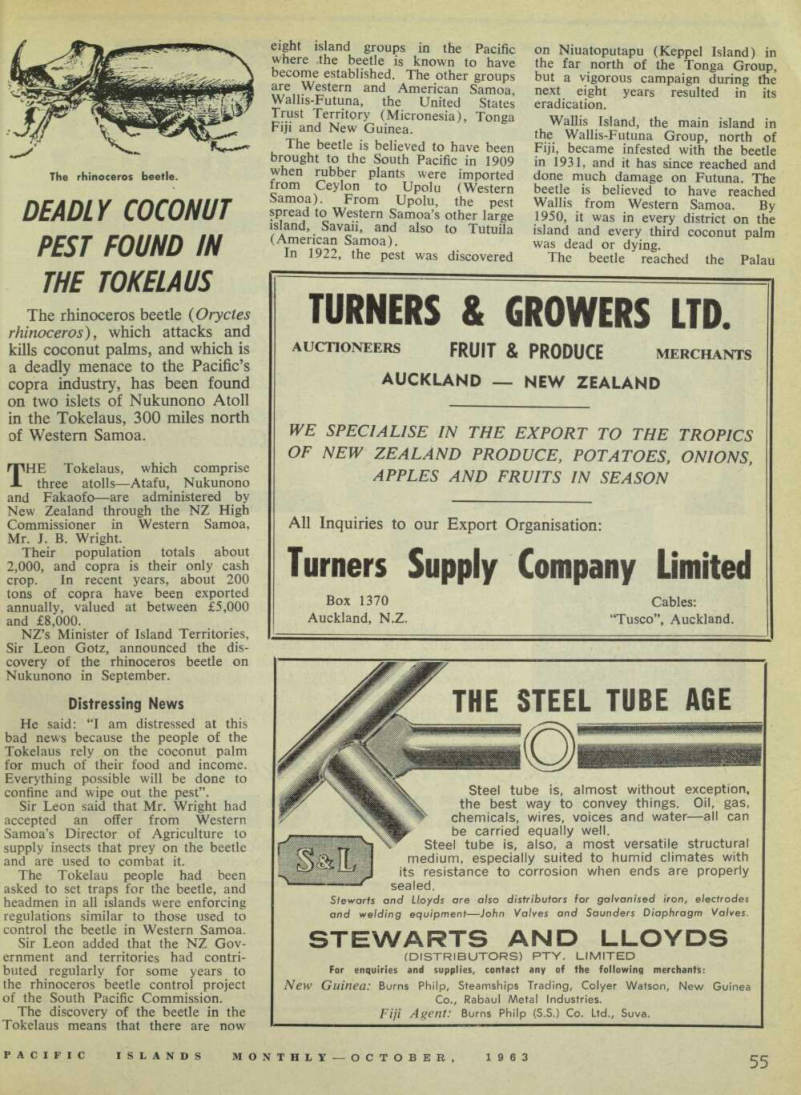
The rhinoceros beetle.
District of Micronesia in 1941, probably from Indonesia or Indo- China (now Vietnam), and destroyed a large proportion of the coconut palms there after the war. Strict quarantine regulations were intro duced to prevent its spread to other districts, and it is believed to have been confined to Palau.
The beetle became established in Tonga’s Vavau Group in. 1950, and although its spread has been arrested, it has not been eradicated.
In 1953, a live female rhinoceros beetle was found in Suva under a hatch tarpaulin of a ship that had come from Apia, and this led to the discovery that the pest was widely established on the island of Viti Levu.
Since then, the Fiji Government has spent hundreds of thousands of pounds on an eradication campaign, but so far the pest has merely been confined to Viti Levu and not elimina ted. (Fortunately, little of Fiji’s copra comes from Viti Levu), An indigenous species of beetle appears to exist in New Guinea, but Oryctes was introduced during the Japanese occupation of New Britain.
It has, however, done less damage than in other Pacific islands.
In the Tokelaus, the rhinoceros beetle could cause the entire popula tion to be evacuated if it should become firmly established.
The total area of the Tokelaus is only 2,500 acres—about twice the area of Pitcairn Island—and the soil is so poor that there is little pos sibility of raising any commercial crops apart from coconuts.