More Organised Sport Needed
pp. 47-51 · Read in the full issue

To Beat Fiji At Next Games
By Stuart Inder, who reported the Suva Games for PIM Back home from the First South Pacific Games at Suva, most competing territories have been holding post-mortems to decide what can be done to prevent Fiji from again scooping the gold medal pool at Noumea in 1966.
THE answers they have been getting seem to add up to the same thing. More organisation is needed.
Fiji deserved its runaway win at the Games because it was better organised at sport than anybody else.
Fiji plays more sport, more kinds of sport and has more and better grounds to play on than any other territory in the South Seas. It has achieved this for itself, through enthusiasm.
I worked for a few months in Fiji in 1958, not long after leaving New Guinea, and I was astonished by the great enthusiasm for sport there compared with what I had known in the big Territory.
Until then I had always thought New Guinea took an extraordinarily great interest in sport, but in fact Fiji left New Guinea for dead.
Fiji played sport, listened to it,
watched it, read about it and cheered it without stint, The result has been that in Fiji, more than anywhere else in the South Seas, a sports “nationalism” has de veloped—sport is universal in Fiji, and not something that is followed keenly only in the main centres, It is not surprising that the original suggestion to hold a Pacific Games should have come from Fiji, And the decision to hold the first Games in Suva gave the Colony an other advantage, Fiji as host territory couldn’t let itself down, so it worked hard to field teams in all sports—the only one of the 13 competing territories to do so.
Having done this it had the extra advantage of having all the best com petitors on hand, in their own en vironment among their own bar rackers.
None of these advantages can de
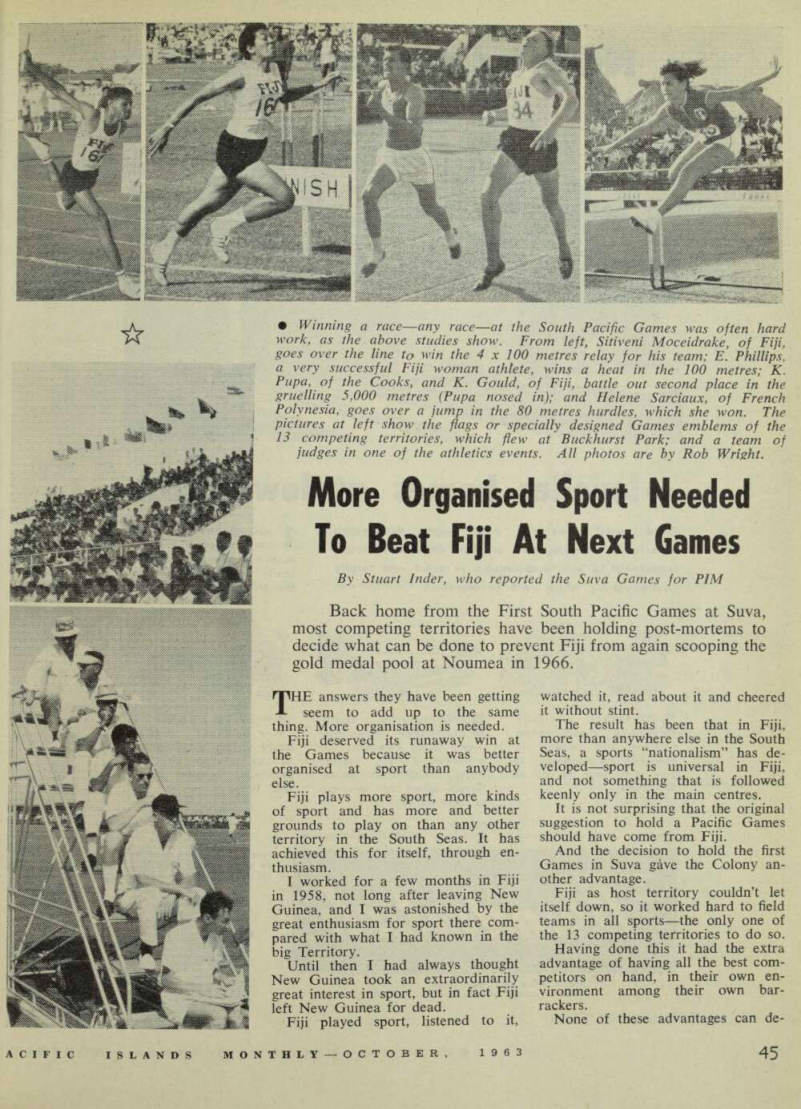
Winning a race—any race—at the South Pacific Games was often hard work, as the above studies show. From left, Sitiveni Moceidrake, of Fiji, goes over the line to win the 4 x 100 metres relay for his team; E. Phillips, a very successful Fiji woman athlete, wins a heat in the 100 metres; K.
Pupa, of the Cooks, and K. Gould, of Fiji, battle out second place in the gruelling 5,000 metres (Pupa nosed in); and Helene Sarciaux, of French Polynesia, goes over a jump in the 80 metres hurdles, which she won. The pictures at left show the flags or specially designed Games emblems of the 13 competing territories, which flew at Buckhurst Park; and a team of judges in one of the athletics events. All photos are by Rob Wright.
tract from Fiji’s Games success— especially the success of the Colony’s amazing women athletes who were the real glory of the Games. But all of them must be taken into account by other territories looking at the reasons why Fiji should have won 175 points, compared with New Guinea’s 62, New Caledonia’s 50 and French Polynesia’s 20.
None of the competing territories has any reason to hang its head over Fiji’s victory.
While a few were probably a little too slap-dash in their approach, a little too off-hand about what was needed, most could not have done better, simply because it was not pos sible for them to try any harder.
Nobody really knew anything be fore Suva.
Nobody, including Fiji, knew what the competition was, how much or how little was required, or how big was a team.
The Cook Islanders did a big job with a handful of men; after Fiji, American Samoa fielded the biggest team (99, including 22 officials) with little result in the way of medals.
But that’s a lesson for next time, and nobody can offer any criticism on how things could have been handled in Suva.
Already the days of the walkover are ended for the Games.
At Noumea the competition will be fiercer, and the teams better balanced and more carefully selected and trained.
Territories have seen for them selves what swimming pools and ath letic fields can do to build up young hopefuls, for no team manager re turned from Suva without that know ledge firmly planted in his mind.
More money on sports facilities and training will be spent everywhere in the next three years, as the weak nesses revealed at Suva are system atically attacked.
Fiji can expect more determined tennis competition from French Poly nesia and New Guinea; the Cook Islands and New Guinea will clearly throw more punches at Fiji in the boxing ring; New Caledonia will put in a bigger table tennis team; and on the athletics field all territories will
be looking for women able to wrest superiority from those of Fiji.
Swimming will never again be left to four territories. New Caledonia and New Guinea will be the main challengers at Noumea, as they will be determined to find and train
“natural” swimmers. There will be no repeats of the galling occasions at Suva when no bronze medals were awarded because only two teams faced each other in the finals.
Noumea will also bring to the fore many of the youngsters who also were present at Suva but who were too young to gain much but ex perience. In three years they will be ready to take some medals of their own. French Polynesia and New Guinea should be among the terri tories to benefit largely from this.
Sports organisation and planning are what are required to win at the South Pacific Games, and there can be no doubt in the mind of anybody lucky enough to have seen the Suva Games from start to finish that or ganisation is just what the South Seas is going to get.
How were the First South Pacific Games in two other important ways —socially and politically?
In a word, fine!
No South Pacific conference was ever as spontaneous or as youthful, or as gay, or as plain good-natured, as the Games.
The French could not always un derstand the Anglo-Saxon mind and the Anglo-Saxons could not always understand the French, but that only served to make the meeting more in teresting.
There were no “incidents” of the kind we are accustomed to read about at the Olympics. There were no power politics, or bad manners, or bad sportsmanship. Things, in fact, went so smoothly as to be refresh ingly different.