Fiji And American Samoa
pp. 27-30 · Read in the full issue

New Plants For Jap Tuna In Fiji And American Samoa
The Cook Islands Legislative Assembly’s decision in Sep tember against a Japanese-supplied tuna cannery in Rarotonga (page 117) corresponded more or less with the extension of Japanese tuna fishing interests in Fiji, American Samoa and New Caledonia.
IN Fiji, initial preparations have be gun at Levuka for a new Japan ese tuna industry which will operate early next year.
The industry will include a freez ing works which will process the fish caught by between 30 and 100 Japan ese ships for re-export to the US and Japan. Two-thirds of the catch is expected to go to the US.
A proportion of the Japanese crews and their families—one family per vessel, probably—will be allowed to live at Levuka.
The Fiji Government is expected to give tax concessions to the Japan ese venture, operated by Pacific Fisheries, in the hope that eventually Fiji will benefit by income tax and increased local expenditure.
American Samoa In American Samoa, the American company Star Kist began canning at its still-unfinished cannery in Pago Pago in the first half of September.
The general manager of the com pany, Mr. Stanley R. Peterson, said that about 25 Japanese and Korean fishing boats would be delivering fish to the cannery by the end of the year.
Star Kist is the second American company to establish a cannery in Pago Pago to can Japanese-supplied tuna. The first was Van Camp, which has been operating for several years.
Star Kist canned about 10 tons of tuna on its first day of operation, with 30 women packers at work. It re quired 70 packers on the second day, when two Japanese tuna boats un loaded about 150 tons of tuna.
Five other boats, then fishing for Van Camp, were to work for the new cannery after unloading their current catch.
The American Can Company, which has opened a factory between the canneries of Van Camp and Star Kist, began producing cans for both companies in the second week of September.
In New Caledonia, the Japanese re frigeration vessel Eiyo Maru, an chored in Noumea Harbour, has been
busy receiving tuna from Japanese trawlers operatng in local waters.
The Eiyo Maru will remain in Noumea for two years to freeze and process Japanese-caught tuna pending the construction of a freezing plant by Societe I’Ocean, a company com posed of Japanese and New Cale donian interests. ( TIM, Sept. p. 11.)
Other Developments
Other developments in Pacific tuna fishing in recent weeks include: • A statement by the Japanese Ambassador to Australia, Mr. Saburo Ohta, that Japanese and Papua-New Guinea interests might be able to co operate in a tuna fishing industry. • Complaints by Australian lob ster fishermen in northern New South Wales that Japanese tuna fishermen have been causing them serious losses by cutting ropes attached to their lobster pots. • The discovery by Australian oceanographers of hundreds of fish eggs in a remote part of the Pacific
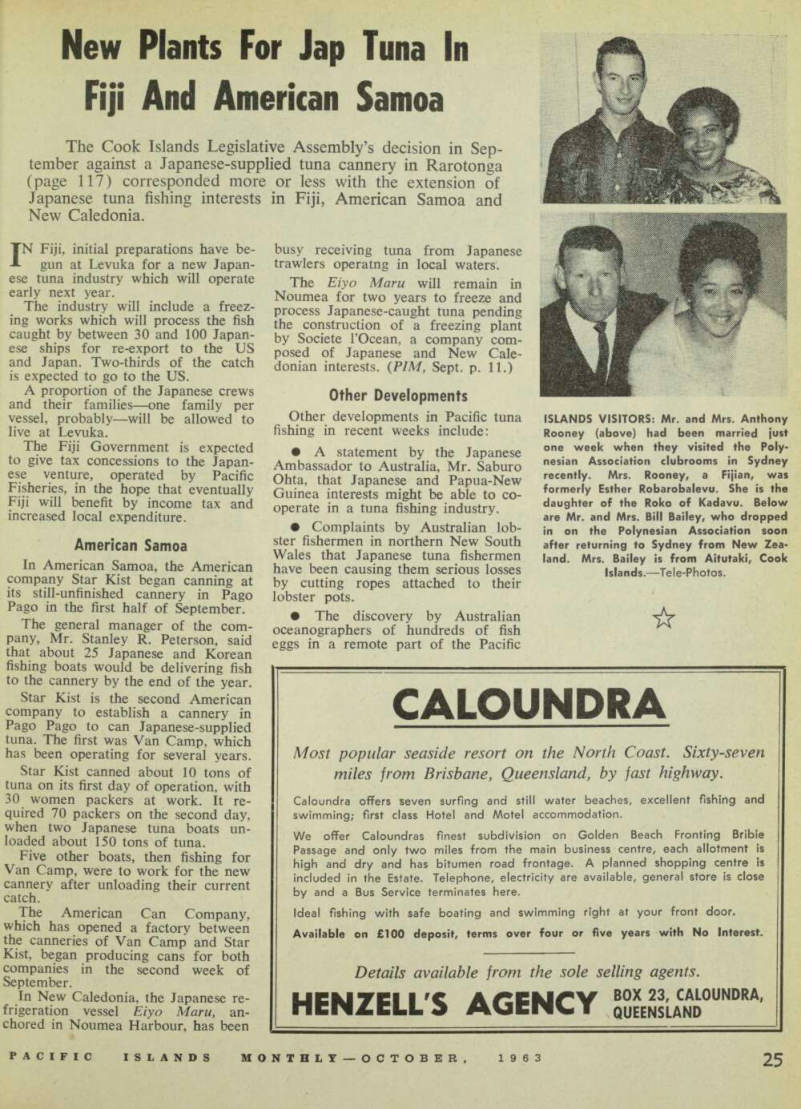
ISLANDS VISITORS: Mr. and Mrs. Anthony Rooney (above) had been married just one week when they visited the Poly nesian Association clubrooms in Sydney recently. Mrs. Rooney, a Fijian, was formerly Esther Robarobalevu. She is the daughter of the Roko of Kadavu. Below are Mr. and Mrs. Bill Bailey, who dropped in on the Polynesian Association soon after returning to Sydney from New Zea land. Mrs. Bailey is from Aitutaki, Cook Islands.—Tele-Photos,
which they think might help to in crease tuna catches off the Australian coast.
The Japanese Ambassador’s state ment on the possibility of co-opera tion in a tuna fishing industry be tween Japanese and P-NG interests was made during an official 10-day visit to P-NG in late August.
Asked at a news conference in Port Moresby about reports that Japanese firms were interested in the fishing industry around New Guinea, Mr.
Ohta said he thought there was a “possibility of co-operation” between Japanese interests and Papua-New Guinea in the installation of cold storages in the Territory.
He emphasised that this would be subject to the Australian Government allowing Japanese experts into the Territory, and also that Japanese fishing vessels be allowed in Territory ports to provision.
No Applications
Mr. Ohta stressed that no Japanese firm had yet applied to Australia for the admission of fisheries experts.
He said waters around Papua-New Guinea were among the best in the world for tuna fishing, and that about 150 to 200 Japanese fishing vessels were regularly engaged in fishing around the Territory’s waters.
Lack of cold storage facilities was their big problem.
Mr. Ohta suggested that if cold stores were erected, they could operate with Japanese vessels catch ing fish and the cold stores buying it from them and selling and export ing it. Such cold storages were being constructed in other Pacific countries by co-operation between Japan and interests in those countries.
Mr. Ohta added that Japan was buying a lot of timber from the Terri tory, and one firm had asked Aus tralia for permission to allow several Japanese experts into the Territory to instruct people in handling methods.
The complaints by New South Wales lobster fishermen about losses caused them by Japanese tuna fisher men were made at the end of August.
The lobster fishermen, who operate from eight to 18 miles off Grassy Head, near Kempsey, said that Jap anese tuna lines became tangled with ropes connecting locally-owned lobster pots with marker buoys.
To free their lines, the Japanese cut the ropes, leaving the lobster pots to sink to the sea floor.
The lobster fishermen said they had lost £2,000 in lobster pots in two days—each pot being worth about £lOO.
One fisherman, Mr. F. Kemp, said on August 28 that a Japanese boat
had worxed within half a mile of his boat that morning hauling in tuna on long lines.
Later, a second Japanese trawler had steamed up, and had then moved closer to the shore.
At one stage an Australian naval frigate had passed between his (Kemp’s) boat and the first trawler, The first trawler had moved to sea when the frigate was sighted, but soon moved back to the area.
Mr. Kemp added that he had winched up about a mile of Japanese line and had salvaged as much of his own gear as he could.
Some lobster fishermen later went
out with rifles, with the intention of shooting if the Japanese came within the three-mile limit.
The possibility that tuna catches off the Australian coast might be in creased following the discovery of hundreds of tuna eggs in a remote part of the Pacific was revealed at the end of August following a six week research trip of 8,000 miles by HMAS Gascoyne.
The Gascoyne carried a party of oceanographers from the Division of Fisheries and Oceanography of the Commonwealth" Scientific Institute Research Organisation.
The officer in charge of the party,
Mr. D. J. Rochford, said the eggs were found in an eastward-moving stream of water with an unusually low salt content.
It was thought that the eggs were spawned off the coast and that they moved eastward in the low-salinity water stream to the westward-flowing southern equatorial current, by which time they were at the larvae stage.
The current then took the tuna back to the coast, by which time they had reached adulthood.
Mr. Rochford said that the oceano graphers hoped to backtrack from the area where the eggs were found to find the tuna breeding grounds and show how the adult tuna reached them.
Footnote : A spokesman for Em press Australia Ltd., which an nounced in May that it was planning to build a tuna cannery on Norfolk Island, told PIM in late September that his company had no further statements to make on the subject for the time being.