Greatest Extravaganza
pp. 21-25 · Read in the full issue


P Ng Elections, 1964
They’re Preparing For The Territory’s Greatest Extravaganza
Papua-New Guinea’s preparations for next year’s House of Assembly elections —which could turn out to be the world’s most fantastic effort to bridge a millennium and bring Western ised democracy to primitive people—are already well on the way and are producing one important by-product; A concen trated patrolling effort that has never been equalled in the Territory.
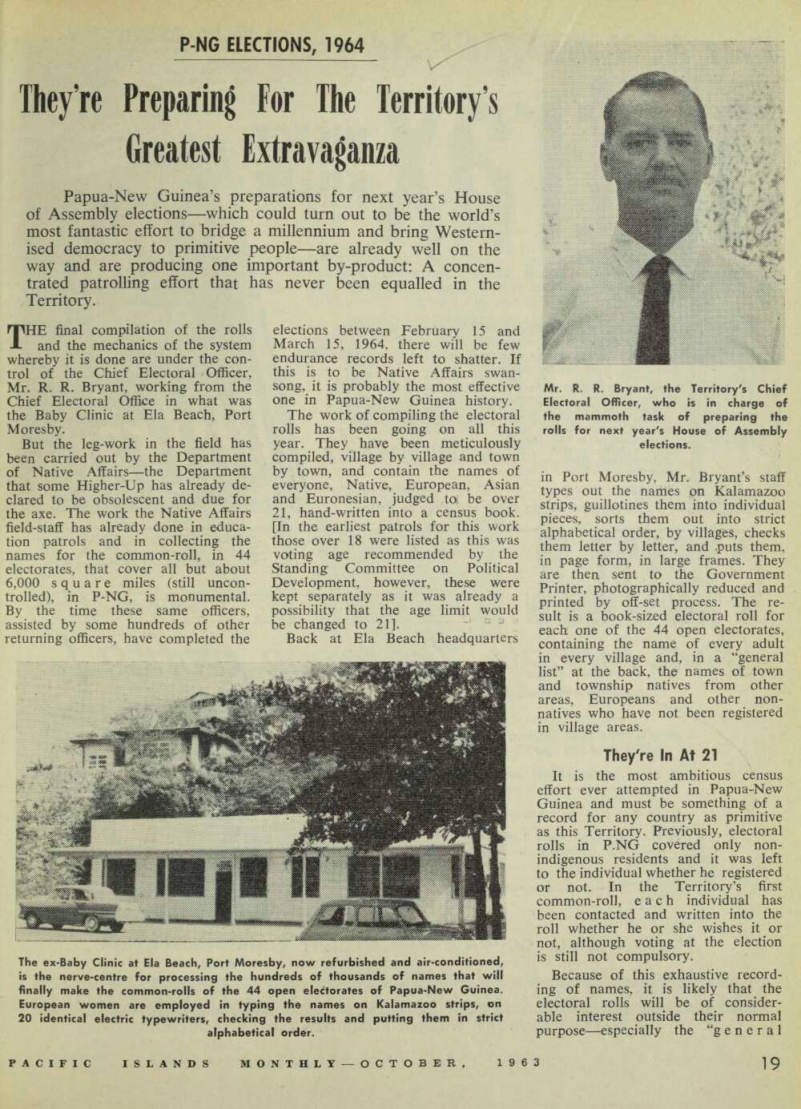
THE final compilation of the rolls and the mechanics of the system whereby it is done are under the control of the Chief Electoral Officer, Mr. R. R. Bryant, working from the Chief Electoral Office in what was the Baby Clinic at Ela Beach, Port Moresby.
But the leg-work in the field has been carried out by the Department of Native Affairs—the Department that some Higher-Up has already dedared to be obsolescent and due for the axe. The work the Native Affairs field-staff has already done in education patrols and in collecting the names for the common-roll, in 44 electorates, that cover all but about 6,000 square miles (still uncontrolled), in P-NG, is monumental.
By the time these same officers, assisted by some hundreds of other returning officers, have completed the
elections between February 15 and March 15, 1964, there will be few endurance records left to shatter. If this is to be Native Affairs swan song, it is probably the most effective one in Papua-New Guinea history, The work of compiling the electoral rolls has been going on all this year. They have been meticulously compiled, village by village and town by town, and contain the names of everyone, Native, European, Asian and Euronesian, judged toi be over 21, hand-written into a census book, [ln the earliest patrols for this work those over 18 were listed as this was voting age recommended by the Standing Committee on Political Development, however, these were kept separately as it was already a possibility that the age limit would be changed to 21].
Back at Ela Beach headquarters
in Port Moresby, Mr. Bryant’s staff types out the names on Kalamazoo strips, guillotines them into individual pieces, sorts them out into strict alphabetical order, by villages, checks them letter by letter, and puts them, in page form, in large frames. They are then, sent to the Government Printer, photographically reduced and printed by off-set process. The re sult is a book-sized electoral roll for each one of the 44 open electorates, containing the name of every adult in every village and, in a “general list” at the back, the names of town and township natives from other areas, Europeans and other non natives who have not been registered in village areas.
They're In At 21 It is the most ambitious census effort ever attempted in Papua-New Guinea and must be something of a record for any country as primitive as this Territory. Previously, electoral rolls in P.NG covered only non indigenous residents and it was left to the individual whether he registered or not. In the Territory’s first common-roll, each individual has been contacted and written into the roll whether he or she wishes it or not, although voting at the election is still not compulsory.
Because of this exhaustive record ing of names, it is likely that the electoral rolls will be of consider able interest outside their normal purpose —especially the “general
The ex-Baby Clinic at Ela Beach, Port Moresby, now refurbished and air-conditioned, is the nerve-centre for processing the hundreds of thousands of names that will finally make the common-rolls of the 44 open electorates of Papua-New Guinea.
European women are employed in typing the names on Kalamazoo strips, on 20 identical electric typewriters, checking the results and putting them in strict
alphabetical order.
Mr. R. R. Bryant, the Territory's Chief Electoral Officer, who is in charge of the mammoth task of preparing the rolls for next year's House of Assembly elections.
lists” at the back of each book where non-indigenees are recorded.
This first phase of field-work— the recording of names—is now near ing completion but concurrently with it has been an education programme that is attempting the uphill task of explaining 1963 Parliamentary pro cedure to people who are, in spite of crash education programmes, still largely illiterate and some of whom have scarcely left off eating their enemies or taking their heads.
This attempt is being made by more patrols, talks, lectures, film strips posters and more talks. During the recent sthojol holidays, school teachers were recruited in the “educa tion for democracy” drive but largely the task has again fallen on the Patrol Officer out in the field, or other Native Affairs officers in Dis tricts and Sub-Districts in outer areas.
How much of this effort falls on barren ground is anyone’s guess and estimates vary according to the pet enthusiams of officers concerned— senior policy-making officers tending towards a rosier view than those en trusted with getting the message home who take a more realistic—and some times dimmer—view of proceedings.
But by polling-day, there will be few natives in the 180,000 sq. miles of the P-NG Terri tory who will be unaware that some thing big is afoot, even though they may have only rudimentary ideas of what it is all about.
Borderland "Duchessing"
Particular attention in name record ing, education and polling facilities is being given to the areas of the Western District of Papua and the Sepik Dis trict of New Guinea where they border on West New Guinea (or West Irian) and where, until last year, certain enclaves rightly belonging to Australia were administered by the Dutch.
The third phase of Operation House of Assembly will be the elec tion itself, a rolling affair that will last, in different parts of the Terri tory, from mid-February to Mid- March and will actively engage about 440 Native Affairs personnel (all but about 20 of full strength) and hundreds of others, Government, Mission and private individuals, re cruited to man the 1,000 fixed or mobile polling places.
The fixed polling places will also serve as headquarters for the mobile polling booths which will open for business, on specific days, on already determined routes. Voting in any one location will take a minimum two days—and some considerably more.
Dates for each location have already been fixed and it is expected that all patrols will accomplish their assignments within the time limit set.
Polling places have been located on the basis that no voter will have to walk for more than 10 hours in order to record his vote—that is, five hours in and five hours home again.
Although there is probably no-one in the civilised world who would take his politics as seriously as this, in country as unroaded as P-NG, experienced field-officers already calculate that over 70 per cent, will cast a vote in remote areas and anything up to 90 per cent, in settled areas— partly, perhaps, because as everyone has been enrolled, native electors will
conclude that voting is obligatory also.
It is believed that each returning officer will be able to process about 200 native voters a day—“process” in this connection being the key word because, in many areas, any connec tion with any recognised form of secret voting will be purely co incidental.
In their wisdom, those who have framed the regulations have provided for preferential voting, as in the Aus tralian system, although the voter does not have to list all his prefer ences unless he wishes; and unlike most Asian and African countries, where elections have been carried out amongst people largely illiterate,
no symbols will be used for candi dates. Ballot papers will carry names only, as in Australia.
This means that not only will most voters have to ask the help of the returning officer (as provided for in the Ordinance), to find out what it is all about, but will have to have the name of his fancies pointed out so that ha can affix his mark against them.
Special light-weight, fibre-g lass ballot boxes and collapsible aluminium polling booths have been designed for the patrols; and helicopters, as well as jeeps and planes for the land, and speed-boats for the rivers, will be used to get returning officers quickly to some of the most remote polling places.
The two largest and most difficult electorates are those that take in the Upper Sepik in New Guinea; and Fly River area of Papua. Upper Sepik is a huge “L” of the Sepik district, start ing as a strip of coast with Vanimo as its centre, running south of Tele fomin on the Papuan border, and east to include Ambunti on the Sepik.
The most western of Papua’s elec torates, Fly River, is even bigger and takes another huge “L” out of the Western District of Papua from Tele fomin on the New Guinea border, south to the sea and east to Dam and the mouth of the Fly. It includes the areas traversed by the Fly and Strick land Rivers and some of the remotest and most isolated polling areas of all.
Polling will start at the heads of the rivers in both these electorates and work down—from Awin on the Fly and Atbalwin on the Sepik. Heli copters will be used from Telefomin, Kiunga (on the Fly) and Dam.
Weather, luck, modem transport equipment, old-fashioned leg-power, native patience and endurance, and Australian genius for bush improvisa tion are all going to play a part in getting the election results through— but which ever way you look at it, what goes on in Papua-New Guinea between February 15 and March 15, 1964, is going to be just about the biggest show on earth.