Soekarno's Disturbances Too
pp. 15-17 · Read in the full issue
Close To P-Ng For Comfort
A Commentary On September's Crisis
By R. W. Robson
“Bung” Soekarno of Indonesia held the headlines during September. His performances astonished most of the world.
But the disturbances he created were a little too close to Papua and New Guinea for that Territory’s comfort.
IN the third week of the month, events were moving to a crisis.
Soekarno declared cold war upon Malaysia—but found himself in con flict with Britain. It was then a question of whether he would retract or go on.
Britain, having deliberately joined with Malaya, Singapore, Sarawak and Sabah (North Borneo) in creating the Federation of Malaysia as a bulwark against the increasing south wards thrust of Red China, was in no mood for sweet words and compromise.
For once—perhaps unexpectedly— Whitehall was enjoying the complete diplomatic support of the United States, and was not being scolded by Soviet Russia. So she adopted, towards Indonesia, a colder, sterner line than has been seen in British international relations for years.
Defied by Malaysia, threatened grimly by Britain, deserted by Moscow, scolded by the US, and told that he would get no more “financial aid”, the “Bung” reacted in a very stupid way.
By September 25, from the interior of Java, he was threatening “con frontation” of Malaysia and her friends.
Economy In A Mess Although Indonesia poses no serious threat to our security—its economy is in such a mess that, under stress, its fighting organisation would fall to pieces—it could cause a tremendous regional dislocation in economic and political affairs.
Soekarno is throwing large numbers of guerillas into the North Borneo jungles to menace Sarawak and Sabah, and they alone could create a big and expensive nuisance.
But it is still possible that there are in Indonesia a sufficient number of men with a sense of responsibility to halt the “playboy President’s” headlong rush into disaster. If there is, it could be that Soekarno will dis
appear overnight, and a dependable government will take over.
Neither Britain, nor Malaysia, nor now deeply-interested Australia wants to go to war because Soekarno wishes it; but the events of the past three months show that, if Soekarno is allowed to carry on as President- Dictator, some sort of war may be difficult to avoid.
With Britain's Blessing Early this year, Britain placed her blessing upon the creation of Malaysia. Malaya, Singapore, Sarawak and Sabah agreed to come together in a Federation on Sep tember 1.
Soekarno did not like this, and, since that unfortunate combination of US and UN forces in 1962 quite unexpectedly gave him possession of West New Guinea, his head has swollen dangerously. He rode across West New Guinea in a plane in May, re-naming the mountain ranges. He decided that the future name of the Indian Ocean should be the Indo nesian Ocean.
He has seen himself, quite seriously, as an Emperor of the Western Pacific. He has pointed out that he now rules the world’s fourth largest nation—even without the addition of the Papuans, he now has 100 million subjects. Most of them are near the breadline —but this matters little to a dictator.
He bitterly resented Britain’s failure to seek his permission to form Malaysia. He has dreamed of being the ruler over all the Malay countries (Indonesia, Malaya, North Borneo and the Philippines). The formation of Malaysia as part of the British Commonwealth exploded his dream; and his reaction was typical.
In June-July, Soekarno damned the proposed Federation, said that if it were formed it would get Indo nesian “confrontation” treatment, and demanded that the Philippines
Republic make common cause with him.
The Philippines supported him; and together they persuaded Britain and the four countries of the pro posed Federation to postpone its declaration until September 16 while a UN team checked with the four to ascertain whether public opinion in each supported federation.
When the UN reported—despite some riots in Sarawak, obviously staged by Indonesian agents —that the majority of people were definitely for federation; and the British pro ceeded smartly with their plan and launched the Federation on Sep tember 16; and Tunku Abdul Rahman, of Malaya, spoke—in an Oxford accent—his opinion of Soekarno in a few nicely-chosen phrases, the Indonesian President obviously saw red.
Rioters Take Over He insisted that Malaysia never would function; he broke off diplomatic and trade relations with Malaya and Singapore; and he per mitted thousands of hoodlums to as semble in Djakarta and attack the British.
The British Embassy was burned down by the mobs, while police and troops made only a token attempt to stop them. Individual British families were attacked in their homes.
Several British enterprises (Britain has some £2OO million invested in Indonesia) were seized by the trade unions.
There was a remarkable demon stration on September 23, when the British Ambassador tried to prevent
the Indonesians from breaking into his locked strong-room in his burned out embassy.
The police kept him out; whereupon Ambassadors and Ministers repre senting the United States, Australia, France and other Western nations rushed to the support of the British, and compelled the Indonesian Government to put the British property under police guard.
Britain’s mounting anger at the destruction of her embassy and the seizure of her plantations and factories; the United States’ forth right condemnation of Indonesian “outrages”; the eagerness of the new Malaysia to kick back—all seemed to point towards war.
But the Powers continued to handle the situation gingerly.
Soekarno may be crazy, and desperately short of money; but he still has at his personal command an army, navy and air force, equipped without regard for cost by the Com munists—that is, before Moscow quarrelled with the Chinese extremists and began to turn a friendly eye Westwards—and, so long as he is in command, he could commit immeasurable damage.
Australia is committed, now, to stand beside the British in protection of Malaysia. Therefore, if Soekarno did start a war he would certainly attack Australia, and Australian territories (from convenient West New Guinea bases), as well as Malaysia.
But surely, before that happens, someone of Soekarno’s own race will put the aggressive “Bung” in cold storage. As September neared its end, even he appeared to be having second-thoughts on some aspects of confrontation.
On September 27, Indonesia asked that telephone and telegraphic com munications, cut off a few days previously, be restored with Singa pore; and there was news also that Indonesia had signed new oil agree ments with Western companies.
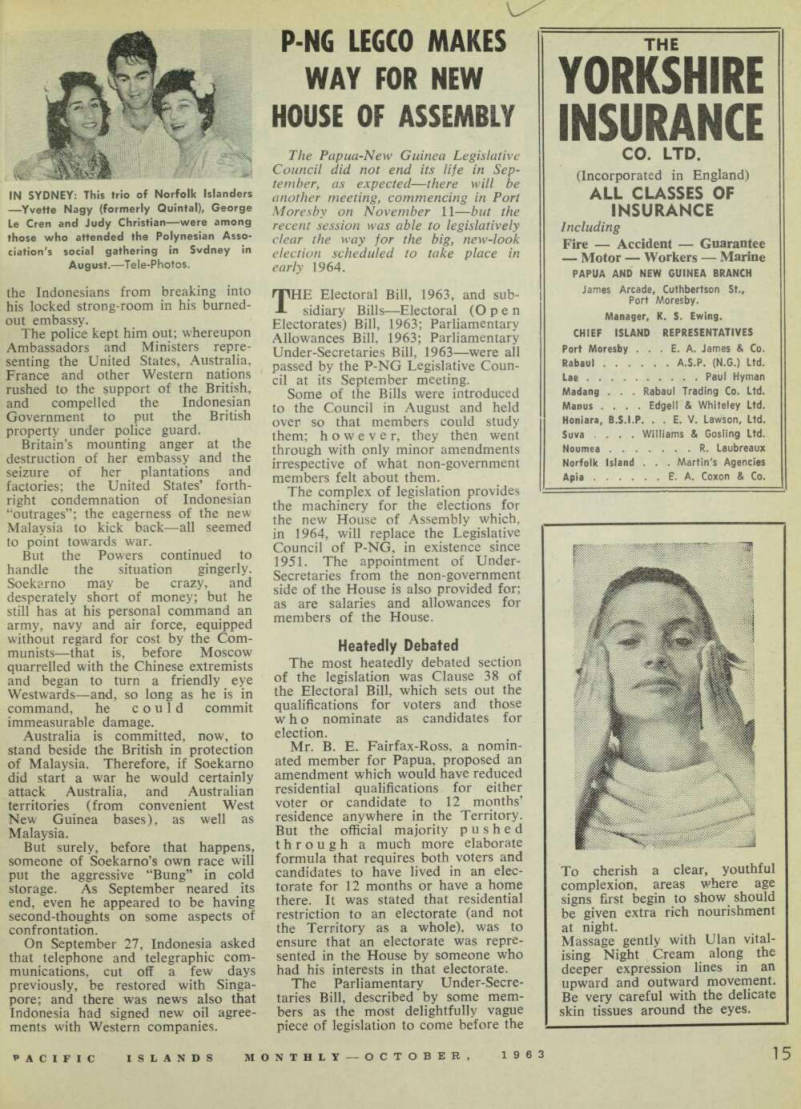
IN SYDNEY: This trio of Norfolk Islanders —Yvette Nagy (formerly Quintal), George Le Cren and Judy Christian—were among those who attended the Polynesian Asso ciation's social gathering in Svdney in August.— Tele-Photos.