—Despite Protests
p. 13 · Read in the full issue
France Goes Ahead With A-Base Plans —Despite Protests
Forty members of the French
Foreign Legion and 29 Poly
nesian workmen recruited at Anaa arrived at Mururoa Atoll in the Tuamotu Archipelago of
French Polynesia in September
to begin building France’s highly
controversial atomic testing centre.
THE legionaires—engineers and labourers were taken to Mururoa in the French destroyer Francis Gamier. Two landing barges, laden with equipment, accompanied the Francis Gamier.
The Polynesian workmen were recruited at Anaa during a visit there by the schooner Orohena on Sep tember 7. They arrived at Mururoa two days later.
Meanwhile, the Governments of Australia, New Zealand, Chile and Peru exchanged strongly-worded protests and counter-protests with the French Government over the build ing of the atomic test centre..
Australia’s Minister for External Affairs, Sir Garfield Barwick, set the ball rolling for Australia on August 15 when he made a statement in the House of Representatives on the nuclear test ban treaty, initiated by the US, UK and Russia, which has now been signed by more than 100 countries.
"Profound Regret"
In this statement, Sir Garfield expressed “profound regret” that France, by declining to become a party to the treaty, had made it less than fully effective.
“She has provided a pretext for other countries which might similarly refuse to bind themselves not to test,”
Sir Garfield said.
“Continuance of French testing could even serve as an excuse to one or more countries to exercise their right to withdraw from the treaty.
“It has also imposed an obstacle to the goal of putting an end to the possibility of danger of contamina tion of the atmosphere from radio active fall-out.”
On September 5, France warned Australia, New Zealand, Chile and Peru that their “campaign” against her testing plans in the Pacific could
damage their friendly relations with her.
In Notes delivered through the French Ambassadors in the four countries, the French Government described the “campaign” against the tests as “systematic” and “dis criminatory”.
The Notes added that, with the exception of New Zealand, none of the four countries had protested against atmospheric experiments by Russia and the United States in 1961 and 1962.
Australia promptly rejected the French Note with an announcement
by Sir Garfield Barwick that “there was no justification for any protest by the French Government”.
Later, in a detailed reply, Sir Garfield said that concern at con tinued nuclear testing in the at mosphere was not confined to the Governments of Australia, New Zealand, Chile and Peru “as would appear to be implied by the French Government”.
“On this issue,” Sir Garfield said, “the Australian Government’s attitude corresponds not only to the wishes of the Australian people, but to the concern of the overwhelming com munity of nations.”
Charge Denied
Sir Garfield denied the French Government’s charge that Australia did not protest against Soviet and US atmospheric nuclear tests in 1961 and 1962. He said protests were made on both occasions.
Other developments in September over the French nuclear testing plans included; • A statement by Western Samoa’s Prime Minister Mataafa that, despite all protests, it seemed that nothing could be done to stop the tests. e A statement by Sir Ernest Marsden, one of NZ’s leading atomic scientists, that New Zealand would almost certainly be “dusted” by radio active fall-out from French tests at Mururoa. .
Sir Ernest said Pitcairn Island would be particularly vulnerable, and the tests could do a lot of harm near Mururoa.
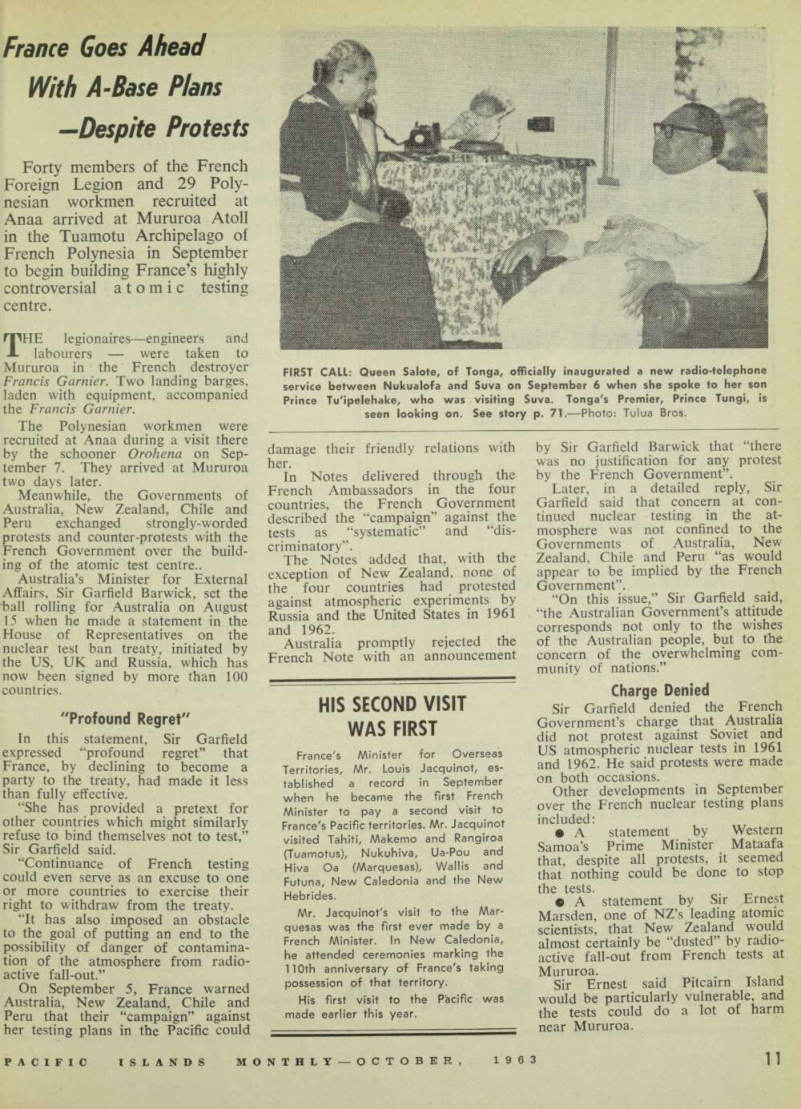
FIRST CALL: Queen Salote, of Tonga, officially inaugurated a new radio-telephone service between Nukualofa and Suva on September 6 when she spoke to her son Prince Tu'ipelehake, who was visiting Suva. Tonga's Premier, Prince Tungi, is seen looking on. See story p. 71. —Photo: Tulua Bros.