Trade Market
pp. 11-12 · Read in the full issue
Fiji Seen As Big Future Trade Market
Two interesting points about Fiji’s future trade emerged at the opening of the 1963 Fiji trades and industries fair—one from the retiring Governor, Sir Kenneth Maddocks, and the other from a leading Australian industrialist, Mr. R. W. C.
Anderson.
SIR KENNETH, who left the Colony three days later, told visiting businessmen there was no doubt that Fiji, in future, would be looking more and more to neighbour ing countries to buy her products if Fiji was to be able to continue to obtain as much of her import require ments from them.
As most businessmen were from Australia (they had 52 stands at the fair, compared with about a half-a dozen from New Zealand) there was little doubt about the intended target of his remarks.
Mr. Anderson, who is director of the Associated Chamber of Manu factures of Australia, pledged himself, when he returned home, to encourage
• For Silsoe report on Fiji copra in dustry to be released early in October, see page 30.
Australian manufacturers to take part to the maximum in further de veloping the Fiji economy.
Sir Kenneth emphasised that Fiji was keenly interested in the Australia- New Zealand trade talks, and was concerned that the results should not hamper Fiji’s ability to trade with those countries.
No doubt with Fiji’s £4,000,000 adverse trade balance with Australia in mind. Sir Kenneth dangled a bait about future trade with the Colony, for with a natural increase in the population in the next 20 years the present market could be three or four times its present size.
But to share in the bonanza the countries which were major traders with Fiji had to play ball.
Sir Kenneth made a plea to over seas suppliers of goods, which could be economicaly manufactured in Fiji, to consider the establishment of fac tories in the Colony. In that way, he
said, suppliers of consumer goods would ensure a long-term market in Fiji for their brands.
There was also the growing South- West Pacific regional market, and Fiji, with her present position astride the main sea and air routes, was strategically situated.
Then Sir Kenneth dangled another bait. Britain was still likely to enter the Common Market some time, and when that happened Fiji would have the status of an associated overseas territory. That meant that goods manufactured in Fiji would have ac cess to the Common Market without quantitative or fiscal barriers.
He also repeated that the Fiji Government offered generous tax and other concessions to new industries establishing themselves in Fiji, and emphasised that comparatively low cost labour was available.
Mr. Anderson, who followed Sir Kenneth, forecast that Fiji one day would become the workshop of the South Pacific, and the trading and commercial centre, supplying all man ner of industrial products to her near neighbours, Australian View He said Australia looked to a pros perous expanding Fiji economy to provide her with the opportunity of supplying the Colony with an increas ing range of goods of the type re quired— not necessarily the finished article, but the raw materials, partly processed goods and capital equip ment.
Mr. Anderson, in the few days he was in the Colony, must have heard the many undercurrents about Fiji’s adverse trade balance with Australia, and he may also have heard how the Coffs Harbour (NSW) banana growers are fighting to keep Fiji bananas out.
He made a plea that too much should not be made of the trade im balance.
“Rather let us devote our energies to increasing the present levels of trade between our two countries,” he said.
He said Australia would not stand in the way of Fiji’s industrial de velopment. Australia had no right to do that—instead Australia would help Fiji.
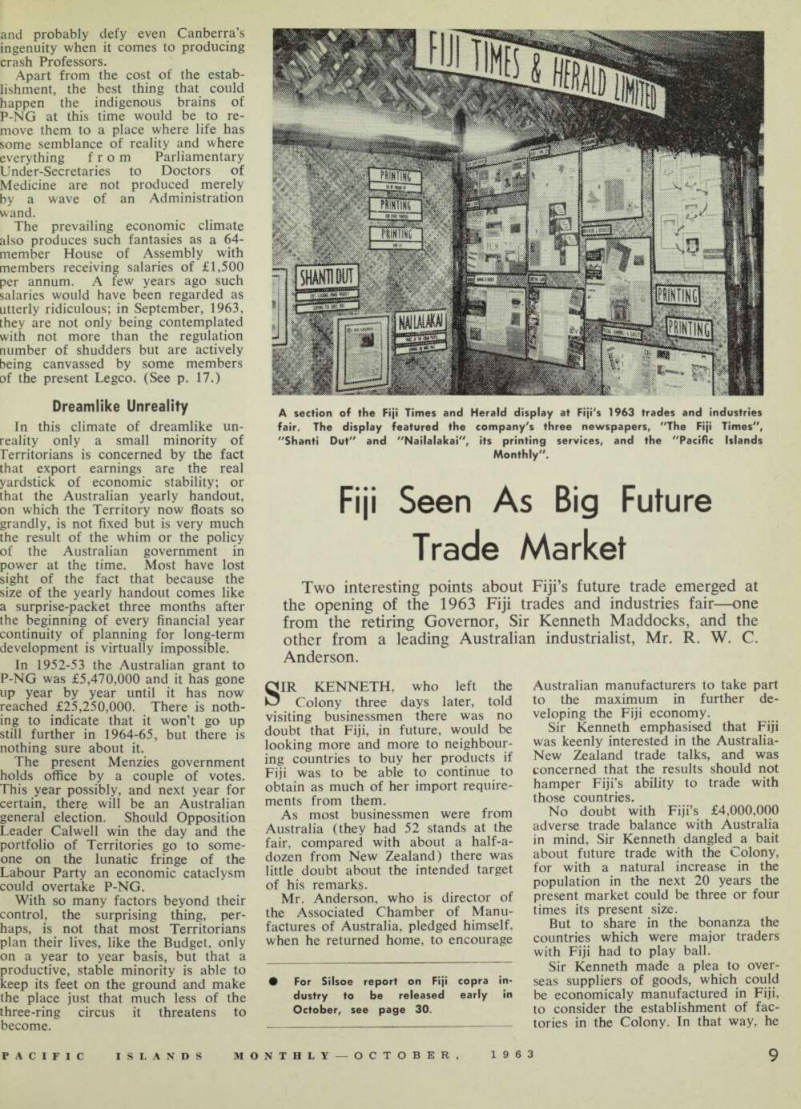
The trade fair attracted tremen dous interest among the local people who had never seen anything on quite such a grand scale. The well-laid-out pavilion allowed exhibitors to display their goods to best advantage.
Within a day or two of the fair’s opening, businessmen were reporting that the prospects of writing new
business were very bright. They did not talk in terms of hard cash, but indicated that there would be a sub stantial rise in their trade with Fiji.
About 40 of them took time off from their work at the fair to make a quick tour of eight Fiji factories, and to look a little more closely at the possibility of establishing them selves here in the years to come.
They were quick to realise that the South Pacific market, though small in comparison with South-East Asia, was still lucrative; and that as the eco nomies of the island folk improve, there will be more trade for them.
The Australian Government showed official interest through a Trade Department stand, depicting the wide variety of commercial, rural and social life of the country.
A Month in Fiji Australia thought the fair was suf ficiently important to send its South Pacific Trade Commissioner, Mr.
Hugh Sullivan, not only to be on deck at the fair, but to spend about a month in the Colony altogether, sounding out trade prospects.
And private enterprise was looking east beyond Fiji. Several Australia ex hibitors, chiefly in the building materials and foodstuffs lines, planned to visit both Samoas, Tonga and Tahiti before they went home.
New Zealand missed out pretty badly for it had very few stands and nowhere near the same amount of encouragement from its Trade De partment as its Australian counter part.
However, New Zealand did send its Pacific Trade Commissioner, Mr.
K. W. Davies, and he must have felt envious of the magnificent Australian display.
Mr. Davies soon let it be known that he would recommend to the NZ Trade Minister, Mr. J. R. Mar shall, when he returned home that New Zealand should take a much greater share in the 1964 fair.
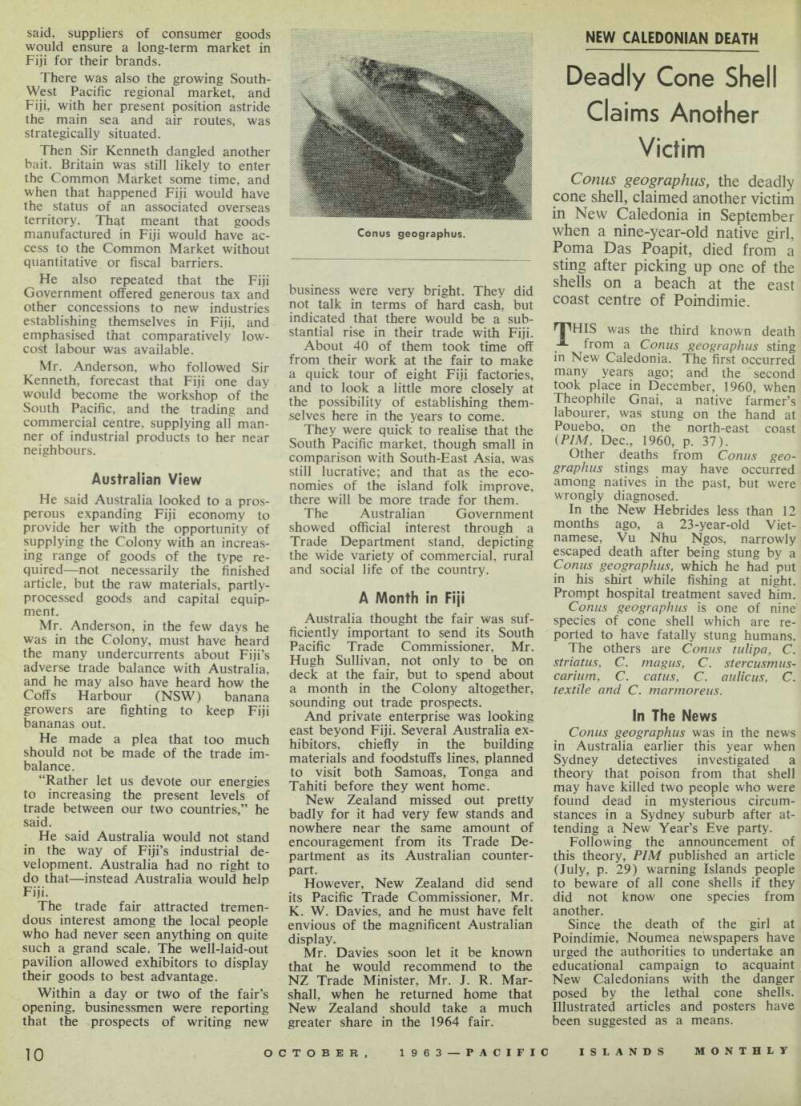
Conus geographus.