Papua-New Guinea Happy
pp. 9-11 · Read in the full issue
Australian Pounds And Mr Newman Make Papua-New Guinea Happy
From Judy Tudor in Port Moresby For some time after Papua-New Guinea Treasurer, Mr.
A. P. J. Newman, had presented his 1963-64 Budget to the Legislative Council here on the night of September 17, he was the most popular man in the Territory.
HE had neither raised the rate of income taxation nor slapped on increased Customs duties, while still producing internal revenue sufficient to meet the time-honoured formula that P-NG raises internally a sum about equal to half what Aus tralia gives as a grant.
It was all done, Mr. Newman said in his Budget speech, by some changes in accounting methods that “inflated . . . internal revenue to the extent of £1,629,700”; plus a loan target of £A1,700,000 (it was only £898,000 last year), which, he was confident, was “not over- Dptimistic”.
The sigh of relief that came from all over the Territory probably pro duced the wild south-east winds that battered Port Moresby for the next
three days. Misgivings had been general since the Minister for Terri tories, a couple of weeks ago, issued a manifesto stating clearly what was expected of P-NG in revenue-raising in the coming financial year. The only mystery was how it was to be done—and Territorians thought the solution was obvious.
Within 24 hours, Mr. Newman’s magic-with-mirrors and accounting systems were being examined a little more closely by those comparatively few people in the Territory who are given to looking ahead, and what they saw was not all rosy.
There was, for example, the innocent two lines in the body of his speech in which he “forecast that revised revenue-raising measures may be introduced in association with the Budget next year”. This brought back all the fears of increased taxation that could make this Territory an even less enticing spot in which to do business than it is today.
Mixture As Before And, in examining the Works Programme and other estimates that went with the Budget speech, it was obvious that this is to be another social-services year, only some £2,241,849 being the planned expendi ture on engineering works (roads, bridges, wharves, aerodromes, power houses, etc.); as against £5,751,000 on architectural projects (public servants’ housing, native accommoda tion, offices and fancy court-houses).
Mr. Newman’s budget provides also for the recruitment of an additional 725 expatriate and 406 indigenous salaried officers (to add to the 5,846 salaried officers and 16,965 employees on the strength of the Public Service in June, 1963), and all they mean in salaries, houses, office accommoda tion and overseas leave privileges every 21 months.
Other interesting budgetary items are £4,149,000 to the Department of
Education (up by over £1 million on last year); £3,642,000 for Health (up £200,000); and £1,390,000 for the Department of Agriculture, Stock and Fisheries (up £170,000).
Briefly then, Papua-New Guinea in 1963-64, with approximately £A37I million available to it, is going to have £8 million more to spend than it did in 1962-63. But it isn’t going to do anything new, spectacular, revolutionary or revenue-producing with it.
It is, in fact, going to have more of the same mixture that it has had in ever-increasing doses for the past 15 years: More public servants, more schools, more health services, more agricultural extension services—all of which are admirable in their way but are now making such snowballing demands on the economy that they come perilously close to making not even long-term common-sense.
And it makes no kind of common sense at all against the most reiterated demand in the Territory—the demand for development.
“Development” is the most used word in P-NG; it is thrown about by the Prime Minister; trampled to death by the Minister for Territories in all his utterances; and is part of the vocabulary of the Territory equivalent of the man-in-the-street.
Many no longer think of it in terms of hard-work, capital and planning, but as a word with magic in its own right; something that, sooner or later, will be turned on like a tap, if someone only finds the right key.
Less than two weeks before the Budget session, Prime Minister Menzies was in Papua to open the
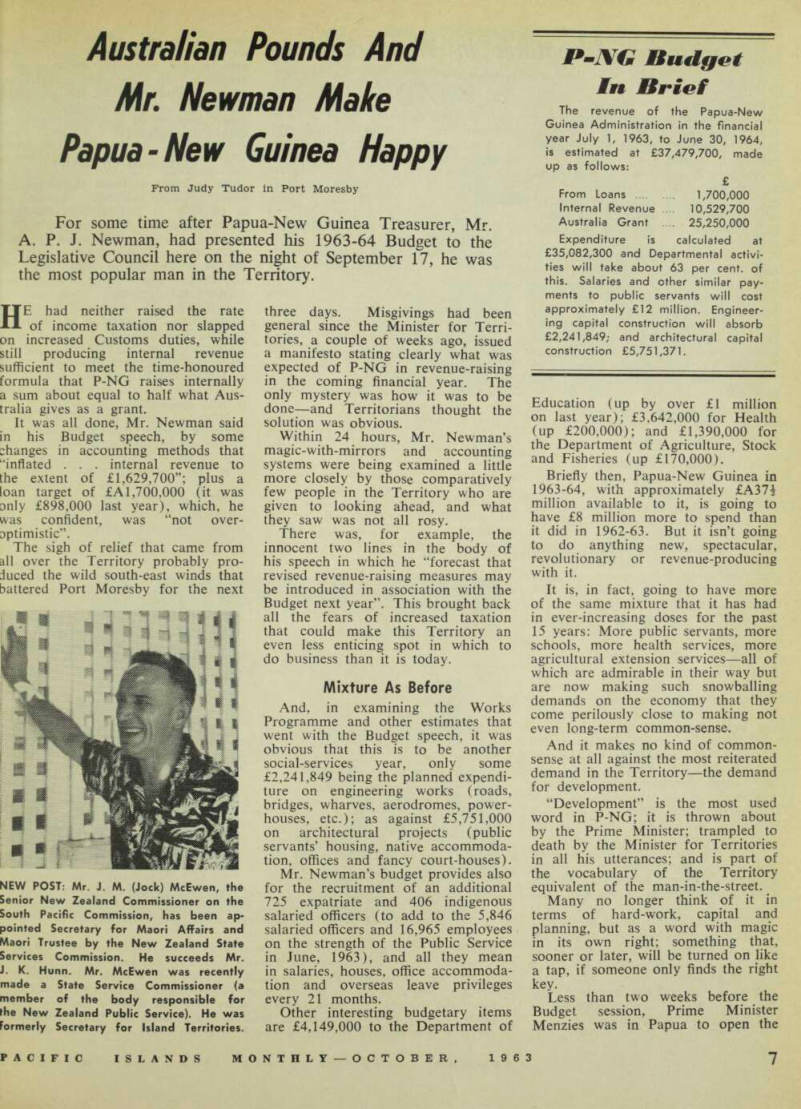
NEW POST: Mr. J. M. (Jock) McEwen, the Senior New Zealand Commissioner on the South Pacific Commission, has been ap pointed Secretary for Maori Affairs and Maori Trustee by the New Zealand State Services Commission. He succeeds Mr.
J. K. Hunn. Mr. McEwen was recently made a State Service Commissioner (a
member of the body responsible for
the New Zealand Public Service). He was Formerly Secretary for Island Territories.
Sirinumu dam and, incidentally, to broadcast a message to P-NG over the local radio network. Of the two tasks, the speech was the most impor tant. Or should have been.
In it Sir Robert said a great deal on the need for development; for economic keeping pace with political advancement; for the need for every one to work together for the good of the country.
It was an admirable speech saying, much better, all the right things that have been said ad nauseam in the Territory for the past 15 years, by less gifted orators.
But it was totally devoid of the few enchanting words that would have given Australian Government backing to investment already in P-NG. Nor did it advance any practical measures whatsoever for encouraging new development capital.
In this regard it was therefore dis appointing.
Lack of Planning Since the inauguration of the Legislative Council in 1951 non official members have been attacking the Administration on its lack of planning for devleopment. To my own painful knowledge, every one of those members, past and present, have said the same thing, over and over again, year in and year out, until they, judging by the Budget debate in the current session, are becoming dispirited and tedious even to their own ears.
Even the native members now get into the act—including Kondom Agaundo (or Kondom Agaundo Esquire, according to the captions on the pictures in the vestibule outside the Council Chambers).
Kondom, who is elected native member for New Guinea Highlands, has a gutteral Pidgin that grates like a blunted buzz-saw and (although everyone agrees that he is pro- European and therefore an old sweetie), an outlook limited to his own backyard.
What he wants from this year of Australian munificence is a bridge here and there, an extra District Commissioner or so, a piece of road and 700 European settlers in Kundiawa and 700 more in Wabag.
He may get his piece of road or even a bridge; but his chances of getting even seven more European settlers is not so good. Mr. New man’s Budget speech indicated that little non-native land settlement is expected in the coming year.
A senior P-NG public servant, who
recently has been in Suva, told me that, in his opinion, the Fiji Gov ernment has its head in the sand.
This may well be so but whether this state of affairs is any more dangerous than living in the Cloud-Cuckoo Land of Papua-New Guinea is anyone’s guess.
Twelve months ago, after the Foot Report was delivered to the United Nations Trusteeship Council, there was something approaching economic panic in this Territory—to such an extent that the Minister for Terri tories felt impelled to administer a shot in the arm by way of a re assuring policy statement.
Today this panic has been largely replaced by a take-the-cash-in-hand and-waive-the-rest sort of philosophy originally propounded by a fellow called Khayyam, a thousand years ago, and the Treasurer’s stay-put budget fits admirably into this scheme of things. But the new philosophy is perhaps more dangerous than the 1962-63 panic.
Superficially the economy of the Territory is buoyant. In the next 12 months no less than £37i million of government money will be cir culating. It will go on public servants’ wages, public servants’
houses, social services, extension services and a few engineering projects but inevitably most of the money has the same end —great slices of it will end up in the tills of retail business, transport companies and other suppliers of goods and services within the Territory.
Crash-Plan University
As a result of these easy millions an atmosphere is created in which it is possible to contemplate expendi tures that would have seemed wildly extravagant and impossible a few years ago. P-NG is now well on the way to getting some sort of University for its so-far almost non existent matriculants.
In the last few days I have spoken to a dozen Territorians, in Admini stration and out of it, and almost without exception they are agreed that the Territory, at this stage, needs a University like it needs two tin tails. But they are convinced that it will get one.
None of these people had given evidence before the Commission set up to deliberate on the matter for fear of being thought “reactionary”.
At the moment P-NG is barely holding its own in crash-training primary-school teachers—yet it can contemplate an establishment of tertiary education that will cost a great deal to set up, more to maintain,
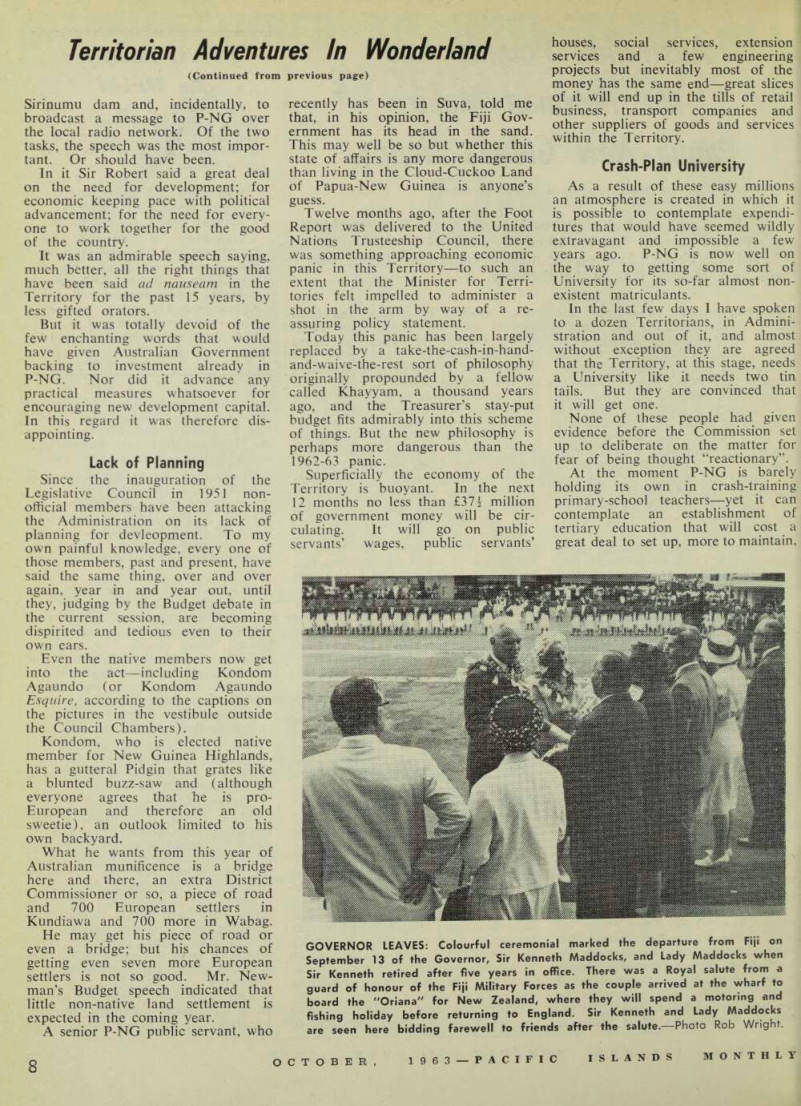
GOVERNOR LEAVES: Colourful ceremonial marked the departure from Fiji on September 13 of the Governor, Sir Kenneth Maddocks, and Lady Maddocks when Sir Kenneth retired after five years in office. There was a Royal salute from a guard of honour of the Fiji Military Forces as the couple arrived at the wharf to board the "Oriana" for New Zealand, where they will spend a motoring and fishing holiday before returning to England. Sir Kenneth and Lady Maddocks are seen here bidding farewell to friends after the salute. Photo Rob Wright.
and probably defy even Canberra’s ingenuity when it comes to producing crash Professors.
Apart from the cost of the estab lishment, the best thing that could happen the indigenous brains of P-NG at this time would be to re move them to a place where life has some semblance of reality and where everything from Parliamentary Under-Secretaries to Doctors of Medicine are not produced merely by a wave of an Administration wand.
The prevailing economic climate also produces such fantasies as a 64member House of Assembly with members receiving salaries of £1,500 per annum. A few years ago such salaries would have been regarded as utterly ridiculous; in September, 1963, they are not only being contemplated with not more than the regulation number of shudders but are actively being canvassed by some members of the present Legco. (See p. 17.)
Dreamlike Unreality
In this climate of dreamlike un reality only a small minority of Ferritorians is concerned by the fact that export earnings are the real yardstick of economic stability; or that the Australian yearly handout, on which the Territory now floats so grandly, is not fixed but is very much the result of the whim or the policy of the Australian government in power at the time. Most have lost sight of the fact that because the size of the yearly handout comes like a surprise-packet three months after the beginning of every financial year continuity of planning for long-term development is virtually impossible.
In 1952-53 the Australian grant to P-NG was £5,470,000 and it has gone up year by year until it has now reached £25,250,000. There is noth ing to indicate that it won’t go up still further in 1964-65, but there is nothing sure about it.
The present Menzies government holds office by a couple of votes.
This year possibly, and next year for certain, there will be an Australian general election. Should Opposition Leader Calwell win the day and the portfolio of Territories go to some one on the lunatic fringe of the Labour Party an economic cataclysm could overtake P-NG.
With so many factors beyond their control, the surprising thing, per haps, is not that most Territorians plan their lives, like the Budget, only on a year to year basis, but that a productive, stable minority is able to keep its feet on the ground and make the place just that much less of the three-ring circus it threatens to become.
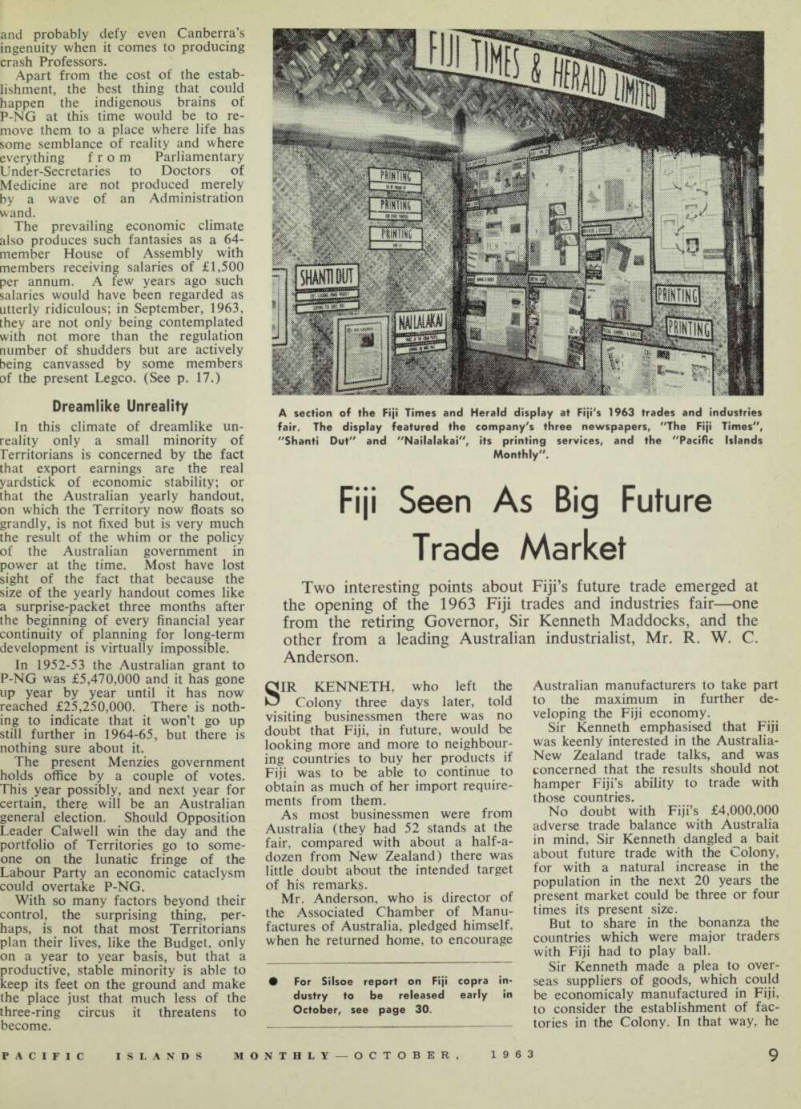
A section of the Fiji Times and Herald display at Fiji's 1963 trades and industries fair. The display featured the company's three newspapers, "The Fiji Times", "Shanti Out" and "Nailalakai", its printing services, and the "Pacific Islands
Monthly".