Ships For Pacific
p. 93 · Read in the full issue
Books For Students
A Treasury Ships For Pacific Historians
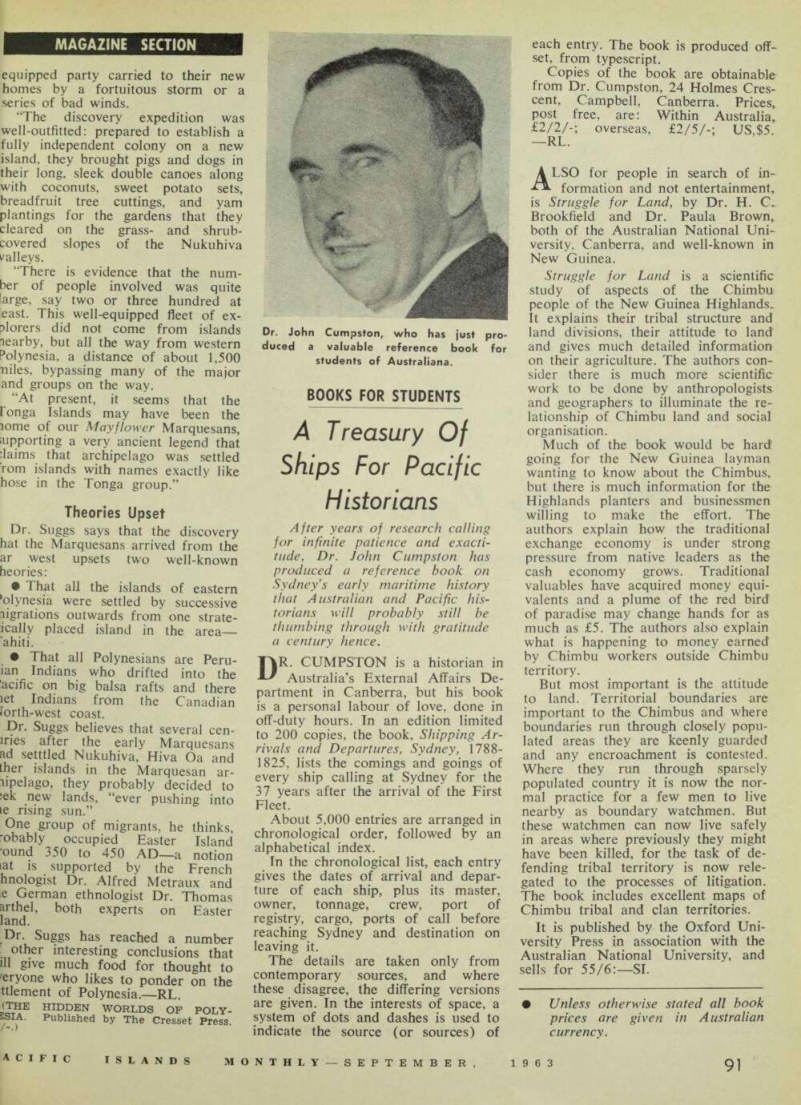
After years of research calling for infinite patience and exacti tude, Dr. John Cumpston has produced a reference book on Sydney’s early maritime history that Australian and Pacific his torians will probably still be thumbing through with gratitude a century hence.
DR. CUMPSTON is a historian in Australia’s External Affairs De partment in Canberra, but his book is a personal labour of love, done in off-duty hours. In an edition limited to 200 copies, the book, Shipping Ar rivals and Departures, Sydney, 1788- 1825, lists the comings and goings of every ship calling at Sydney for the 37 years after the arrival of the First Fleet.
About 5,000 entries are arranged in chronological order, followed by an alphabetical index.
In the chronological list, each entry gives the dates of arrival and depar ture of each ship, plus its master, owner, tonnage, crew, port of registry, cargo, ports of call before reaching Sydney and destination on leaving it.
The details are taken only from contemporary sources, and where these disagree, the differing versions are given. In the interests of space, a system of dots and dashes is used to indicate the source (or sources) of
each entry. The book is produced off set, from typescript.
Copies of the book are obtainable from Dr. Cumpston, 24 Holmes Cres cent, Campbell, Canberra. Prices, post free, are: Within Australia, £2/2/-; overseas, £2/5/-; US,$5.
RL.
ALSO for people in search of in formation and not entertainment, is Struggle for Land, by Dr. H. C..
Brookfield and Dr. Paula Brown, both of the Australian National Uni versity, Canberra, and well-known in New Guinea.
Struggle for Land is a scientific study of aspects of the Chimbu people of the New Guinea Highlands.
It explains their tribal structure and land divisions, their attitude to land and gives much detailed information on their agriculture. The authors con sider there is much more scientific work to be done by anthropologists and geographers to illuminate the re lationship of Chimbu land and social organisation.
Much of the book would be hard going for the New Guinea layman wanting to know about the Chimbus, but there is much information for the Highlands planters and businessmen willing to make the effort. The authors explain how the traditional exchange economy is under strong pressure from native leaders as the cash economy grows. Traditional valuables have acquired money equi valents and a plume of the red bird of paradise may change hands for as much as £5, The authors also explain what is happening to money earned by Chimbu workers outside Chimbu territory.
But most important is the attitude to land. Territorial boundaries are important to the Chimbus and where boundaries run through closely popu lated areas they are keenly guarded and any encroachment is contested.
Where they run through sparsely populated country it is now the nor mal practice for a few men to live nearby as boundary watchmen. But these watchmen can now live safely in areas where previously they might have been killed, for the task of de fending tribal territory is now rele gated to the processes of litigation.
The book includes excellent maps of Chimbu tribal and clan territories.
It is published by the Oxford Uni versity Press in association with the Australian National University, and
sells for 55/6:
SI.
• Unless otherwise stated all book prices are given in Australian currency.
Dr. John Cumpston, who has just pro duced a valuable reference book for students of Australiana.