Archaeologists Give
pp. 91-93 · Read in the full issue

Those Polynesian Canoe Voyages
Archaeologists Give A New Slant To Pacific Settlement
Until a few years ago, it was generally be lieved that the islands of Polynesia were of quite recent Raiatea, in the Society Group, was not settled until about 500 AD, and that Hawaii, the Marquesas, Easter Island, New Zealand, the Cook Island, Samoa and Tonga were settled even later.
Scientists’ calculations on when the Polynesian islands were settled were mainly based on the tradi tions of the people and the number of ancestors they could remember. Until 1956, hardly any ar cheological research had been done outside Hawaii and New Zealand.
SINCE then, however, archaeologists have been busy with their spades at Easter Island, Rapa, Pitcairn, the Marquesas, Tonga, Samoa, Man gareva, Tahiti, and Moorea—and a new picture is rapidly emerging of the history of Polynesia.
With the aid of the recently developed radio-carbon dating tech nique, the archaeologists are finding that the settlement of Polynesia dates back considerably further than ex perts such as the late Peter Buck ever dreamt possible.
One archaeologist who is helping to lift the veil on Polynesia’s ancient past is Dr. Robert C. Suggs, an American, who spent several months in the Marquesas in 1956 and 1957, and who has now told the story of his excavations in The Hidden Worlds of Polynesia.
His story is made lively by numerous pen pictures of the bibu lous, earthy Marquesans of today, some of whom helped the author to uncover the remains of a number of previously unsuspected buildings, quarries and burial sites.
Marquesan Artifacts
When Dr. Suggs finally returned to the United States, he had collected umpteen boxes of Marquesan arti facts, and these, when radio-carbon dated, showed that the Marquesas had been inhabited as far back as 120 BC or even earlier.
The oldest site that Dr. Suggs un covered was a hamlet called Ha’atua tua, on Nukuhiva, which now has the
honour of being both the earliest known settlement in the Marquesas and the earliest yet discovered in any part of Polynesia.
“The Ha’atuatua site,” Dr. Suggs says, “has increased our time pers pective in Polynesia tremendously, de monstrating the short view of the earlier theorists who often claimed that no island had been inhabited for more than a thousand years at most, and that few had been inhabited as long as that.
“Thanks to the ancient campfires of Ha’atuatua and their rich black char-
coal, we know that the Marquesas were occupied by the second century BC, and that therefore the western Polynesian islands must have been in habited even earlier.”
Dr. Suggs says that some unusual types of stone found at Ha’atuatua could not have come from the Mar quesas or any nearby island, so Ha’atuatua was apparently settled by some of the “Mayflower” Marquesans —members of the actual discovery party.
“The discoverers of Nukuhiva,” Dr.
Suggs goes on, “were no small, poorly
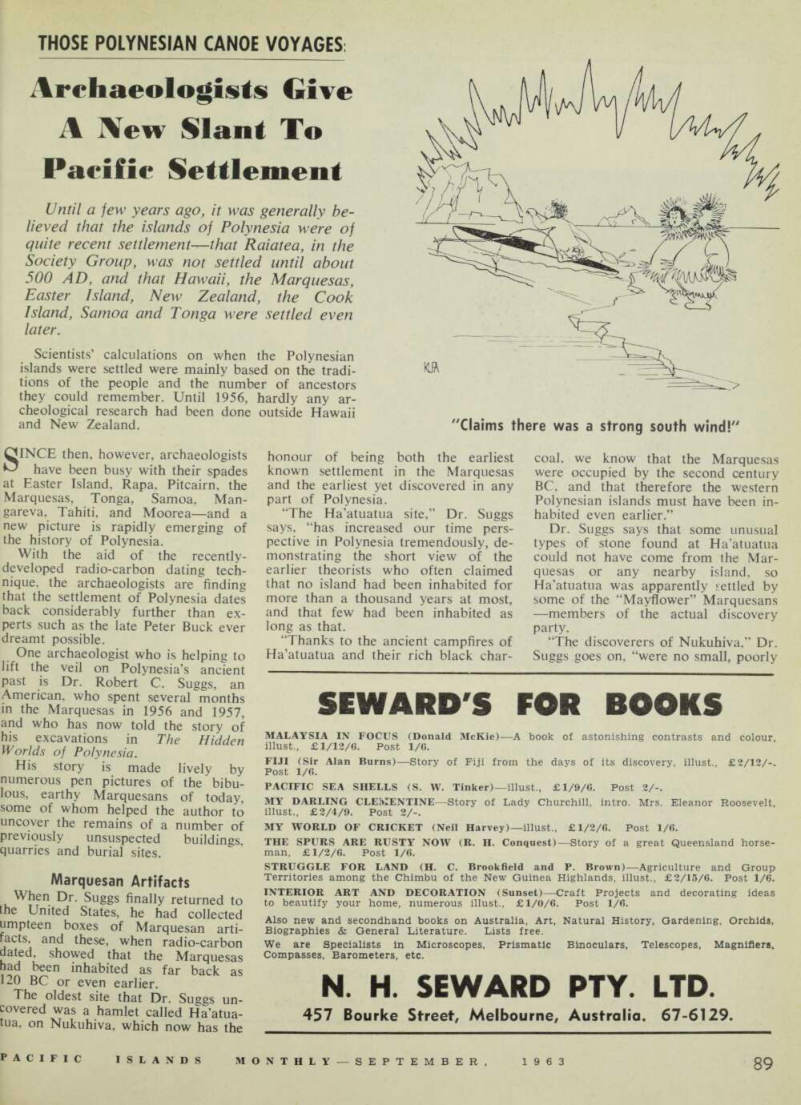
"Claims there was a strong south wind!"
equipped party carried to their new homes by a fortuitous storm or a series of bad winds.
“The discovery expedition was well-outfitted: prepared to establish a fully independent colony on a new island, they brought pigs and dogs in their long, sleek double canoes along with coconuts, sweet potato sets, breadfruit tree cuttings, and yam plantings for the gardens that they cleared on the grass- and shrub covered slopes of the Nukuhiva /alleys.
“There is evidence that the num ber of people involved was quite large, say two or three hundred at least. This well-equipped fleet of ex plorers did not come from islands learby, but all the way from western Polynesia, a distance of about 1,500 niles, bypassing many of the major and groups on the way.
“At present, it seems that the ronga Islands may have been the lome of our Mayflower Marquesans, lupporting a very ancient legend that :laims that archipelago was settled rom islands with names exactly like hose in the Tonga group.”
Theories Upset
Dr. Suggs says that the discovery hat the Marquesans arrived from the ar west upsets two well-known heories: • That all the islands of eastern Polynesia were settled by successive ligrations outwards from one strate ically placed island in the area— 'ahiti. • That all Polynesians are Peru ian Indians who drifted into the ’acific on big balsa rafts and there let Indians from the Canadian lorth-west coast.
Dr. Suggs believes that several cen iries after the early Marquesans ad setttled Nukuhiva, Hiva Oa and ther islands in the Marquesan ar iipelago, they probably decided to :ek new lands, “ever pushing into ie rising sun.”
One group of migrants, he thinks, robably occupied Easter Island •ound 350 to 450 AD—a notion tat is supported by the French hnologist Dr. Alfred Metraux and e German ethnologist Dr. Thomas arthel, both experts on Easter land.
Dr. Suggs has reached a number other interesting conclusions that ill give much food for thought to who likes to ponder on the ttlement of Polynesia.—RL.
Fthe Hidden Worlds Of Poly
iSIA. Published by The Cresset Press.