Water, Water Everywhere,
p. 161 · Read in the full issue
South Seas Paradox
Water, Water Everywhere, But Few Good Swimmers
One of the strangest paradoxes of the Games was that, although the 13 competing Territories are planted in the greatest ocean in the world, they produce very few good swimmers.
)NLY four of the 13 territories— Fiji, Papua-New Guinea, New aledonia and American Samoa— ere represented by swimming teams; id at one stage before the Games ;gan, the organisers seriously cen tered cancelling the swimming ents because of lack of support.
As it was, some of the few nomina )ns had to be withdrawn when the aws were announced because the /immers were entered in events )ich clashed or nearly clashed.
The swimming card was therefore led out with local events and hibitions to give the paying cus mers something to watch, and to /e a breather to competitors taking rt in several events a night.
Standards generally, were not high probably because some territories ligingly entered anybody likely to im the course.
There were some strange con juences. In a heat of the 30-lap le event, for example, an American moan was pulled from the water hausted after only eight laps!
On the other hand, 17-year-old ian school girl Winikiti Adi, who rned to swim in a river near her lage and has no style, won a gold ;dal for Fiji in the 110 yd. women’s :kstroke event with a time of 1
min. 27.6 sec. She “amazed” Fiji officials, who had expected the event to go to Mrs. Joan Blyth (also of Fiji). Winikiti followed this gold medal with two others.
The Games’ youngest competitor, 13-year-old Joan Herrington, also won three gold medals for Fiji, and a bronze.
One Games official said: “You’d hardly believe that an area that in vented the style (the crawl stroke) that is now the basis of world swimming could have slipped so far behind in the sport”.
Why, then, are there so few good swimmers in the Islands?
"Happy Splash"
According to Games organisers, it is because: • Competitive swimming is foreign to the Islanders, who swim at home only for fun or for survival. • Few islands have swimming pools, and where they do, they are often used only by Europeans. • Women in the Islands have had less experience than men because, for generations, many have been coy swimmers, unwilling to uncover themselves in the company of men.
In short, South Sea Islands swim ming has been traditionally “just one big happy splash”. So unless more organised swimming is introduced in the Islands, future Games will be dominated by European swimmers, as this one was.
The value of swimming pools, in cidentally, was proved by the wins of two New Guinea natives, T. Jo vel and K. Jarope, who took out first and second place in the men’s 110 yds. butterfly. Both are privates with the Pacific Islands Regiment and neither had done any real swim ming until a few months ago when a new pool was opened at the PIR barracks at Taurama, Port Moresby.
They have been using it regularly since.
New Caledonian swimmers would have done better if they had pools.
nikiti Adi, who won three gold medals [?] swimming.— Photo: Gordon Clear.
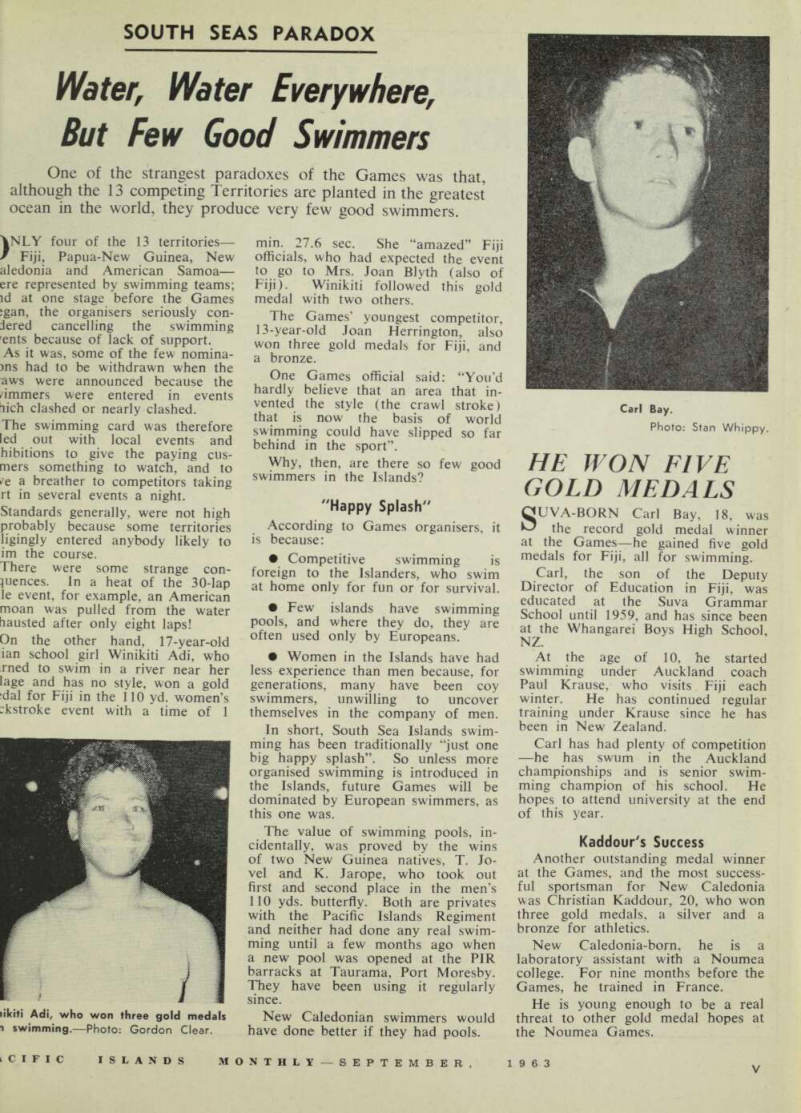
Carl Bay.
Photo: Stan Whippy.