Pacific Commerce and Produce
pp. 137-138 · Read in the full issue
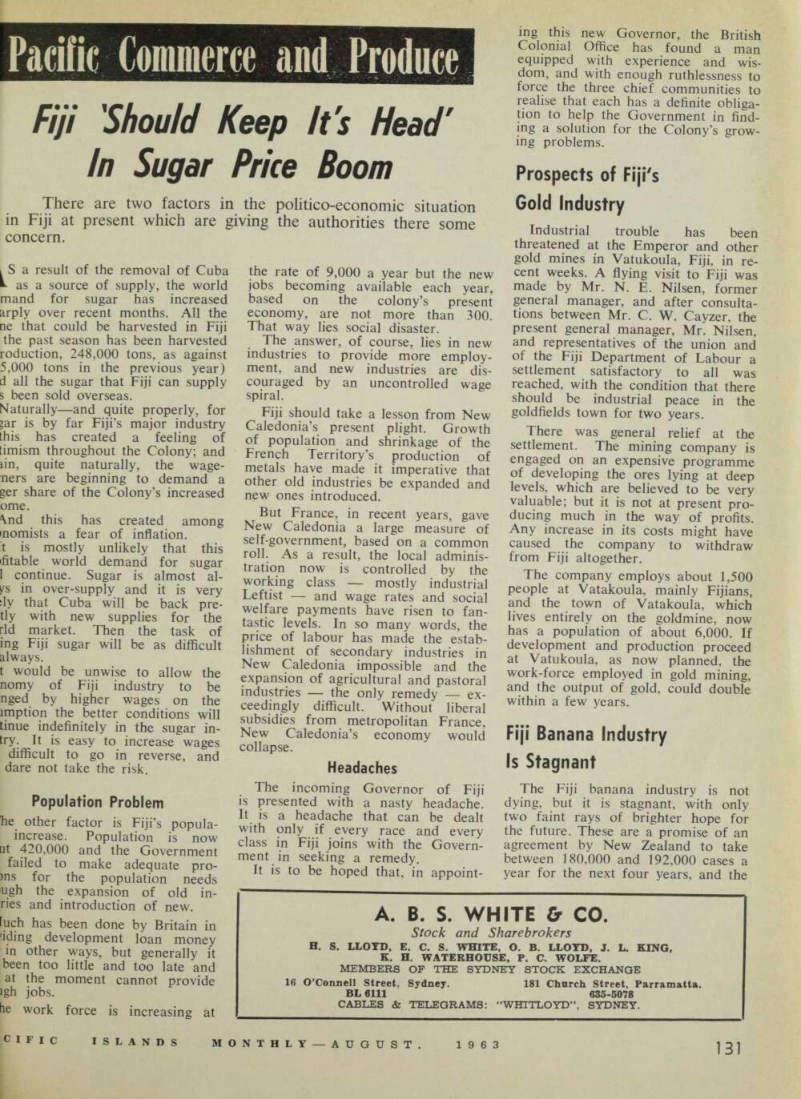
Fiji Should Keep It's Head' In Sugar Price Boom
There are two factors in the politico-economic situation in Fiji at present which are giving the authorities there some concern.
i S a result of the removal of Cuba as a source of supply, the world mand for sugar has increased arply over recent months. All the ne that could be harvested in Fiji the past season has been harvested reduction, 248,000 tons, as against 5,000 tons in the previous year) d all the sugar that Fiji can supply s been sold overseas.
Naturally—and quite properly, for »ar is by far Fiji’s major industry this has created a feeling of timism throughout the Colony; and tin, quite naturally, the wage ners are beginning to demand a ger share of the Colony’s increased ome. \nd this has created among momists a fear of inflation, t is mostly unlikely that this ifitable world demand for sugar 1 continue. Sugar is almost al ps in over-supply and it is very dy that Cuba will be back pre tly with new supplies for the rid market. Then the task of ing Fiji sugar will be as difficult always. t would be unwise to allow the nomy of Fiji industry to be nged by higher wages on the imption the better conditions will tinue indefinitely in the sugar in try. It is easy to increase wages difficult to go in reverse, and dare not take the risk.
Population Problem
he other factor is Fiji’s popula increase. Population is now at 420,000 and the Government failed to make adequate pro ms for the population needs ugh the expansion of old in ries and introduction of new. hich has been done by Britain in iding development loan money in other ways, but generally it been too little and too late and at the moment cannot provide igh jobs. tie work force is increasing at
the rate of 9,000 a year but the new jobs becoming available each year, based on the colony’s present economy, are not more than 300.
That way lies social disaster.
The answer, of course, lies in new industries to provide more employ ment, and new industries are dis couraged by an uncontrolled wage spiral.
Fiji should take a lesson from New Caledonia’s present plight. Growth of population and shrinkage of the French Territory’s production of metals have made it imperative that other old industries be expanded and new ones introduced.
But France, in recent years, gave New Caledonia a large measure of self-government, based on a common roll. As a result, the local adminis tration now is controlled by the working class mostly industrial Leftist and wage rates and social welfare payments have risen to fan tastic levels. In so many words, the price of labour has made the estab lishment of secondary industries in New Caledonia impossible and the expansion of agricultural and pastoral industries the only remedy ex ceedingly difficult. Without liberal subsidies from metropolitan France, New Caledonia’s economy would collapse.
Headaches The incoming Governor of Fiji is presented with a nasty headache.
It is a headache that can be dealt with only if every race and every class in Fiji joins with the Govern ment in seeking a remedy.
It is to be hoped that, in appoint
ing this new Governor, the British Colonial Office has found a man equipped with experience and wis dom, and with enough ruthlessness to force the three chief communities to realise that each has a definite obliga tion to help the Government in find ing a solution for the Colony’s grow ing problems.
Prospects of Fiji's
Gold Industry
Industrial trouble has been threatened at the Emperor and other gold mines in Vatukoula, Fiji, in re cent weeks. A flying visit to Fiji was made by Mr. N. E, Nilsen, former general manager, and after consulta tions between Mr. C. W. Cayzer, the present general manager, Mr. Nilsen, and representatives of the union and of the Fiji Department of Labour a settlement satisfactory to all was reached, with the condition that there should be industrial peace in the goldfields town for two years.
There was general relief at the settlement. The mining company is engaged on an expensive programme of developing the ores lying at deep levels, which are believed to be very valuable; but it is not at present pro ducing much in the way of profits.
Any increase in its costs might have caused the company to withdraw from Fiji altogether.
The company employs about 1,500 people at Vatakoula, mainly Fijians, and the town of Vatakoula, which lives entirely on the goldmine, now has a population of about 6,000. If development and production proceed at Vatukoula, as now planned, the work-force employed in gold mining, and the output of gold, could double within a few years.
Fiji Banana Industry
Is Stagnant
The Fiji banana industry is not dying, but it is stagnant, with only two faint rays of brighter hope for the future. These are a promise of an agreement by New Zealand to take between 180,000 and 192,000 cases a year for the next four years, and the
possibility of developing the market in Japan.
The former Fiji Director of Agri culture, Mr. J. M. Watson, who re tired a few months ago, describes the New Zealand quota as depressingly small, but at least it gives suppliers a small guaranteed market. But be fore the trade with Japan can be de veloped properly, production will have to be stepped up and quality im proved.
Last year Fiji shipped only 149,934 cases of bananas to New Zealand, compared with 201,879 cases in 1961 and 201,075 cases in 1960. There were two experimental shipments, totalling 8,656 cases to Japan.
Rabaul Registers The
Long Way Round
Papua-New Guinea company execu tives responsible for the registration of legal documents in accordance with Administration laws complain that the Administration has provided no machinery in Rabaul for registra tions connected with such things as company changes, the stamping of documents, probate and estates. Under present conditions the documents have to go to Port Moresby (it costs 2/8 to send a share transfer by registered mail) with the usual lengthy delays connected with Government depart ments.
“We would much rather have regis tration facilities here than a new Court House, on which they propose to spend £150,000,” said one com pany manager.
Mr. Dudley Jones, has recently transferred his legal practice from Rabaul to Queensland and now there is only one qualified lawyer left in Rabaul, Mr. Warner Shand. Mr.
Shand does not like it, however—he says that a law practitioner in a big town like Rabaul has a much more comfortable existence if he has at least one opposite number.
New Slipway and Freezer
For Hebrides Fishing Company
The South Pacific Fishing Com pany, a New Hebrides organisation which exports frozen tuna, celebrated its fifth anniversary in July with festivities at Vila and at its best at Palekula, Espiritu Santo.
During the celebrations at Palekula, the French Resident Commissioner, Mr. M. Delauney, officially opened a new slipway capable of taking ships up to 450 tons. The slip will eventu ally be enlarged to take ships of 750 tons.
Mr. Delauney’s British counterpart, Mr. A. M. Wilkie, officially opened a new freezing plant which will en able the company’s annual production of frozen fish to be increased from 4,000 to 6,000 tons.
The South Pacific Fishing Com pany has nine ships and 350 em ployees, of whom about three-quarters are Japanese. The other employees are Gilbert and Ellice Islanders and New Hebrideans.
Shares in the company are held by two Japanese firms, Mitsui and Taiheiyo Suisan Kaisha, one American firm, Washington Fish and Oyster Ltd., and a New Hebrides firm, D. J.
Gubbay and Co. Ltd. Mr. Donald Gubbay is managing director.
The company expects to export about 6,000 tons of frozen tuna this year. About 80 per cent, of the exports go to the United States, par ticularly Hawaii, in the company’s ship Santo Maru. The remainder goes in equal quantities to France and Japan.
Exports for the first quarter of this year were worth £61,514 Stg.—the most valuable New Hebrides com modity for the quarter after copra.
The copra exports were worth £375,046 Stg.