Territories TALK-TALK
pp. 119-121 · Read in the full issue
With Tola la
It is not often that you come across an individual in these modern days of streamlined living, who is prepared to maintain any of those old traditions and customs which characterise the courteous, more leisurely days of half a century ago.
SO it was all the more pleasing for me to read about Raka Motu, a descendant of the old Hanuabadan Chief, Boe Vagi, who raises and lowers his flag every morning and evening. Good luck to him and I hope he delegates some tradition loving neighbour to carry on when he joins his ancestors, seeing that he has no children of his own.
As a race we Australians are not a flag-waving people in comparison with other nations. Before the Aus tralian occupation of German New Guinea in 1914 it was the usual custom for almost every plantation, no matter how isolated, to have its flagstaff from which flew the flag of its owner’s nationality, punctiliously dipped to every passing vessel, which naturally returned the salute. And what a kick was got by the “flag boy” whose job it was to “look out belong flag!”
Pomp and ceremony are dear to the heart of the New Guinean and it was a great disappointment to them when, after the advent of the Aus tralian troops, the custom was virtu ally abandoned.
This was due most likely to a ban on flying the German flag, which was only natural, but then later, when the properties changed hands, the new owners (most of them Australian ex servicemen) had “had” ceremonial and couldn’t care less now they were wearing their bowler hats.
Pay Packets
In a recent issue of South Pacific Post, given front page display, there was the interesting news of “more cash to be rammed into the already well-stocked pay packets of second and third division (Public Service) workers”. It further stated that the “Administration’s already huge wage bill could rise from nearly £9 million this financial year to a fat £ll million next year”.
That’s a lot of chips in anybody’s money; but seeing that it is being spent for native welfare it would be, presumably, impolitic to make any adverse comment.
Nevertheless, stodgy fuddy-duddies like myself cannot help but cast their minds back a few years and compare
the remuneration received in the days gone by when pay packets rarely reached an annual four figure amount, even for officers in the upper echelon.
In the 1920’s and 1930’s salaries for European employees in New Guinea averaged from £240 to £4OO a year, A married man invariably received £4OO.
For Government officials there would be a bit of sugar on the side in the shape of “travelling allow ances”, “expenses” and so forth.
Plantation overseers and/or managers would probably have an extra wind fall with commission on recruits and copra produced.
I remember when I first went to the old German colony in 1911 as a lay missionary. I received £lOO a year and I cannot recall having suf fered any special degrees of penury as a result of the low income, due no doubt to the fact that there were no Japanese to keep up with in those days and it was quite the thing to curb one’s appetite to suit one’s budget.
Certainly there were numerous little perks I had—like cheap board and lodging. A sympathetic Govern ment also allowed imports duty free to mission workers.
Between the wars it was the Euro pean clerical worker in the towns who had an uphill job making ends meet on his £360 a year. There was a rather high standard of sartorial elegance to be maintained in the wearing of well-laundered white suits—the Way of Life then. A slap happy system of “chits” prevailed in the clubs and pubs where men gathered to drink, and this en couraged the liberal consumption of liquor when all a man had to do was sign his name for a round of drinks. The reckoning at month’s end proved invariably an unpleasant shock and put many an enthusiastic imbiber well in the red.
When a good clerical man got in the red in the German days, some of the more considerate business mana gers would temporarily transfer him to a plantation and allow him generous commissions on copra pro-
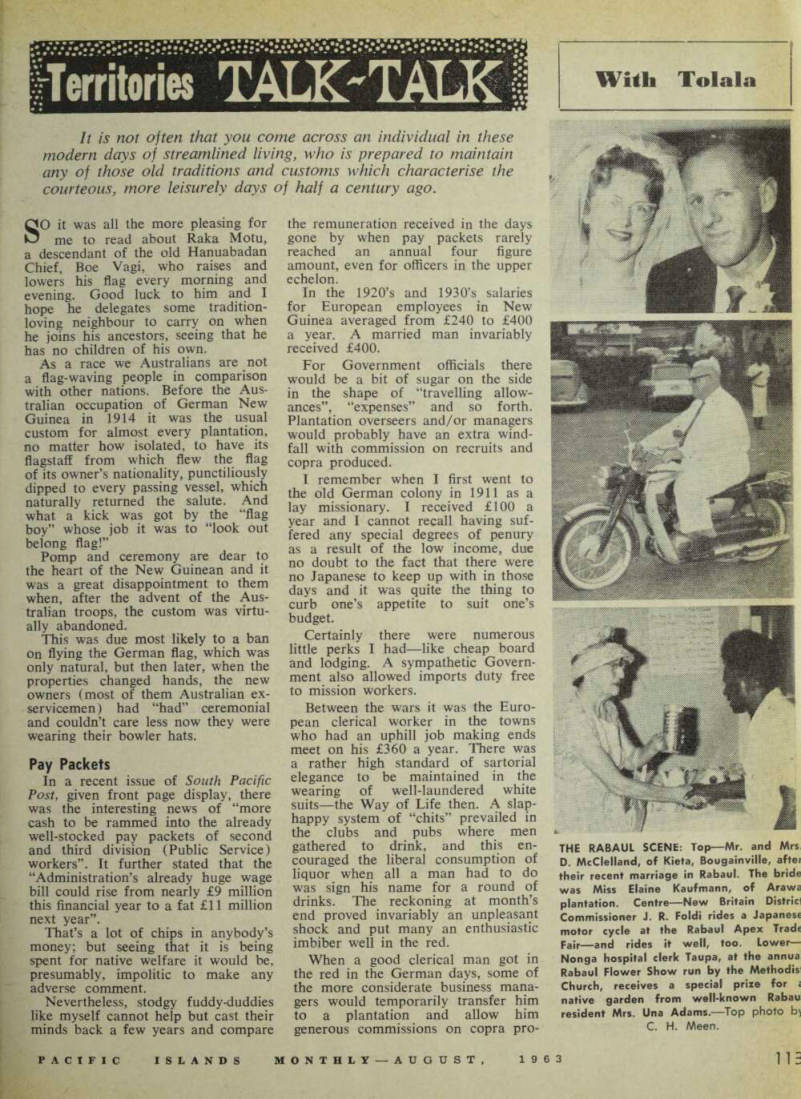
THE RABAUL SCENE: Top—Mr. and Mrs[?] D. McClelland, of Kieta, Bougainville, after their recent marriage in Rabaul. The bride was Miss Elaine Kaufmann, of Arawa[?] plantation. Centre —New Britain District Commissioner J. R. Fold! rides a Japanese motor cycle at the Rabaul Apex Trade Fair—and rides it well, too. Lower— Nonga hospital clerk Taupa, at the annua Rabaul Flower Show run by the Methodist Church, receives a special prize for a native garden from well-known Rabau[?] resident Mrs. Una Adams. — Top photo by C. H. Meen.
duced, new land planted up and on recruiting labourers. This would bump up his monthly salary and thus “square” their books. That is what might be termed a cordial employeremployee relationship, tending towards happy co-existence. I don’t recall that this way of life was continued after Australia took over the reins of Government. Those German times were the Bad Colonial Days!
On the other hand, the plantation man of the time, even on £2OO a year, plus his commissions, was far better off. No chits or sartorial standards to contend with; he grew his own vegetables and fruit; there were fish in the sea, pigeons and pigs
in the bush, and if he could not wangle a few sticks of tobacco or pounds of rice from the labourers’ rations occasionally it was just too bad.
Glancing at a Sydney advertisement of vacancies in the P-NG Public Service I note that a male librarian “to administer regional Public Library, Rabaul” starts off at £1,241 p.a. and a female of the species collects £1,053; a senior marketing officer in the Department of Forests commences at £2,546 p.a., while a female Welfare Officer in the Depart ment of Native Affairs starts off on £1,603 increasing to £1,823 p.a.
It would seem that P-NG is
headed for the same pernicious rat race of wages chasing the cost of living as prevails in Australia. It will be interesting to see, when the time comes, how independent New Guineans will deal with such a legacy left them by the Administration which is their present guide and mentor.
Surveyors 7 Paradise There is no doubt but that New Guinea has become, more than ever during the past year, a haven for the peregrinating politician, diplomat, economist and scientific observer en gaged in “fact-finding missions”.
The latest team of investigators comprises four “Australian university students” due to depart in August to “investigate the development of higher education”. They will spend three weeks in the Territory and report their findings to the Commission on Higher Education in P-NG.
They will certainly accomplish something if they can evaluate the education situation throughout both Territories in three weeks.
New Guinea has been a fruitful guinea pig for wandering scientists for many years. Botanists, geologists and anthropologists toured the old German colony at the turn of the century, filling tomes with their ex pert observations, but little is avail able for Australians who do not read German.
Even Parkinson’s Thirty Years in the South Seas, a recognised classic of the early days, although diligently translated by the late Noel Barry into English, has not been published. I wonder why? Noel Barry, an expert German scholar, was engaged for some years as translator in the New Guinea Administration. On his retire ment from the service he received every encouragement from the then Judge Phillips (later Sir Beaumont) to make the translation, for the judge realised what a valuable addition Parkinson’s records would be to New Guinea literature.
With the advent of Australia to the Mandated Territory came an influx of English-speaking anthropologists: Pitt-Rivers, Margaret Mead, Gregory Bateson, Miss Powdermaker, Beatrice Blackwood, Camella Wedgewood, and then at regular intervals came touring Australian politicians on “fact-finding missions”.
I travelled up from Sydney with one such party in 1923 in the Mata ram. Senator Crawford, of Queens land, was the leader and with him were, among others, Senators Benn and Bennie from Tasmania, old Senator Donald Grant from Sydney
and a young live-wire MHR named Francis Forde, not long elected for the Quenesland electorate of Capri cornia. He was about the only one who seemed to take the trip seriously.
He was forever asking questions and making notes in his little black book.
Incidentally, Forde was the only one who looked decently dressed; the others, especially when we arrived at Rabaul, were sartorially embarrassing in their coloured shirts, no coats, southern pants held up by conspicuous braces (and Donald Grant favoured a red bandana handkerchief around his neck!) There were a few raised eyebrows as they stepped ashore at Rabaul to receive a VIP welcome, red carpet and all.
I suppose such rig worn by visit ing politicians would go unnoticed in these days?
Footnote The present address of Mrs. Edie Huson, wanted by a reader (Talk- Talk, June, p. 117) is 32 Veterans Parade, Collaroy Heights, NSW. Al though now over 80 she lives alone and is still very active—to the extent of having terraced her own garden with local stone.
Our information comes from Mr.
J. Cook, now living in the Parra matta district, but once a resident of Emirau Island, off New Ireland.
Mr. Cook was at Emirau when the German raiders landed survivors from the ships they had sunk at Nauru and elsewhere around Decem ber, 1940. He still has the diary he kept at that time.
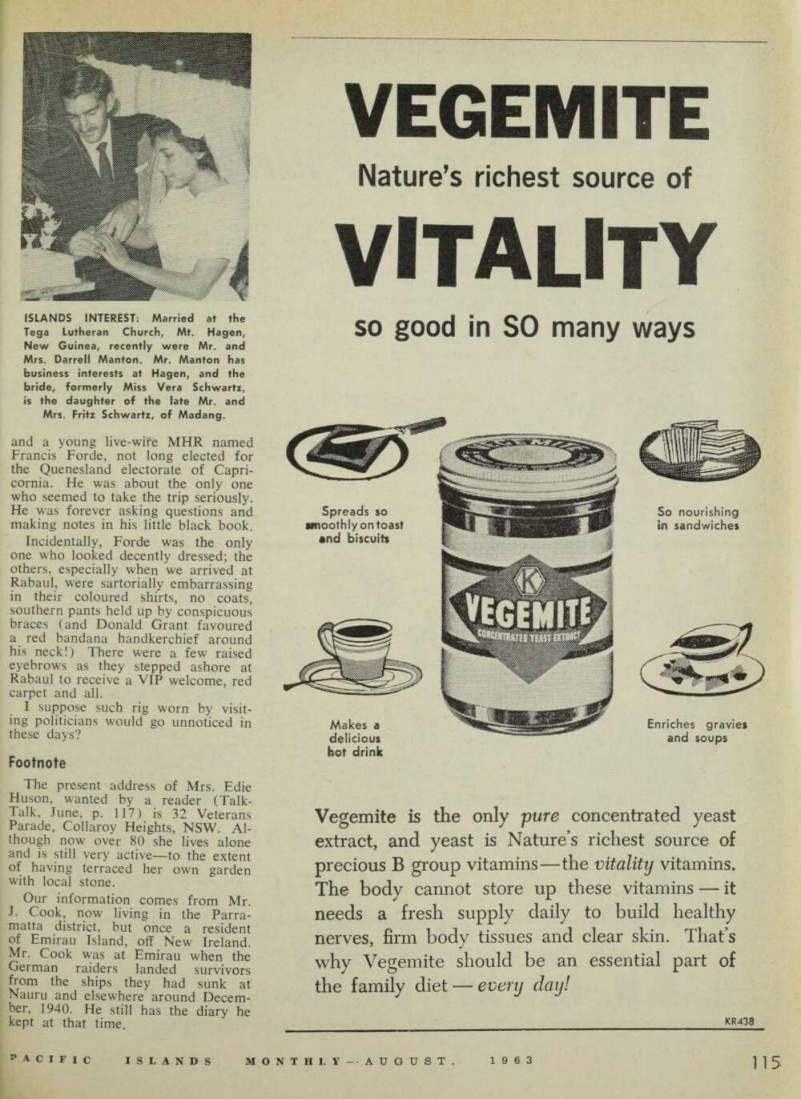
ISLANDS INTEREST: Married at the Tega Lutheran Church, Mt. Hagen, New Guinea, recently were Mr. and Mrs. Darrell Manton. Mr. Manton has business interests at Hagen, and the bride, formerly Miss Vera Schwartz, is the daughter of the late Mr. and Mrs. Fritz Schwartz, of Madang.