Cruising Yachts
pp. 101-114 · Read in the full issue
Pacific Shipping And Cruising Yachts
Prince Tungi Buys Ship
For Tonga Copra Board
Tonga’s Premier, Prince Tungi, bought a motor vessel of 2,600 tons dead weight for the Tonga Copra Board during his recent two-month tour overseas.
THE ship will be used to carry cargoes for the Pacific Coconut Processing Corporation in Pago Pago, in which the Tonga Copra Board has a 40 per cent, interest.
Prince Tungi was accompanied on part of his overseas tour by Tonga’s Chief Harbourmaster, Captain J. T.
Sutherland. He returned to Nuku alofa on July 7 after visiting England and the Continent, India, Honolulu, Japan and the Samoas.
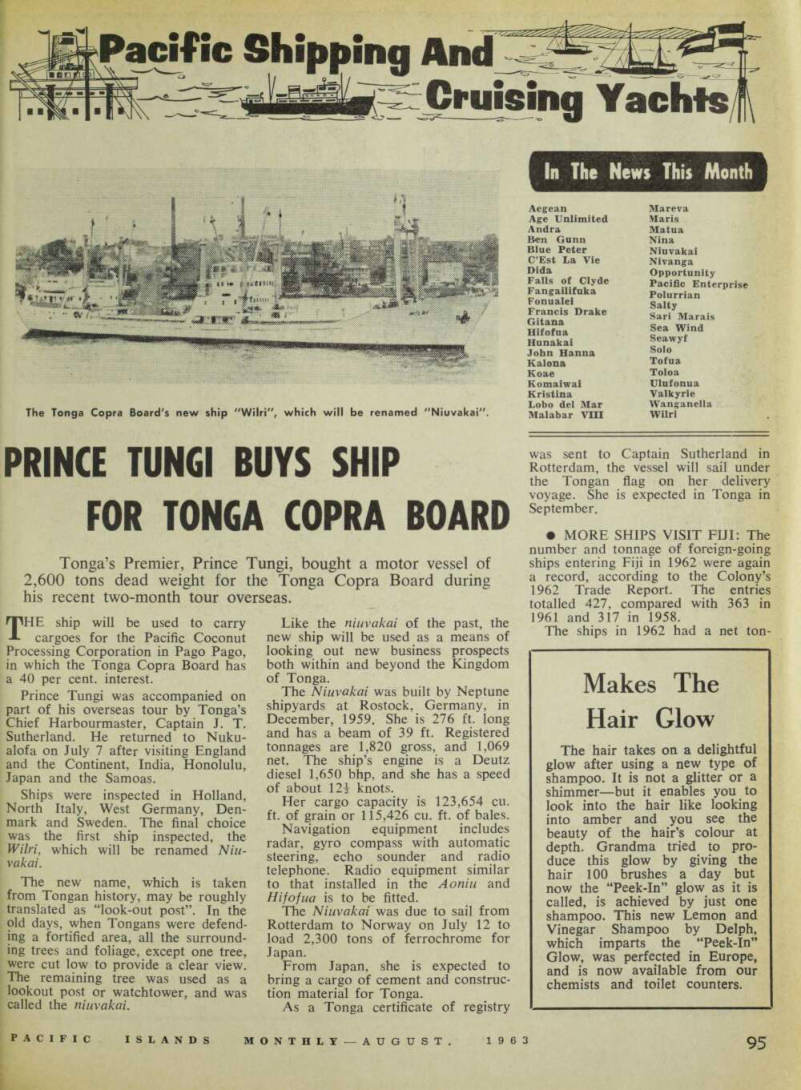
Ships were inspected in Holland, North Italy, West Germany, Den mark and Sweden, The final choice was the first ship inspected, the Wilri, which will be renamed Niu vakai.
The new name, which is taken from Tongan history, may be roughly translated as “look-out post”. In the old days, when Tongans were defend ing a fortified area, all the surround ing trees and foliage, except one tree, were cut low to provide a clear view.
The remaining tree was used as a lookout post or watchtower, and was called the niuvakai.
Like the niuvakai of the past, the new ship will be used as a means of looking out new business prospects both within and beyond the Kingdom of Tonga.
J* 16 Niuvakai was built by Neptune shipyards at Rostock, Germany, m December, 1959. She is 276 ft. long and has a bea “<£ 39 iL Rc § ls e^ tonnages are 1,820 gross, and 1,069 The ship s engine is a Deutz diesel b 650 bh P> and she has a s P eed of Her OU car 1 go capacity is 123,654 cu. f f ; B ,5,426 cu. ft. of bales.
Navigation equipment includes d com p‘ ass P with automa ti c hu- steeri^g By echo |: ounder a nd radio telephone. Radio equipment similar to that installed in the Aoniu and Hifofua is to be fitted, The Niuvakai was due to sail from Rotterdam to Norway on July 12 to load 2,300 tons of ferrochrome for Japan.
From Japan, she is expected to bring a cargo of cement and construc tion material for Tonga, As a Tonga certificate of registry
was sent to Captain Sutherland in Rotterdam, the vessel will sail under the Tongan flag on her delivery voyage. She is expected in Tonga in September.
• More Ships Visit Pui: The
number and tonnage of foreign-going ships entering Fiji in 1962 were again a record, according to the Colony’s 1962 Trade Report. The entries totalled 427, compared with 363 in 1961 and 317 in 1958.
The ships in 1962 had a net ton-
The Tonga Copra Board's new ship "Wilri", which will be renamed "Niuvakai".
nage of 1,336,628, against 1,203,350 in 1961 and 1,161,601 in 1958. The number and tonnage of ships have in creased each year for the last 10 years. In 1952 the number of en tries was only 171 with a tonnage of 553,633.
The Trade Report says that the continuous rise must be attributed more to increased international ship ping services than to anything directly related to Fiji’s trade.
Ships of United Kingdom register were highest in numbers (103) and by far the highest in tonnage (704,887). Japanese ships were next in number (94), but as a great many of them were from fishing fleets the tonnage was relatively small (88,882).
These figures compared with 32 Japanese fishing ships in 1960 with a tonnage of 50,627.
There were 72 ships of New Zealand register, tonnage 153,636, which made that country Fiji’s second most important carrier. The United States was third with 27 ships with a tonnage of 117,588.
In all, ships of 24 countries were represented, including Norway 80,945 tons, Australia 34,655 tons and Singapore 33,053 tons.
The total cargo handled at all ports rose sharply from 561,000 tons to 623,000 tons, but that was still ap preciably below 1959 and 1960, when the figure was close to the 650,000 tons mark each year.
As in the past Lautoka was the main port for exports (sugar and gold), and Suva for imports, but Lautoka imports have ben rising.
• Dock Firm’S Centenary:
The Hong Kong and Whampoa Dock Co. Ltd., shipbuilding and ship re pairing firm which has built and re paired many ships in the Islands trade
over the years, celebrated its 100th birthday on July 1. To mark the occasion, the company published an attractive 44-page booklet, with some colour illustrations, to demonstrate the range of its activities. The com pany has five building berths and four dry docks. Among the ships it has built in recent years is the GEIC’s MV Nivanga.
• No Reason For Sinking
FOUND: The Rabaul Coroner, Mr.
J. F. Winkle, announced in July that no reason could be established for the sinking of the MV Polurrian, with the loss of 53 lives in March.
Mr. Winkle was giving his finding following an inquest into the death of the Pollurian's captain, Dallas Henderson (“Peter”) Fenwick, of Rabaul. ( PIM , May, p. 177.) He said Fenwick had died by mis adventure by drowning off West Bougainville as a result of the ship’s foundering. (Over)
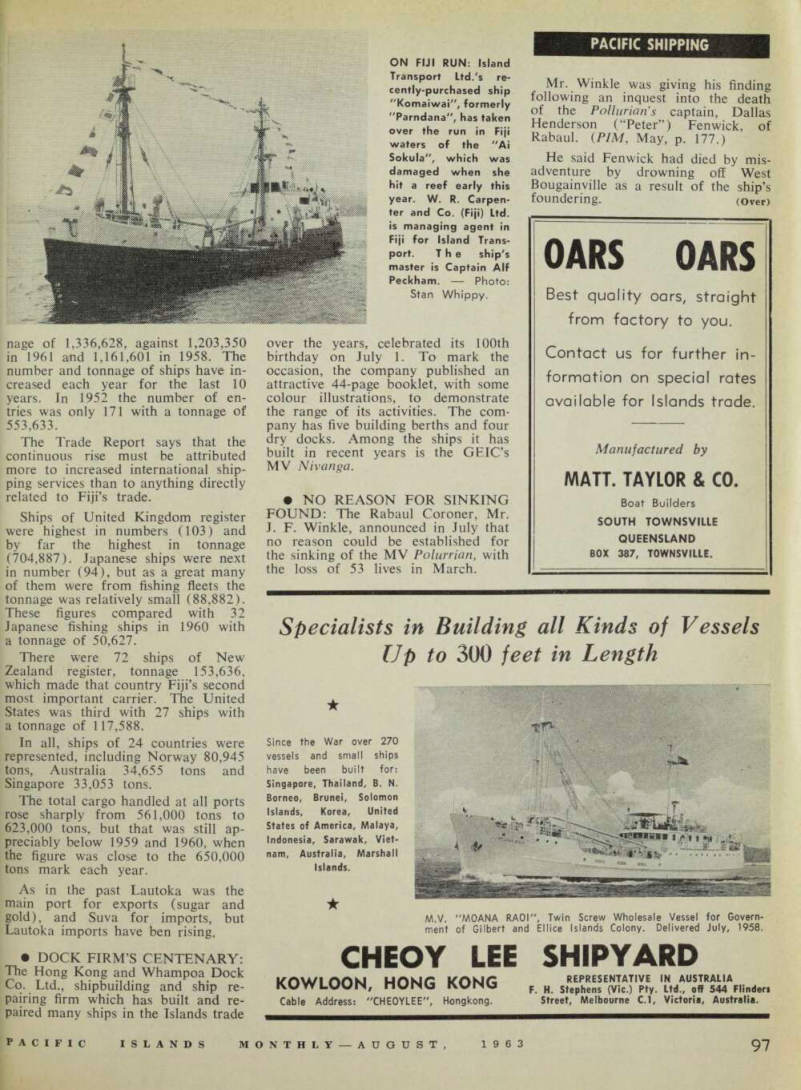
ON FIJI RUN; Island Transport Ltd.'s re
cently-purchased ship
"Komaiwai", formerly
"Parndana", has taken over the run in Fiji waters of the "Ai Sokula", which was damaged when she hit a reef early this year. W. R. Carpen ter and Co. (Fiji) Ltd. is managing agent in Fiji for Island Trans port. The ship's master is Captain Alf Peckham. Photo: Stan Whippy.
Polurrian, a 339-ton trader owned by the Bougainville Co. Ltd., left her home port of Rabaul on March 15.
After calling at several islands, she left Sohano at 5.30 p.m. on March 28 bound for Rabaul, a journey which normally would have taken slightly less than 24 hours.
Mr. Winkle said she had foundered between 9 and 10 o’clock at night.
“It is abundantly clear from the evidence that MV Pollurian listed to starboard and thus capsized com pletely by the starboard so that she lay with the keel upwards and more or less parallel to the water before finally subsiding,” Mr, Winkle said.
“A picture of events immediately prior to listing and capsizing, how ever, is not so readily available from evidence.
“Of the 29 survivors, only five were awake at the relevant time and able to give any information.”
Mr. Winkle said the evidence ex cluded the possibility of collision with any object, of explosion on board, or of any substantial abnormality or violence of the elements.
He added that he was satisfied that there was no evidence the ship’s be haviour pointed “with even a rea sonable degree of possibility” to in stability because of lack of water in the ballast tanks.
Mr. Winkle said there was no evidence to support allegations made by a woman survivor, Jeanne (Jenny) Viva, who claimed certain surviving crew members forced her and her husband and two children off a raft.
The two children died of exposure and Mrs. Viva’s husband was taken by sharks. Mrs. Viva was in the water almost three days.
“I think the possibility of hysteria cannot be overlooked,” Mr. Winkle said.
• Sale Of Wanganella :
Negotiations had been all but com pleted in mid-July for the sale of the
liner Wanganella to a firm which will build a big hydro-electric scheme at Laka Manapouri in the far south of New Zealand’s South Island. The ship will be used as a floating hostel for 400 workers. The ship’s Sydney agents said that all scheduled voyages would be made up to August 31.
The Wanganella, a former trans- Tasman liner, has been owned by the Hong Kong Shipping and Trading Company, of Hong Kong since August, 1962. Since then she has made tourist cruises in the Pacific.
• Mine Menace Will Go:
Six ships of the RAN’s 16th Mine sweeping Squadron will clear mines from Tonolei Harbour on the south coast of Bougainville in October.
About 150 mines were dropped in the area by US aircraft in 1943.
• Old Sailer Saved: Ship
lovers in Hawaii and the mainland United States have saved the four
masted ship Falls of Clyde from be ing used as a breakwater in Canada.
By June 29, they had raised the neces sary $18,950 to buy the ship, which in recent years has been used as a barge at Lake Washington, Seattle.
Eventually, it is hoped to raise about $lBO,OOO to restore and re-rig the ship as she was when she was launched in Glasgow in 1878, and to make her part of Hawaii’s Bishop Museum.
A move to save the ship from destruction was begun several years ago by Mr. Karl Kortum, director of the Maritime Museum in San Francisco. Others, including Captain Fred K, Klebingat, an occasional PIM contributor who is research associate at the museum and a former crew member of the Falls of Clyde, lent their support. Finally, the Bishop Museum and Honolulu’s Chamber of Commerce, sponsored a fund-raising project, which was supported by newspaper publicity.
An Alaska bank, which held a mortgage on the ship, set July 1 as the deadline for her purchase—so the necessary money was raised with only two days to spare. A cheque for $5,000 was contributed by the Matson Line, whose founder, Captain William Matson, bought the Falls of Clyde from British owners in 1898.
Under Captain Matson’s ownership the Falls of Clyde was the only vessel having yards and all four masts flying the Hawaiian flag and entering the port of Honolulu. When Hawaii be came American territory, she came under American registry and carried
The "Falls of Clyde" as she was when Capt. Matson bought her in 1898. The picture is reproduced from the "San Fran cisco Call" for De cember 21 of that year.
cargo and passengers between San Francisco and Hilo.
In a note to PIM, Captain Klebin gat said that if plans to restore and re-rig the ship as she was originally are carried out, the Falls of Clyde will be the only ship in the world with yards on all four masts.
• Raft Voyage Begins:
William Willis, the 70 - year - old American raftsman, began his attempt to drift on a 10-ton raft from the Peruvian coast to Australia on July 4.
Willis’ raft, called Age Unlimited, was towed out of Callao harbour to a point 45 miles off the Peruvian coast and cast adrift in the Humboldt Current. Accompanied by two cats, Willis hopes to drift north to Samoa, then south-west to Sydney, a distance of about 10,000 miles. He expects the voyage to take three months.
Nine years ago, Willis drifted the 6,700 miles from Callao to Pago Pago on a raft called Seven Little Sisters.
His latest voyage is a challenge to the traditional limitations of age and a protest against the tendency to set arbitrary age limits for retirement.
Age Unlimited is made of three pontoons filled with plastic material to prevent sinking in case of leakage.
It has a wooden deck with a circular steel bridge, a 10-ft. jib boom, a triangular 33-ft. main mast and a 20ft. mizzen fitted with dacron sails.
It is steered by a wheel and a rudder.
• New Launch For Tonga:
A 52-ft. 6 in. launch to replace that of the Governor of Ha’apai, which was lost in a hurricane in 1961, was commissioned in Tonga on July 12.
Called Fangailifuka, the vessel is the sister ship to the Fonualei which is stationed at Vavau and the Ulu fonua, stationed at Nukualofa, which plies regularly between Tongatapu and Eua. An improvement on the latest vessel, however, is the incor poration of 1,350 cu. ft. of re frigerator space in the forward hold.
The new launch will provide a much needed regular service in the transportation of fresh fruit and vegetables, etc., from Pangai to Tofua Island and Kao Island.
Supplies can also be brought to Nukualofa for the Government market or to link up with the Niu vakai for the Samoan markets. • GEIC CREW: On a recent visit to Tarawa, the tanker Pacific Enterprise engaged a crew of 10 Gilbert and Ellice Islanders in place of her previous Chinese crew. All the men had had experience on Colony ships and most had been overseas before. As the Pacific Enter prise visits Tarawa every three months
or so, the men will not lose contact with their homes.
The GEIC Administration is keen to place crews on other overseas vessels, as employment opportunities in the Colony are very limited. The islanders make good seamen.
• Tofua’S New Master:
Captain Peter Bennett, formerly master of the Matua, has been ap pointed to succeed Captain N. H.
Pearson as master of the Tofua.
Captain Pearson retired in May.
It was erroneously stated in PIM for July (p. 101) that Captain John Kirk, the present master of the Matua, would succeed Captain Pear son.
Captain Bennett was in command of the Matua almost continuously from October, 1957, until his new appointment.
He was born at Gisborne, NZ, and went to sea as deck boy in the Aorangi in the early 30’s. He rose steadily and served in many USS Co. ships before he received his first com mand as master of the Kanna in January, 1953.
In 1955 he brought the Navua to New Zealand on her delivery voyage from England, and he received a similar assignment in 1956—t0 sail the Kaituna to New Zealand.
• AEGEAN, 38 ft. ketch, which left Vancouver, Canada, in September last year, reached Suva on June 4 from Nukualofa to do a spot of painting, etc., before going for a cruise round Fiji and then on to New Caledonia and Australia “if all goes well”. Aegean s crew is a family affair, with Mr. C. D. Nordlund, skipper, his wife and two daughters aged eight and three.
Mr. Nordlund said in a friendly note from Suva that since leaving Vancouver Aegean had called at the Marquesas, Tuamotus, Tahiti, Raiatea, Huahine, Tahaa, Bora Bora, Raro tonga and Nukualofa. • BEN GUNN, 41 ft. ketch, which was in the South Pacific last year under skipper Hank Horn, was sold in Honolulu in June to Robert Kellogg, former owner of the 60 ft. schooner Flying Fish. • BLUE PETER, Bill Phillips’ 40ton Hong Kong-built motor yacht, which had been a familiar sight in Suva for nearly a year, reached
Honolulu on June 21 and found a hostile group of US Customs agents awaiting her. Mr. Phillips was charged with violating a section of the “Trading with the Enemy Act”, and more than 250 Chinese artifacts —jade, porcelain, coins and wood carvings—were removed from the bulkheads of his ship over the next two days. Mr. Phillips was told not to move Blue Peter without per mission. Blue Peter is registered in Panama.
PlM’s Honolulu correspondent says that Mr. Phillips, a semi-retired San Diego advertising and public relations executive, bought the artifacts in Hong Kong. He apparently did not obtain the usual Certificate of Origin (required by the US from Americans to prove that the goods did not come from Red China) believing that, as the artifacts were to be built into his vessel, the certificates were not re quired.
Blue Peter has had a long run of trouble. After being towed to Suva from the Koro Sea after engine failure last August, she set off again in late September on a cruise home to San Diego via Hawaii, got as far as the vicinity of Canton Island, had another engine breakdown, and was towed back to Suva again. Blue Peter then remained in Suva until making her latest voyage to Honolulu. • C’EST LA VIE, Lyall Price’s 23 ft. sloop, left Honolulu for Tahiti in June with crewman Tu Mihi. C’Est La Vie arrived in Honolulu several months ago following a cruise of the South Pacific which began in Sydney in the latter half of 1961. • DID A, a ketch, arrived in Noumea from Vila in mid-July after several weeks in the New Hebrides.
The ketch had come from the Solo mons and is four years out of Jamaica. • GIT AN A, 34 ft. yawl, arrived in Honolulu from Tahiti via Raiatea recently with Bill and Marcie Taylor, and their three children, Linda, Teri and Jeff. The voyage from Raiatea took 29 days. The Taylors ex perienced five days of calms at 10 degrees south, and they reefed through much of the doldrums. Dead batteries meant no motor power and added a few days to the passage.
The Taylors planned to return home to California after a month in Hono lulu. • HUNAKAI, 36 ft. Block Island ketch, last reported in Papeete in March, reached Suva on July 1.
After leaving San Pedro in July, 1962, with Mr. and Mrs. H. M.
Christopher and their children, Corey, 13, and Dane, 11, Hunakai sailed to the Marquesas, cruising through a greater part of that archipelago, then on to the Tuamotus and Tahiti.
Six months were spent in the Society Islands, then it was on to Pago Pago, Savaii (Western Samoa) and Suva.
The Christophers stayed at Pago Pago for two months while Mr.
Christopher underwent an operation, and between Savaii and Suva they spent a short time on a reef.
From Suva they plan to move on to the New Hebrides, the BSIP, New Guinea, Bali, Djakarta, Singapore, Hong Kong, Manila, Yokahama and
To rid your home of cock roaches, set this simple trap in all rooms where they are observed. If jam is not readily available for the saucer, use food bait. The powder must not have an insecticide poison smell otherwise the insects will be come suspicious and it must have a permanent action so it can be relaid each night. There fore Pea Beu powder is recom mended. Cockroaches walking over the powder, will retire to their hideouts and die. Also sprinkle the Pea Beu in drawers and back of range, frig, and radio.
SEEN IN RABAUL: The Dominion Naviga tion Co. Ltd.'s 7,500-ton vessel "Francis Drake" (above) and a sister ship "George Anson" are now operating a regular passenger-cargo service from Sydney to Japan and Hong Kong via Manila and Keelung, returning via Guam and Rabaul.
The round voyage takes from 45 to 52 days. On the "Francis Drake's" last visit to Guam, passengers and crew took up a collection to help pay for damage caused by Typhoon Olive on May 1.
"Mareva", a 65 ft. Norwegian-built trawler yacht, at Honolulu. (See p. 105.) Photo W. R. Roll.
then home in the 1964 Northern Hemisphere spring.
Mr. S. Larsen joined the ketch in Pago Pago as a crew member.
Mr. Christopher, a manufacturer at Acapulco, Mexico, says he is taking a two-year vacation, and is then going back to work. • KALONA, yacht, reached Hawaii on June 22 after an unevent ful 19-day voyage from Tahiti and left again for San Pedro on June 26.
Kalona had an all-Sydney crew from Tahiti skipper Dick Mcllvride, David Lewis, John Hislop and Helen Waters. Two others—Wayne Dum bleton, of New Zealand, and Steve Tarr, of Hanford, California—were added for the trip to San Pedro. • KOAE, 30 ft. ketch from Seattle with C. B. Taylor, a former US naval man, his wife, and one crewman, reached Suva on June 5 from Nuku alofa.
Koae left the American west coast on July 7, 1962, on a trip which may take her round the world.
Stops have been made at Hawaii, Tahiti, Moorea, Huahine, Haupiti, Mopelia, Aitutaki, Rarotonga, Nuku alofa and Vavau.
Crewman Ross Foster, of Seattle,
who joined Koae in Moorea left the ketch in Suva to return home, but Mr. and Mrs. Taylor expect to re place him in Suva.
Mr. and Mrs. Taylor expect to stay in Fiji until after the South Pacific Games, and then move on to New Zealand, Brisbane, Indonesia, Ceylon, and on round the world.
They built their trim little 7-ton yacht in 1958 and earlier made a voyage in her from the US west coast to Tahiti and back. © KRISTINA, 24 ft. Lapworth design sailboat, arrived in Honolulu on June 27 after 19 days of “Sunday sailing” from California. Her best day’s run was 150 miles.
Kristina is the smallest all-fibreglass sailboat to make the Pacific run to Honolulu. She is owned and skip pered by Wayne Kocher and carries two other crew members, Kocher plans to head for Tahiti after working for several months in Honolulu. • LOBO DEL MAR, 30 ft. Tahiti ketch of Newport Beach, California, with Terry Dalton and his wife, reached Suva from Nukualofa on May 27 in the course of a round-the world cruise. Lobo del Mar will eventually go on to the New Hebrides.
• MALABAR VIII, a marconi staysail schooner, left Honolulu for Palmyra on June 16 with owners Dan Burhans and Jerry Hyatt, three Uni versity of California oceanographers, and a crew of three. At Palmyra, the oceanographers, Dr. Gordon Groves, Frank Snodgrass and Jim Carr, were to spend three days investigating “vibratons” in 100 ft. of water, the results of which will help to forecast weather and tidal waves.
Malabar VIII was then heading for Tahiti, the Tuamotus, Samoa and Fiji.
C M A REVA, 65 ft. Norwegian built trawler yacht, arrived in Hono lulu on June 22 after an lli-day voyage from Newport, California.
Mareva will leave for Tahiti soon following some minor alterations.
She is owned by Spencer Murphy. • MARIS, 36 ft. yawl with Sydney artist-yachtsman Jack Earl and his son Mick, reached Tahiti from Russell, NZ, on June 18 in the course of a world cruise. Maris covered the 3,400 miles from Russell in 24 days, said to be a record for a boat of her size. (Over)
• NINA, a 10-ton Auckland ketch, arrived at Rarotonga on June 18 after a 20-day passage from Auck land. The yacht, skippered by Mr.
J. Samson, a Canadian, has an all girl crew consisting of his wife, Pat, Miss J. Cameron, of Sydney, and Miss J. Mac Nicol and Miss L, Hellyer, both of Auckland.
The yacht is making a five-month voyage to Honolulu via Tahiti and the Marquesas. The crew hoped to reach Papeete in time for the Bastille celebrations on July 14. • SALTY, a 36 ft. German sloop, which was seen in the Pacific last year, was wrecked on Wharton Reef, 240 miles north of Cairns, Queens land, on June 29. Wharton Reef is 15 miles off the coast.
Salty's crew of three Germans— owner-skipper Arthur Menkhoff, 37, Siegfried Metschaulat, 31, and Horst Kasber, 24—were rescued by the lighthouse and supply ship Cape Leeuwin on July 1. They were later transferred to the coastal trading vessel VFC2, which brought them to Cairns on July 7.
The three men were extremely lucky to be rescued as the Cape Leeuwin visits the little-frequented Wharton Reef area only once every four months to check an unmanned light.
Menkhoff said in Cairns that the wreck had followed a misunderstood order to the man at the helm.
He said the crew worked for two days easing the vessel off the reef and caulking leaks as they went.
Then, as Salty slipped free, she toppled on her side and was holed on a huge rock, sinking within seconds.
For the rest of that day and that night, the three men huddled on the roof of the cockpit while sharks circled them. The Cape Leeuwin found them next morning.
Salty, lone-handed by Menkhoff, left Hamburg on April 13, 1961, bound west around the world. In the Pacific, she called at Papeete, Nuku
alofa and Whangarei, NZ. Menkhoff later added two countrymen to his crew. • SARI MARAIS, 45 ft. yacht, skippered by Royce Hubert, of Port land, Oregon, arrived in Suva from Vavau on July 1. She is on a voyage round the world.
The cruise started at Charlotte Amalie, Virgin Islands, in May, 1960.
In the Pacific, Sari Marais has called at the Galapagos, Marquesas, Tuamotus, Tahiti, Cook Islands, Auckland, and Tonga, where 12 islands were visited in three months.
While in Tongan waters the yacht spent 11 hours on a reef at Haano, near Haapai.
From Suva, Mr. Hubert plans to sail to the New Hebrides, New Cale donia, Australia, Indonesia, the Philip
pines, Japan, Hong Kong, Singapore, and Ceylon and on around the world. He expects to reach North America again in about five years. • SEA WIND, 38 ft. ketch with Malcolm and Muff Graham, reached Port Moresby on June 25 after “a slow, miserable voyage” across the Coral Sea from the New Hebrides due to a cyclonic depression. Sea Wind had arrived in Vila in mid-May from Suva. She began a cruise round the world in San Diego, California, about two years ago.
Mrs. Graham said in a cordial note from Port Moresby: “We left Vila on June 2 after a most enjoyable visit.
The anchorage was perfect and the natives and Europeans very generous and kind.
“We sailed to Havannah Harbour and joined the ketch John Hanna (which had also reached Vila from Suva in May) and swam in beautiful coral waters and explored the island for caves. Later on we sailed to gether to Nguna Island, where we again found more warm and friendly hospitality. There are some excellent native musicians on the island. They came aboard to serenade one evening.
“On June 9, we parted with John Hanna and sailed away from the beautiful New Hebrides. Our only regret is not being able to spend more
From Sydney: The
yacht "Kalona" had an all - Sydney crew when she arrived in Honolulu from Tahiti recently. Members of the crew, from left to right, are Dick
Mcllvride, skipper,
Helen Waters, David Lewis, and John His lop. (See page 105.) Photo: W. R. Roll.
time in them. We are running behind schedule, but still plan to go to Bali and Singapore.” ® SEAWYF, a 16-ton Canadian yacht, reached Suva on July 1 from Apia, with skipper W. Rudolph, of Vancouver, planning to stay in Fiji for several weeks, including a month at Kadavu.
Seawyf will then leave for New Caledonia and Brisbane. After about four months in Australia present plans are to return to Canada, via New Zealand and Tahiti.
Seawyf left Canada in July, .
arid Xu" visited 16
Tuamotus, Tahiti and Western Samoa n^Tu g dol£ spefkTproudly of Cook, and Terai Mara, who joined Seawyf in Tahiti seawyf in lam i. • TOLOA, a yacht from Vancouver. which arrived in Nukualofa late last year aboard the was still in Nukualofa in June. • VALKYRIE, 32 ft. ketch of Charlotte Amalie, Virgin Islands, arrived in Suva on June 20 from Hawaii
via Samoa, with owner John Goetzche and Rolf Novak. The ketch left Hawaii on April 18. She is on a voyage round the world.
Mr. Goetzche sailed from Detroit, Michigan, six years ago, on a business-pleasure trip. After calling a t many points on the US eastern sea board, the Gulf of Mexico, and the Caribbean, Mr. Goetzche sailed through the Panama Canal, and has been cruising in Pacific waters ever since.
Mr Goetzche plans t 0 stay at Suva for some wee^s anc j t b en sail f Qr New Zealand, Australia, Papua- New Guinea, and the Philippines. nr>r>m?TTJNITY 34 ft 9 in Charles McCudden Seattle ft Rarotonga for Pago Pa B« °" f" e American yacht Andra, with skipper R D Sewell and two crew members.
They had reached Pago by July, Andra had arrived Thorsile, from Moorea on May 16. A later visitor to Rarotonga was t «-V V yacht Solo, which arrived on June 26 from Nukualofa en route to Tahiti with skipper Vic Meyer and Bo Brinkman.
NEW SUVA WHARF: This recent aerial photograph by Rob Wright of the Suva dock area shows the city's new wharf, the last stage of which was officially opened by Fiji's Governor, Sir Kenneth Maddocks, on June 7. In the immediate foreground are the two slipways, which are a part of the project, and the ship refitting berths. An overseas freighter is alongside the new north face of Suva wharf, while two other overseas vessels are against the main face. Prince's Wharf at the south end is principally for local shipping.