The Japs
p. 95 · Read in the full issue
Prisoners Of The Japs
It seems a remarkable thing that almost 20 years after the end of World War II a readable new book can appear about the ex periences of a group of Aus tralians taken prisoner by the
Japs.
HUGH CLARKE has just pub lished such a book in The Tub, which tells the story of some mem bers of the Australian 2/10th Field Regiment who were taken prisoners in Malaya in 1942 and survived Changi, the Burma railway, the Nagasaki dockyards of Japan, and finally the Nakarma coal mines. It is written, certainly, as a novel, around four main characters and an old tub that one of them picked up, but the events are true and the characters are real though disguised, and only for the sake of the narrative flow was the novel form adopted by Clarke.
“I don’t appear in the story. I was the observer,” says Clarke, who to day is the officer-in-charge of the publications section of the Australian Department of Territories, Canberra, and as such has close interests in the Islands.
“None of the four main characters is me, although some of the things
that happened to the characters, in fact, happened to me.”
Tony was the man with the tub— an ordinary galvanised iron wash tub which he acquired by accident and which became such a part of his life, and the life of others, that even when it had out-worn its usefulness as an item of equipment it had taken on a new role as a symbol of the necessity to carry on. In Clarke’s book the tub fulfils another purpose as a cleverly handled literary device to keep the narrative moving through what might otherwise be unconnected stories.
Clarke has some of John O’Grady’s skill in reporting the Australian idiom, such as this example when Tony steps forward to address a non- English-speaking Japanese sergeant with an enormous set of teeth “pro truding from his face like a cow catcher on a Queensland outback train”: “ ‘Strike me bloody pink, sergeant.’
Tony said, with a broad, disarming grin. ‘You would be about the ugliest poor bastard I have seen in my life!’
“Turning to the apprehensive work party Tony added, ‘Be on the teeth, will you? Ever seen anything more like a Moreton Bay shark in yer life?’ ”
There are good and bad Japs in this story and there is evidence enough of the atrocities we have come to expect from Japanese war activities, yet they appear here as atrocities without horror—as if the passage of years had mellowed the author’s recollections of those un happy days. This absence of heat makes it a better book, and a worth while addition to the unofficial his tory of the war.
Hugh Clarke has the manuscript of a second book with his publishers.
Titled The Utmost Clerk, it is a humorous account of life among Canberra civil servants since the
war.-
S.I.
(THE TUB Published by The Jacaranda Press. 22/6.)
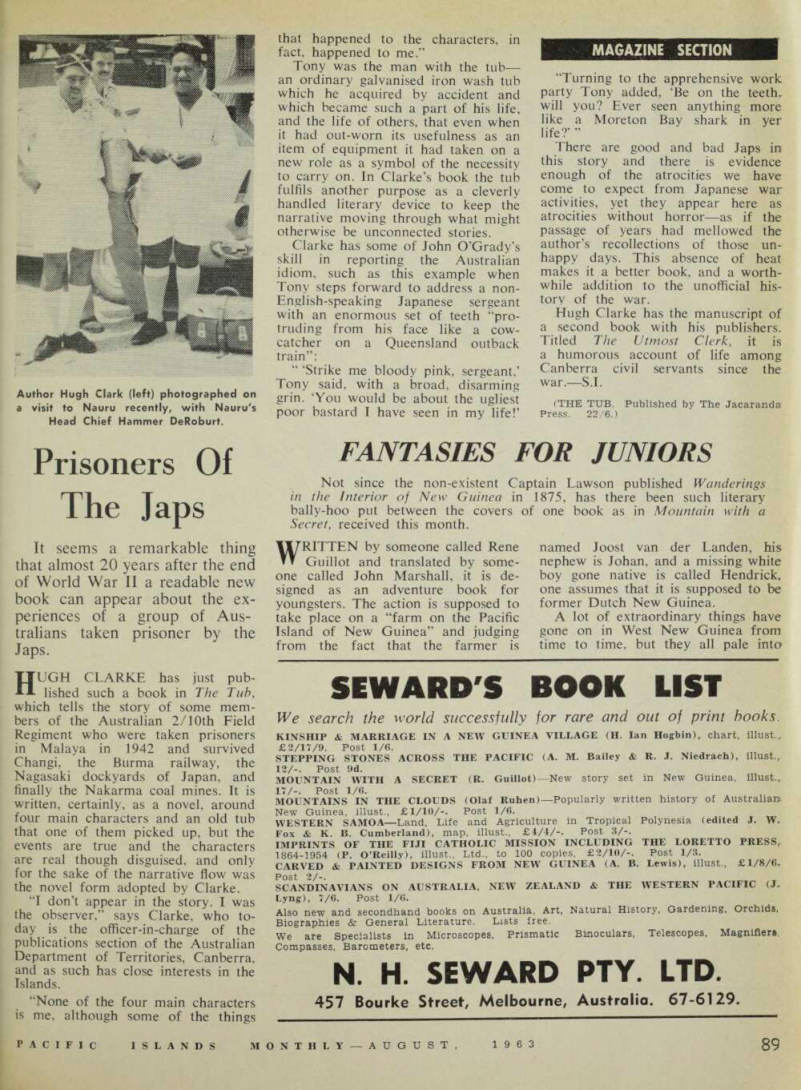
Author Hugh Clark (left) photographed on a visit to Nauru recently, with Nauru's Head Chief Hammer DeRoburt.