Trobriand Islands
pp. 89-91 · Read in the full issue
Pearl Buyers Had
The Came Sewn Up
By Basil Hall
The Trobriand Islands, off the northern coast of Papua, are as near to the islands of one’s dreams as any in the wide Pacific Ocean.
THE people are fair-skinned and pleasant, the climate is good and even pearls were to be had there before the war.
Those who bought the pearls really had the game sewn up. Of course, they had their troubles.
For one thing, the village people, who lived along the three-fathom lagoon around which the island of Kiriwina wraps itself, were apt to be busy with garden work about the end of the year when skin-diving conditions were at their best.
Any inducement to go swimming for pearls aroused official wrath, for an offering of cash or hand-out kai kai, was rightly considered to be no substitute for a well-filled yam house.
Pink Champagne to Match Besides that, the ruling prices for pearls had dropped between the two World Wars. The happy days when Russian aristocrats matched pink champagne with rosy-tinted Trobri and Island pearls and Indian nabobs offered fantastic amounts for any thing that took their fancy, were gone forever.
Pearls worth about £9,000 are shown among Papua’s list of exports in 1911. But, when I was in the Trobriands at the beginning of 1939, the declared value of pearls sent abroad had fallen to something like £2,000.
Not that anyone paid much regard to figures, for, unlike other kinds of fishermen, pearlers keep their own council, and seldom talk about the “big ones.”
Whatever their size, pearls ob tained in the Trobriands were never of first quality. What made them attractive was that they were to be had without much outlay, and pearl buying—as distinct from the pearl shell trade as it is understood in places like Torres Strait—could be relied on to show a reasonable profit.
The small, thin-shelled oysters, locally called “lapi lapi,” have al ways provided an easily-gathered form of food, and, for that reason, the Papuan Administration reserved the fishing rights exclusively for the natives.
Pearls found could be looked on as a bonus, and there were enough to keep several full-time buyers happy.
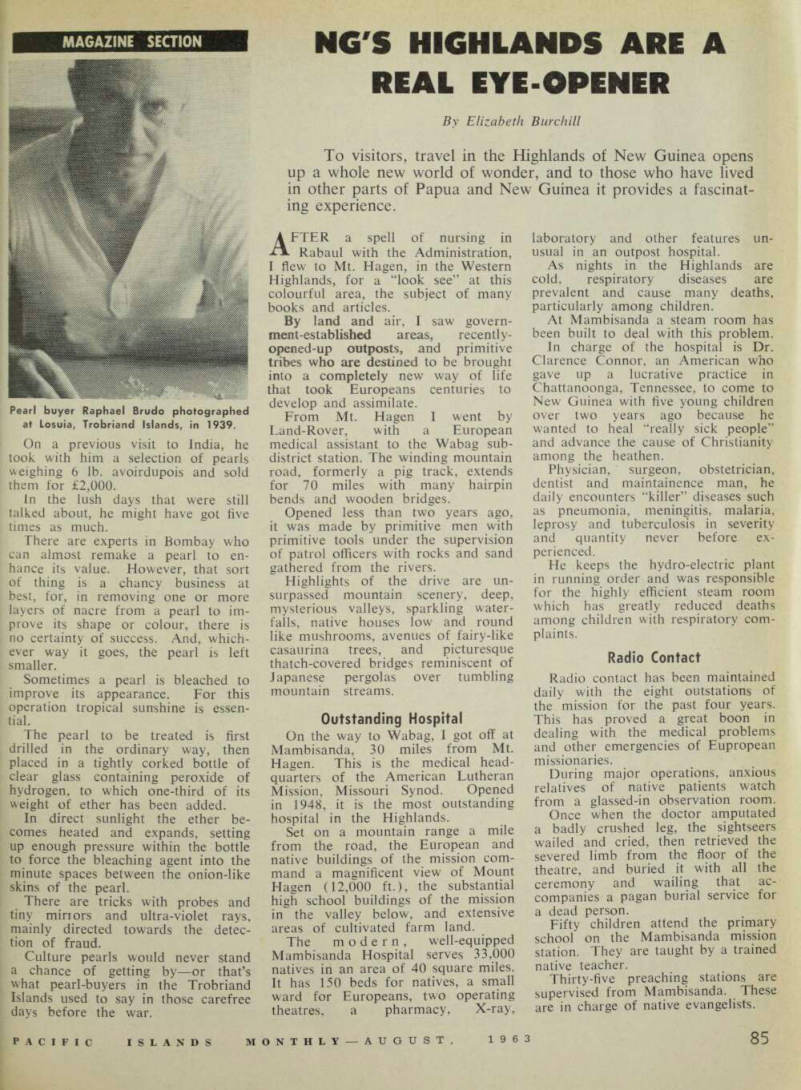
Among the buyers was Raphael Brudo, who had once lived in Paris, and who dealt direct with associates in France and elsewhere. A cul tivated man with a prodigious know ledge of pearls, he was always good company.
A nephew of his named Henry was a buyer on his own account, but Brudo’s keenest competitor was Charley Lumley, who, helped by a kindly and energetic wife, was even more active in shipping yams and other garden produce to the Papuan mainland.
Down Sinaketta way, Vic Poole, another old-timer, was smoke-drying beche de mer. Because his boys were diving for these cucumber-like creatures that add a spice to Chinese cookery, he was obliged to take out a pearl-buyer’s licence.
Such a licence cost £5O a year, but with that bit of paper, all a man needed to set up in business was a couple of caddies of tobacco and a roll of old newspapers for cigarette making.
He could hardly go wrong. All he had to do was sit on his veranda, and wait for things to come in.
Mainly it would be seed pearls or blisters still attached to the shell, but every now and then a pearl of gem class would turn up.
Prices paid differed widely. I remember one pearl of five carats being bought for 6/- in cash plus five sticks of tobacco, a box of matches and three handfuls of betel nut.
As against that, a pair of arm shells of the kind to which the Tro briands Islanders attach great ritual importance, were hanging on a nail in Henry Brudo’s store. Years be fore his father had bought them for £7.
Graded Wax Beads Although old men used to come in just to look at them, theft had never been attempted. It was gen erally understood that the armshells could only be redeemed with some outstanding pearl.
Charley Lumley’s principals in Australia sent up sets of graded wax beads to give him some idea of what was wanted.
But Raphael Brudo could string a necklace with the best of them, and numbered among his clients dealers in Bombay who yere always on the look out for pearls of unusual shape. (Over)
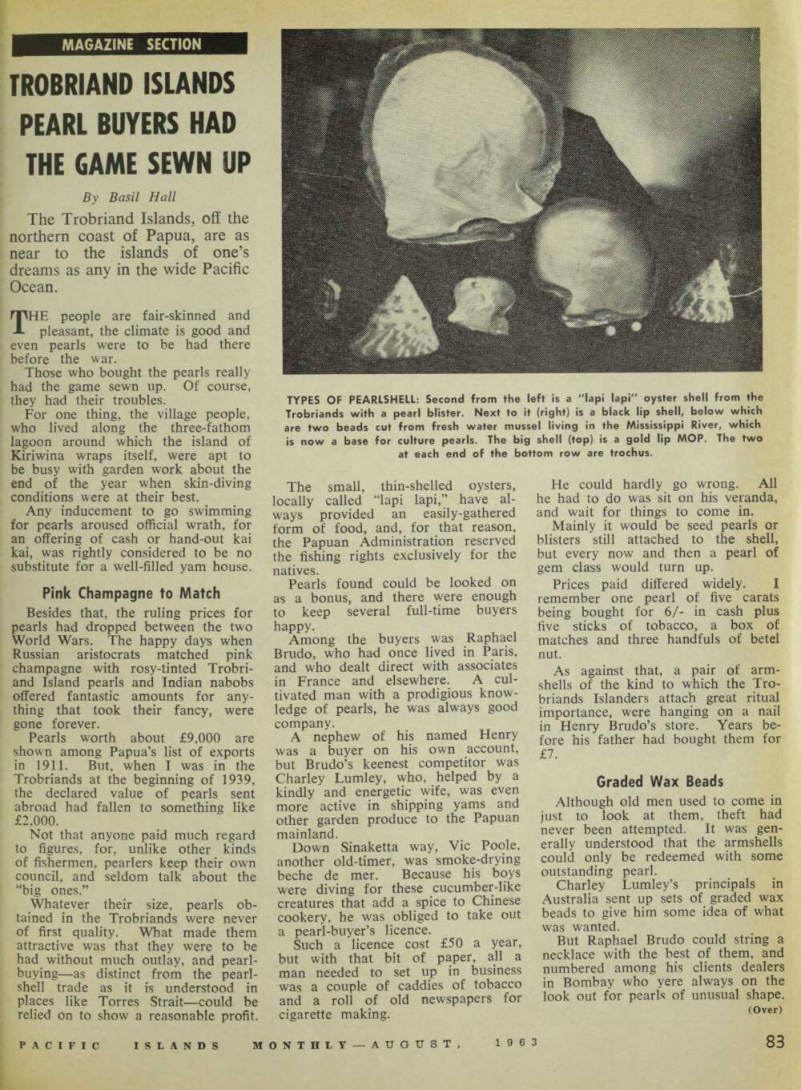
TYPES OF PEARLSHELL; Second from the left is a "lapi lapi" oyster shell from the Trobriands with a pearl blister. Next to it (right) is a black lip shell, below which are two beads cut from fresh water mussel living in the Mississippi River, which is now a base for culture pearls. The big shell (top) is a gold lip MOP. The two at each end of the bottom row are trochus.
On a previous visit to India, he took with him a selection of pearls weighing 6 lb. avoirdupois and sold them for £2,000.
In the lush days that were still talked about, he might have got five times as much.
There are experts in Bombay who can almost remake a pearl to en hance its value. However, that sort of thing is a chancy business at best, for, in removing one or more layers of nacre from a pearl to im prove its shape or colour, there is no certainty of success. And, which ever way it goes, the pearl is left smaller.
Sometimes a pearl is bleached to improve its appearance. For this operation tropical sunshine is essen tial.
The pearl to be treated is first drilled in the ordinary way, then placed in a tightly corked bottle of clear glass containing peroxide of hydrogen, to which one-third of its weight of ether has been added.
In direct sunlight the ether be comes heated and expands, setting up enough pressure within the bottle to force the bleaching agent into the minute spaces between the onion-like skins of the pearl.
There are tricks with probes and tiny minors and ultra-violet rays, mainly directed towards the detec tion of fraud.
Culture pearls would never stand a chance of getting by—or that’s what pearl-buyers in the Trobriand Islands used to say in those carefree days before the war.
Pearl buyer Raphael Brudo photographed at Losuia, Trobriand Islands, in 1939.