Magazine Section
pp. 83-87 · Read in the full issue

Pacific Islands Monthly
Lonely, Neglected
Rapa Makes Do
Without Money
By Joe Pachernegg, who visited Rapa recently with his wife, Benita, in their yacht “Okeanos”
Seven hundred miles south-south-east of Tahiti, in the kingdom of eternal winds and the mighty albatross, is the island of Rapa, a tiny speck of mountainous land in a vast and empty sea. It is the last outpost of Polynesia towards the cold Antarctic.
FORTRESSES (pares) on the steep ridges of the mountains bear witness to the heroic past of the few hundred people who live there, vir tually forgotten by the modern world.
A century or so ago, the waters around Rapa were sailed by many square-riggers and Yankee whalers.
Now they are empty and visitors to Rapa are rare.
Our visit to Rapa in the Okeanos was one of the highlights on our re cent voyage from Tahiti to Val paraiso, Chile, and one of the re wards for all our labours and hard ships of the past.
Heavy rain and wind-swollen clouds hung over the ocean as we approached the island early one mor ning. Visibility was limited to only a few miles.
Then, as the sun rose higher and the sky began to clear, Rapa suddenly appeared as a steep cliff jutting out through the murk over the sea, less than 10 miles away towards the south.
We steered towards the eastern part of the island—towards Ahurae Bay.
As the bay opened up ahead, we saw a few red roofs of a settlement nest ling peacefully on the edge of the sea beneath the mountains. This was Ahurae, one of Rapa’s two small vil lages.
At the entrance to the bay, a husky boat’s crew rested on their oars, awaiting our approach.
“lorana!” they shouted, as we downed sails and they came alongside with a few strong strokes. Although the morning was fresh and windy, the
men were clad only in tattered shorts.
They had leis on their heads and were full of laughter. An old man called Tuaraina came aboard.
“Good evening. Me pilot,” he said confidently, shaking our hands. Then his knowledge of English deserted him, and he simply took the wheel and steered the Okeanos into the anchorage off Ahurae.
Visitors Galore Many boatloads of curious and in quisitive islanders were soon all around us, shouting the warm greet ing of “lorana!” They crowded on board and tumbled below, critically examining our unexpected ship and her treasures from the outside world.
With them, came other visitors — the famous flies of Rapa, a big, blue black, utterly persistent species. They seemed to enjoy our unexpected arrival just as much as the people.
Meanwhile, the people having heard that we had not eaten break fast, they pressed us generously to come ashore at once and eat with
them. This was the beginning of a hapny and friendly association that lasted throughout our visit.
Rapa is about four miles long by four miles wide. It is of volcanic ori gin, with ridges and valleys running down to the sea like the tentacles of a giant octopus.
In the lower parts, the valleys are covered with brushwood, and a few crooked trees are scattered here and there. On the slopes and the knife sharp ridges is a hardy type of grass.
Otherwise, the mountains are bare.
Some time in the distant past, Ahurae Bay, now a deep scar in the land, must have been a mighty crater which exploded in a terrific eruption.
It is a bad anchorage for small ships.
Even on so-called calm days, a fresh breeze whistles through the entrance to the bay. At other times, strong willywaws frequently sweep over the mountains in chain-torturing gusts.
In our case, a jagged coral bank astern of us was just waiting for our anchor to drag. So after several an xious days and nights, we found a
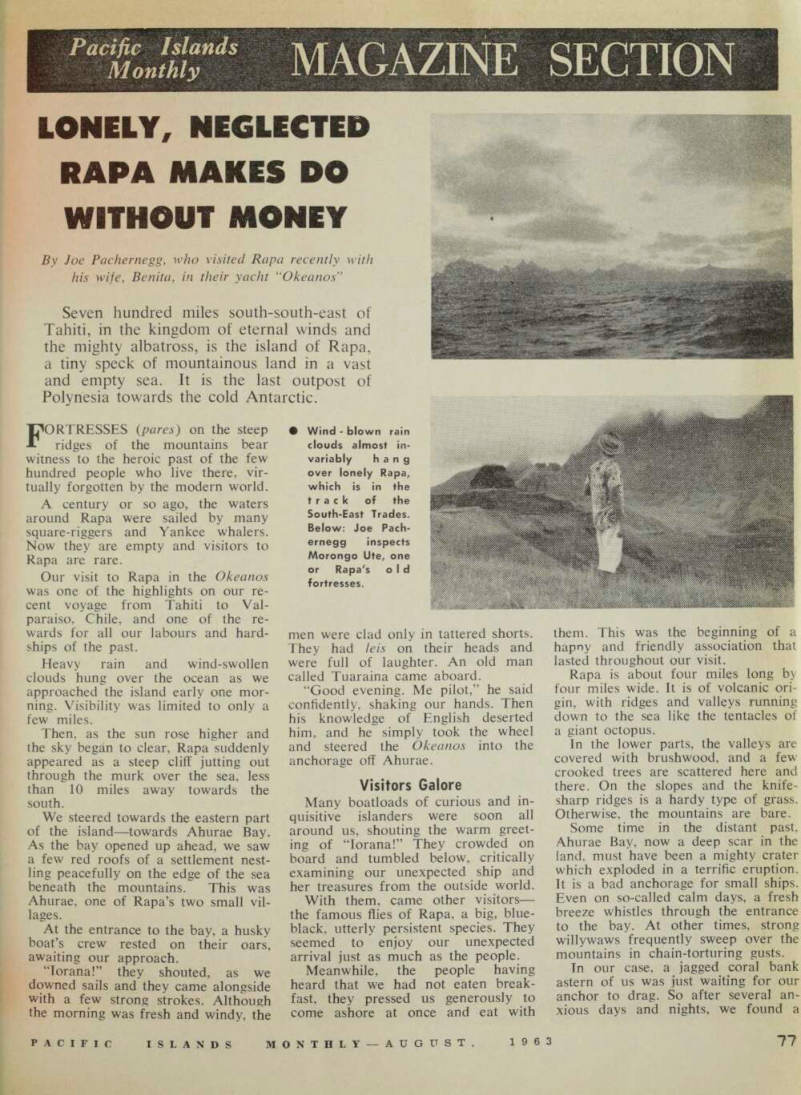
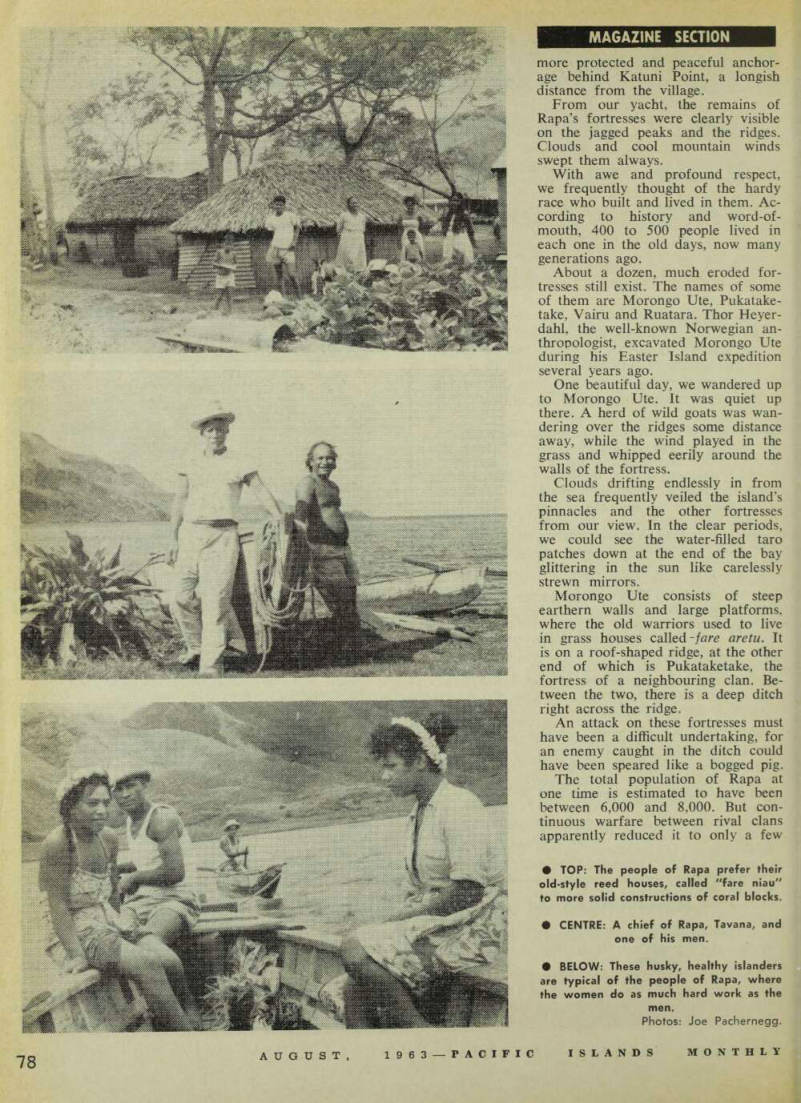
• Wind - blown rain clouds almost in variably hang over lonely Rapa, which is in the track of the South-East Trades.
Below: Joe Pach ernegg inspects Morongo Ute, one or Rapa's oI d fortresses.
more protected and peaceful anchor age behind Katuni Point, a longish distance from the village.
From our yacht, the remains of Rapa’s fortresses were clearly visible on the jagged peaks and the ridges.
Clouds and cool mountain winds swept them always.
With awe and profound respect, we frequently thought of the hardy race who built and lived in them. Ac cording to history and word-of mouth, 400 to 500 people lived in each one in the old days, now many generations ago.
About a dozen, much eroded for tresses still exist. The names of some of them are Morongo Ute, Pukatake take, Vairu and Ruatara. Thor Heyer dahl, the well-known Norwegian an thropologist, excavated Morongo Ute during his Easter Island expedition several years ago.
One beautiful day, we wandered up to Morongo Ute. It was quiet up there. A herd of wild goats was wan dering over the ridges some distance away, while the wind played in the grass and whipped eerily around the walls of the fortress.
Clouds drifting endlessly in from the sea frequently veiled the island’s pinnacles and the other fortresses from our view. In the clear periods, we could see the water-filled taro patches down at the end of the bay glittering in the sun like carelessly strewn mirrors.
Morongo Ute consists of steep earthern walls and large platforms, where the old warriors used to live in grass houses called -fare aretu. It is on a roof-shaped ridge, at the other end of which is Pukataketake, the fortress of a neighbouring clan. Be tween the two, there is a deep ditch right across the ridge.
An attack on these fortresses must have been a difficult undertaking, for an enemy caught in the ditch could have been speared like a bogged pig.
The total population of Rapa at one time is estimated to have been between 6,000 and 8,000. But con tinuous warfare between rival clans apparently reduced it to only a few
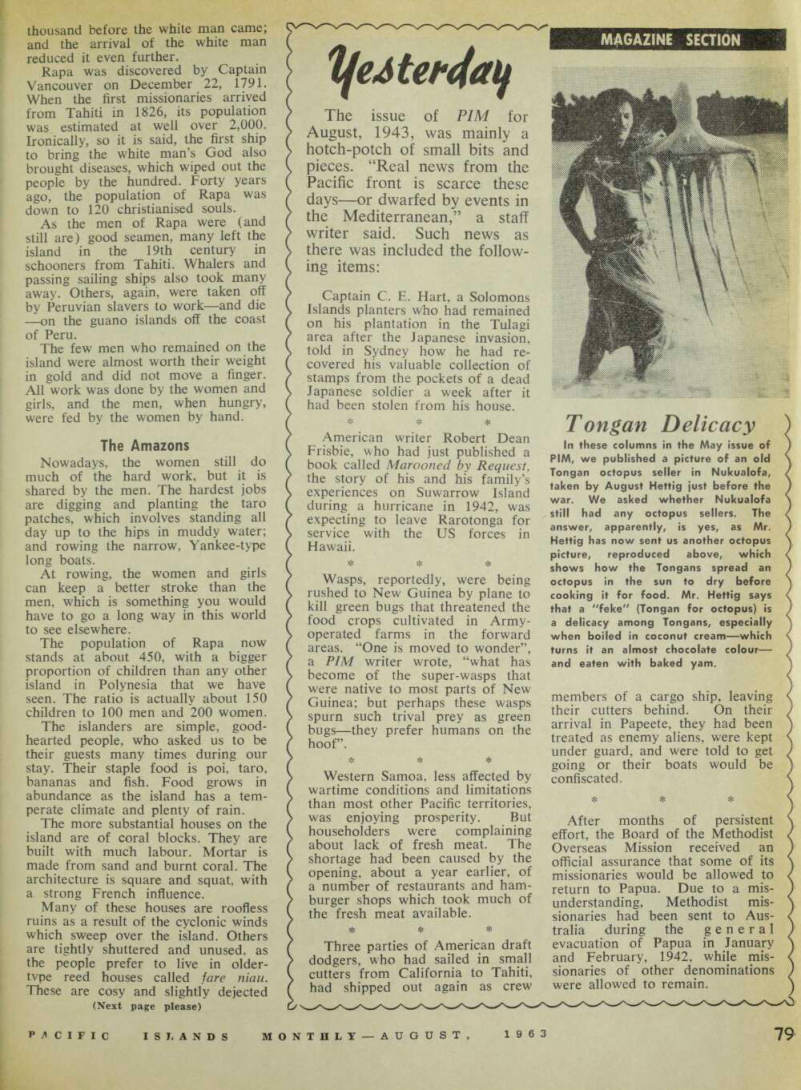
• TOP: The people of Rapa prefer their old-style reed houses, called "fare niau" to more solid constructions of coral blocks.
• CENTRE: A chief of Rapa, Tavana, and one of his men.
• BELOW: These husky, healthy islanders are typical of the people of Rapa, where the women do as much hard work as the men.
Photos: Joe Pachernegg.
thousand before the white man came; and the arrival of the white man reduced it even further.
Rapa was discovered by Captain Vancouver on December 22, 1791.
When the first missionaries arrived from Tahiti in 1826, its population was estimated at well over 2,000.
Ironically, so it is said, the first ship to bring the white man’s God also brought diseases, which wiped out the people by the hundred. Forty years ago, the population of Rapa was down to 120 christianised souls.
As the men of Rapa were (and still are) good seamen, many left the island in the 19 th century in schooners from Tahiti. Whalers and passing sailing ships also took many away. Others, again, were taken off by Peruvian slavers to work—and die —on the guano islands off the coast of Peru.
The few men who remained on the island were almost worth their weight in gold and did not move a finger.
All work was done by the women and girls, and the men, when hungry, were fed by the women by hand.
The Amazons Nowadays, the women still do much of the hard work, but it is shared by the men. The hardest jobs are digging and planting the taro patches, which involves standing all day up to the hips in muddy water; and rowing the narrow, Yankee-type long boats.
At rowing, the women and girls can keep a better stroke than the men, which is something you would have to go a long way in this world to see elsewhere.
The population of Rapa now stands at about 450, with a bigger proportion of children than any other island in Polynesia that we have seen. The ratio is actually about 150 children to 100 men and 200 women.
The islanders are simple, good hearted people, who asked us to be their guests many times during our stay. Their staple food is poi, taro, bananas and fish. Food grows in abundance as the island has a tem perate climate and plenty of rain.
The more substantial houses on the island are of coral blocks. They are built with much labour. Mortar is made from sand and burnt coral. The architecture is square and squat, with a strong French influence.
Many of these houses are roofless ruins as a result of the cyclonic winds which sweep over the island. Others are tightly shuttered and unused, as the people prefer to live in older tvpe reed houses called fare niau.
These are cosy and slightly dejected (Next page please)
lean-to’s which stand in the shadows of the real houses.
Grassy roads wind through the vil lage of Ahurae, punctuated here and there by very modern-looking water taps. Uncultivated flowers grow brazenly near the continuous trickles from the taps.
There are also some carefully nur tured plots of tobacco, for imported cigarettes are almost unknown.
The French Administration in Tahiti maintains a weather station on the island, and —to judge by the noise and eagerness of the pupils—a pretty efficient school.
A small aid post in a slightly ne glected state is apparently mainly used for confinements. Another build ing in Ahurae is a tightly-shuttered co-operative trade store, which seems to be in a permanent state of empti ness due, no doubt, to lack of goods and lack of money. Money, in fact, is virtually non-existent. Not once during our two-week stay did we hear the word mentioned.
A ship from Tahiti comes to Rapa twice or, at most, three times a year.
The island has little to export, although a much bigger trade could be developed if the French Adminis tration took an interest in the island.
Cattle, for example, seem to thrive; potatoes, tomatoes and coffee are do ing fine; and many varieties of fruit trees could be introduced. At present, Tahiti imports potatoes and coffee from America and France at scream ing prices.
The only white man who lives on Rapa is, surprisingly, a French noble man, Count le Champs de Verneix.
The count, a friendly man of over 60, spent some years with the Australian Army during the war.
He speaks excellent English and re members nostalgically the days he spent in Australia. On the far end of Ahurae Bay, he has built himself a little homestead —hidden among orange trees and coffee bushes, and isolated from everybody.
The count first came to Rapa in 1930. “1 had a title, inheritance and wealth,” he says, “but also duties towards my family.
“Now I am free. Here on Rapa, I live close to the earth, and everything I need I produce myself. Here I have peace.”
The count now devotes himself to growing coffee and raising cattle— a crossbred strain of Angus and Hereford which came originally from Australia.
The count says that the reason his coffee grows so well is that hundreds of people are buried under his land.
And he adds: “They were not killed in the fighting, but in the epidemics.”
This warm-hearted race has cer tainly suffered frightfully under the advance of the white man’s civilisa tion; and it is to be hoped that the Administration will do something to improve the island’s sanitation and give the people a better economic future.