Erromanga, The Martyr
pp. 73-74 · Read in the full issue

Isle, May Hear The Woodsman's Axe Again
The New Hebrides island of Erromanga, once famous for its sandalwood trade and the number of missionaries murdered there, may be in the news again soon as a forestry centre.
A FIVE-LINE paragraph in a re cent news bulletin issued by the French Administration in the New Hebrides suggests this.
The paragraph said simply that a Mr. Williams, “equally representing M. Rouleau, now absent from the archipelago”, had left Vila for Erromanga on June 10 in the vessel Bel Ami to investigate the possibility of exploiting timber resources in the south of Erromanga, Two things that make this news item significant are: • It is understood that joint forestry legislation, drawn up earlier this year, was designed to cover the possible exploitation of timber on Erromanga. (The chief Forestry Officer in the BSIP, Mr. K. W.
Trenaman, made a special visit to Vila to discuss the legislation.) • M. (Claude) Rouleau, men tioned in the news bulletin, has had his eye on Erromanga’s vast, but little-known timber resources for more than 10 years.
Dense Forests In a letter to PIM in March, 1952, M. Rouleau said that the density of the forests on the south of Erro manga was so exceptional that the forestry people of Australia and New Zealand would find it difficult to be lieve that such stands of timber could exist.
He said the density of kauri and tamanu was considerable. Over 150 million super feet of timber had actu ally been surveyed, but it was more likely that twice that amount was available.
Roads, M. Rouleau said, would have to be built and considerable capital put into bulldozers, milling machinery, shipping, etc. But with Australia’s building needs, this vast quantity of excellent timber at her doors should easily provide the stimulus for the necessary capital.
M. Rouleau also made these points: Lane Pool, an Australian forestry expert, had described the forests in
a radio broadcast as the most beauti ful he had ever seen. • Erromanga had no fever, an equable climate, a rich soil capable of growing every kind of temperate vegetable and fruit, and was excellent for stock. But its exploitation had undoubtedly been held back by its early history of savagery.
Erromanga is some 60 miles south of Vila. It is 35 miles long and 25 miles wide at its broadest point, with three peaks from 2,500 to 3,000 ft high.
Most of its coast is steep-to, the southern coast is cliffy, and there are no good harbours. But anchorages may be obtained in Cook, Narevin and Polenia Bays on the eastern side, and in Dillon Bay on the west.
Erromanga has had a reputation for savagery ever since the first Euro pean visited it. Captain Cook, the first visitor, named a high headland on the east coast Traitor’s Head “from
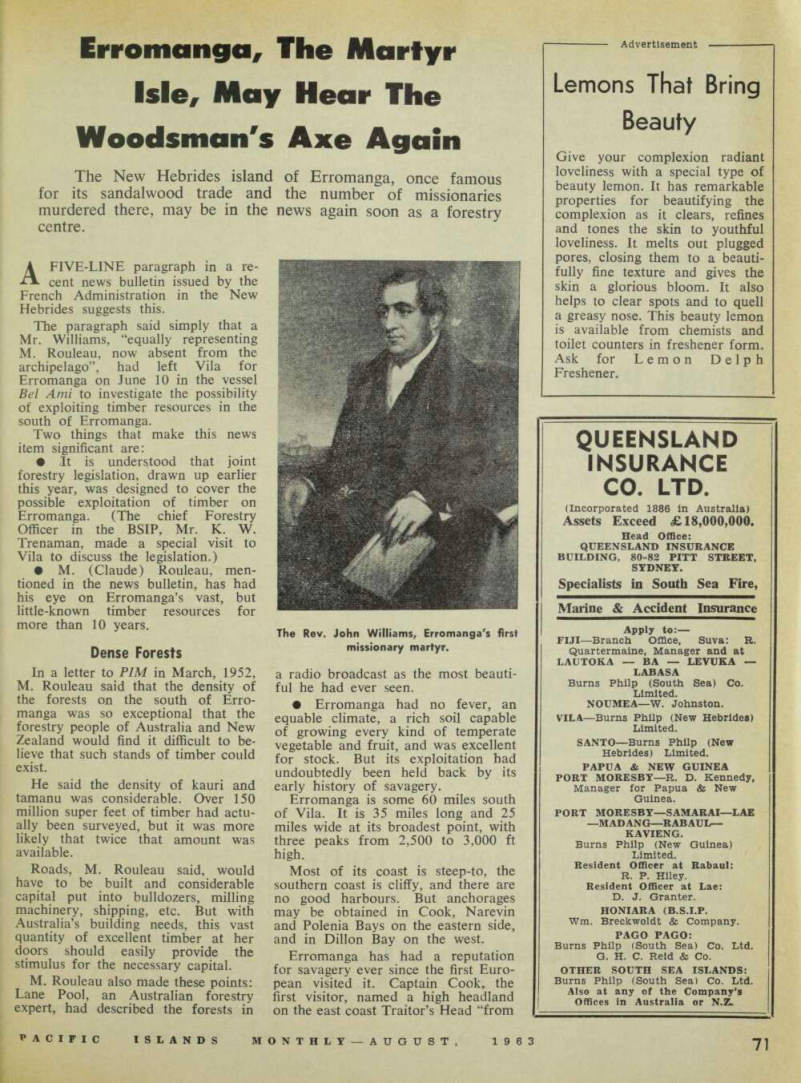
The Rev. John Williams, Erromanga's first missionary martyr.
the treacherous nature of its inhabi tants”.
Some 50 years later—in 1825 Captain Peter Dillon, the discoverer of the fate of La Perouse, found two or three pieces of sandalwood at Port Resolution. Tanna, and was told of an abundance of that wood at neigh
boring Erromanga.
News of this discovery brought scores of sandalwood ships to Erro manga during the next 30 to 40 years.
But some of the sandalwooders were so ruthless in their methods that hundreds of natives were killed.
The natives, in retaliation, cut off and massacred several sandalwooding crews, and murdered half a dozen missionaries between 1839 and 1872.
The famous LMS missionary, the Rev.
John Williams, was the first to die there.
However, sandalwood fetched such high prices on the China market that the sandalwooders were prepared to take almost any risk to get it. They did not give up their trade until—as one of them wrote in the late 1860’s —“we now have little to remind us that at one time the sandalwood grew on every hill and clustered in every valley of Erromanga”.
Blackbirding Trade
By that time the missionaries had made some progress, but the notorious blackbirding trade was in full swing and hundreds of Erro mangans were inveigled off to work on the cotton and sugar plantations of Queensland and Fiji. Many of them did not return.
The labour trade went on into the
early years of this century—until the native population had declined from several thousands to 800 or 900.
Since then, little has happened at Erromanga apart from the establish ment some years ago of a sheep sta tion, now abandoned because of lack of shipping. By 1960, the population was down to 589.
Meanwhile, the forests on the southern side of the island have been
growing undisturbed and virtually
forgotten. But the woodsman’s axe may soon be heard there again.
If it is, the New Hebrides’ trade in timber, which was the prime cause of bringing Europeans to the Group, may have its greatest boost for more than a century.