U.N. Ignorance
pp. 53-55 · Read in the full issue
On Fiji Affairs
Appalling
From a Suva Correspondent
The appalling ignorance of
Fijian affairs shown by Afro- Asian members of a 24-man United Nations Special Com mittee on Colonialism, which met in New York in June and July, brought some astounded re actions in Fiji.
THE UN did nothing to advance its aims in the Colony as a re sult of the woeful, sometimes ridicu lous standard of the comments in New York.
The burden of the UN comment by people representing such places as Iraq, Yugoslavia, Cambodia, Poland, Ethiopa, Tanganyika and Syria was that Britain should do something urgently to give the poor down trodden citizens of Fiji their inde pendence. The fact that the Fijians have specifically said they don’t want independence doesn’t appear to have got through.
There were UN suggestions that Fiji’s racial divisions might develop “along the same dangerous lines” as in British Guiana.
Many of the delegates repeatedly referred to Fijians when apparently they meant the entire population of Fiji, which is more than half Indian.
Others suggested that the Executive Council was controlled by the Gover nor and was merely “an instrument by which the Fijians were prevented from exercising the power of govern ment”, and that a majority of the members of the Legislative Council were “hand picked” by the Governor.
Fijian members of the Legislative Council were quick to say, with usual Fijian dignity, that some of the more voluble members should put their own houses in order before telling another country what to do. The four European elected members supported them, but the four Indian elected members chose to remain silent.
Russia's Request
During the committee’s delibera tions, Russia suggested that a UN “fact-finding team” be sent to Fiji.
The Soviet delegate (Mr. Vladimir Brykin) said the committee could visit other colonial territories in the Pacific and report back before the next General Assembly in September.
Particularly some of the nonsense Mr. Brykin spoke left people in Fiji gasping. He had most of his facts wrong.
He said that Britain was cutting off the people of Fiji from contact with the outside world, and had given the UN extremely sparse information about the Colony.
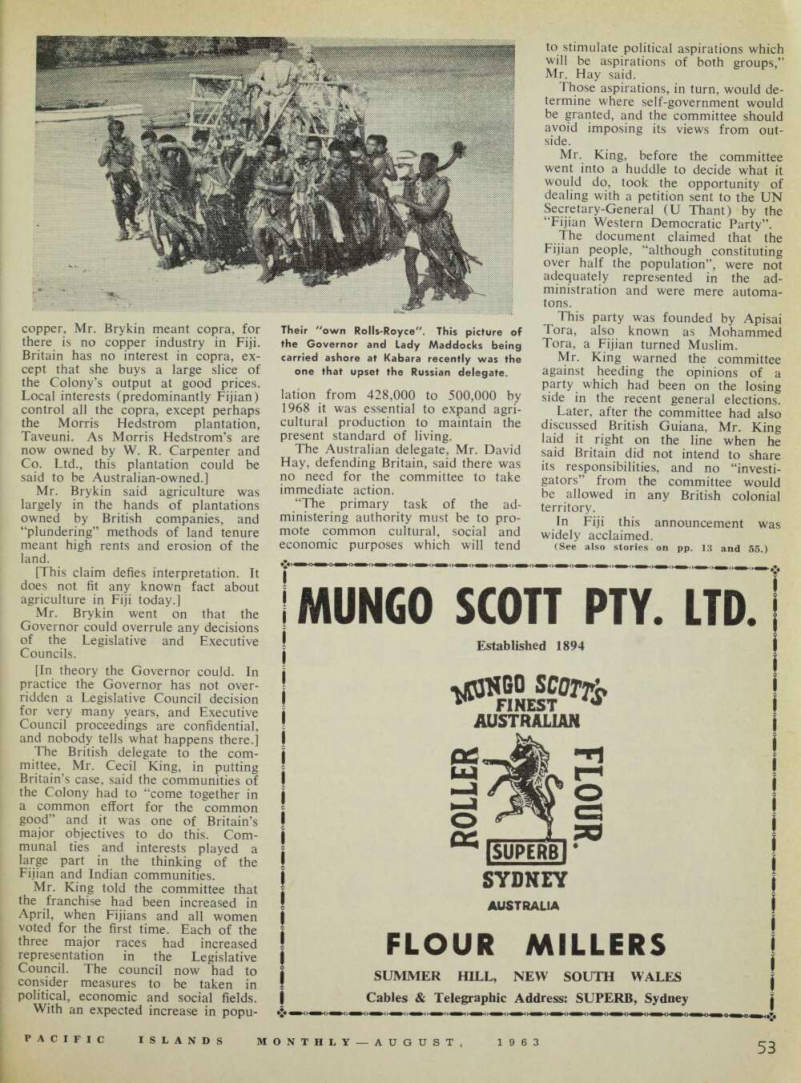
The information, Mr. Brykin said, provided a picture of a “classical, old time colony, with unlimited power in the hands of the Governor”. Photo graphs in a London newspaper had shown the Governor and his wife borne aloft on a sort of dais by native Fijians “as if it were a Rolls- Royce”.
[Similar treatment is accorded to other persons of high rank. It could even happen to Mr. Brykin himself should he make an official visit to Fiji and be received with traditional Fijian ceremonial.] Tentacles The Russian delegates said the British had their “tentacles” on all activities of the islands, including sugar, pineapple and copper. [The British interest in sugar is practically nil. The growers get the biggest rake-off from sugar. There is now no pineapple canning—that in dustry folded up eight or 10 years ago. Presumably when he spoke of
copper, Mr. Brykin meant copra, for there is no copper industry in Fiji.
Britain has no interest in copra, ex cept that she buys a large slice of the Colony’s output at good prices.
Local interests (predominantly Fijian) control all the copra, except perhaps the Morris Hedstrom plantation, Taveuni. As Morris Hedstrom’s are now owned by W. R. Carpenter and Co. Ltd., this plantation could be said to be Australian-owned.] Mr. Brykin said agriculture was largely in the hands of plantations owned by British companies, and “plundering” methods of land tenure meant high rents and erosion of the land. [This claim defies interpretation. It does not fit any known fact about agriculture in Fiji today.] Mr. Brykin went on that the Governor could overrule any decisions of the Legislative and Executive Councils. [ln theory the Governor could. In practice the Governor has not over ridden a Legislative Council decision for very many years, and Executive Council proceedings are confidential, and nobody tells what happens there.] The British delegate to the com- Mr. Cecil King, in putting Britain’s case, said the communities of the Colony had to “come together in a common effort for the common good” and it was one of Britain’s major objectives to do this. Com munal ties and interests played a large part in the thinking of the Fijian and Indian communities, Mr. King told the committee that the franchise had been increased in April, when Fijians and all women voted for the first time. Each of the three major races had increased representation in the Legislative Council. The council now had to consider measures to be taken in political, economic and social fields.
With an expected increase in popu
lation from 428,000 to 500,000 by 1968 it was essential to expand agri cultural production to maintain the present standard of living.
The Australian delegate, Mr. David Hay, defending Britain, said there was no need for the committee to take immediate action.
“The primary task of the ad ministering authority must be to pro mote common cultural, social and economic purposes which will tend
to stimulate political aspirations which will be aspirations of both groups,”
Mr. Hay said.
Those aspirations, in turn, would de termine where self-government would be granted, and the committee should avoid imposing its views from out side.
Mr. King, before the committee went into a huddle to decide what it would do, took the opportunity of dealing with a petition sent to the UN Secretary-General (U Thant) by the “Fijian Western Democratic Party”.
The document claimed that the Fijian people, “although constituting over half the population”, were not adequately represented in the ad ministration and were mere automa tons.
This party was founded by Apisai Tora, also known as Mohammed Tora, a Fijian turned Muslim.
Mr. King warned the committee against heeding the opinions of a party which had been on the losing side in the recent general elections.
Later, after the committee had also discussed British Guiana, Mr, King laid it right on the line when he said Britain did not intend to share its responsibilities, and no “investi gators” from the committee would be allowed in any British colonial territory.
In Fiji this announcement was widely acclaimed.
(See also stories on pp. 13 and 55.)
Their "own Rolls-Royce". This picture of the Governor and Lady Maddocks being carried ashore at Kabara recently was the one that upset the Russian delegate.