Takes A Practical View
p. 23 · Read in the full issue
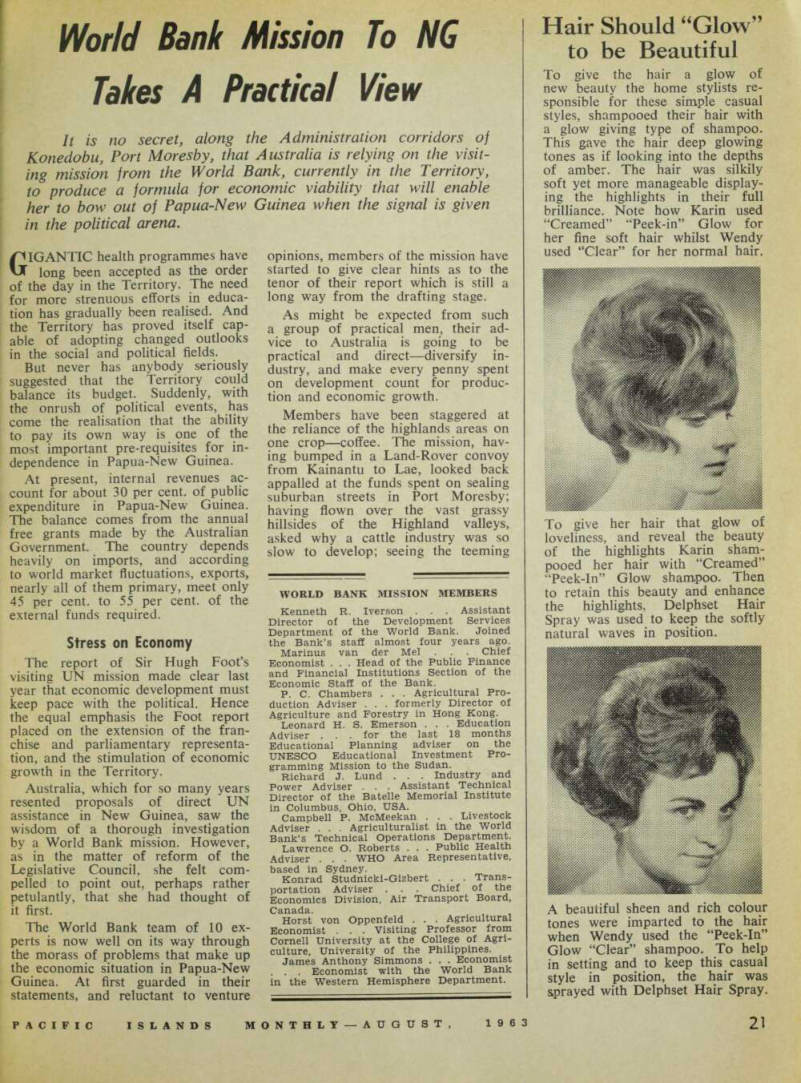
World Bank Mission To NG Takes A Practical View
It is no secret, along the Administration corridors of Konedobu, Port Moresby, that Australia is relying on the visit ing mission from the World Bank, currently in the Territory, to produce a formula for economic viability that will enable her to bow out of Papua-New Guinea when the signal is given in the political arena.
GIGANTIC health programmes have long been accepted as the order of the day in the Territory. The need for more strenuous efforts in educa tion has gradually been realised. And the Territory has proved itself cap able of adopting changed outlooks in the social and political fields.
But never has anybody seriously suggested that the Territory could balance its budget. Suddenly, with the onrush of political events, has come the realisation that the ability to pay its own way is one of the most important pre-requisites for in dependence in Papua-New Guinea.
At present, internal revenues ac count for about 30 per cent, of public expenditure in Papua-New Guinea.
The balance comes from the annual free grants made by the Australian Government. The country depends heavily on imports, and according to world market fluctuations, exports, nearly all of them primary, meet only 45 per cent, to 55 per cent, of the external funds required.
Stress on Economy The report of Sir Hugh Foot’s visiting UN mission made clear last year that economic development must keep pace with the political. Hence the equal emphasis the Foot report placed on the extension of the fran chise and parliamentary representa tion, and the stimulation of economic growth in the Territory.
Australia, which for so many years resented proposals of direct UN assistance in New Guinea, saw the wisdom of a thorough investigation by a World Bank mission. However, as in the matter of reform of the Legislative Council, she felt com pelled to point out, perhaps rather petulantly, that she had thought of it first.
The World Bank team of 10 ex perts is now well on its way through the morass of problems that make up the economic situation in Papua-New Guinea. At first guarded in their statements, and reluctant to venture
opinions, members of the mission have started to give clear hints as to the tenor of their report which is still a long way from the drafting stage.
As might be expected from such a group of practical men, their ad vice to Australia is going to be practical and direct —diversify in dustry, and make every penny spent on development count for produc tion and economic growth.
Members have been staggered at the reliance of the highlands areas on one crop—coffee. The mission, hav ing bumped in a Land-Rover convoy from Kainantu to Lae, looked back appalled at the funds spent on sealing suburban streets in Port Moresby; having flown over the vast grassy hillsides of the Highland valleys, asked why a cattle industry was so slow to develop; seeing the teeming