Commentary
pp. 13-15 · Read in the full issue
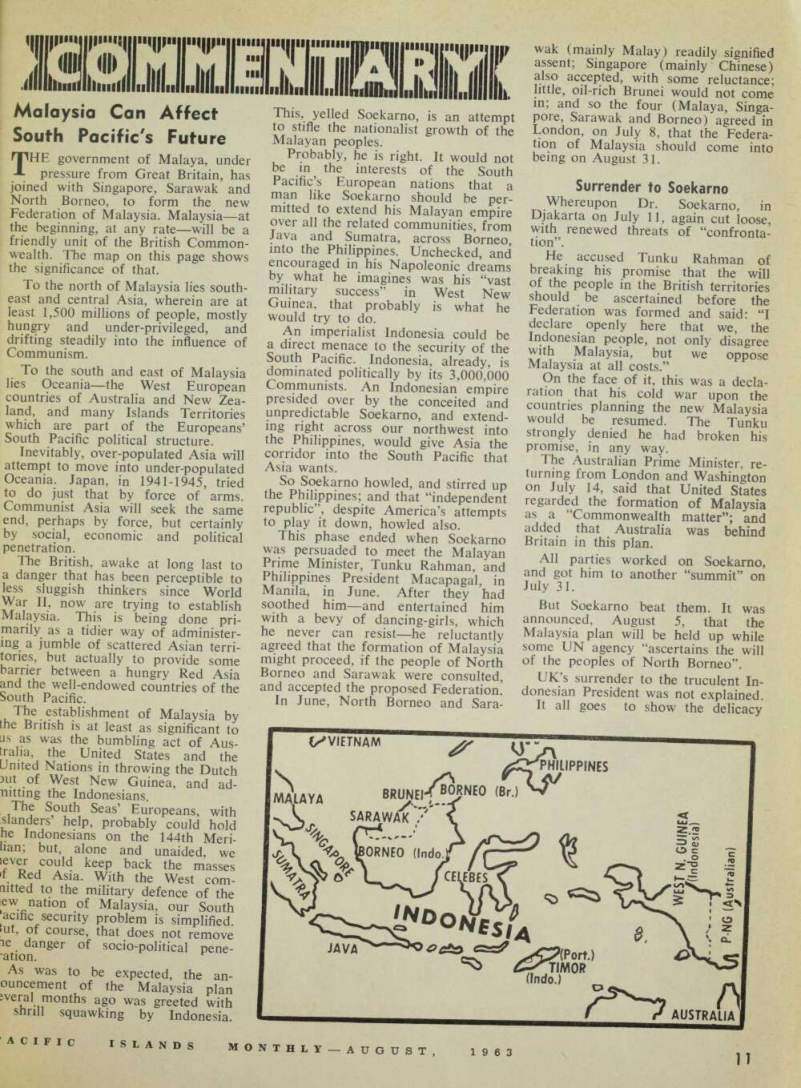

Malaysia Can Affect-
South Pacific's Future
THE government of Malaya, under pressure from Great Britain, has joined with Singapore, Sarawak and North Borneo, to form the new Federation of Malaysia. Malaysia— at the beginning, at any rate—will be a friendly unit of the British Common wealth. The map on this page shows the significance of that.
To the north of Malaysia lies south east and central Asia, wherein are at least 1,500 millions of people, mostly hungry and under-privileged, and drifting steadily into the influence of Communism.
To the south and east of Malaysia lies Oceania—the West European countries of Australia and New Zea land, and many Islands Territories which are part of the Europeans’
South Pacific political structure.
Inevitably, over-populated Asia will attempt to move into under-populated Oceania. Japan, in 1941-1945, tried to do just that by force of arms.
Communist Asia will seek the same end, perhaps by force, but certainly by social, economic and political penetration.
The British, awake at long last to a danger that has been perceptible to less sluggish thinkers since World War 11, now are trying to establish Malaysia. This is being done pri marily as a tidier way of administer ing a jumble of scattered Asian terri tories, but actually to provide some barrier between a hungry Red Asia and the well-endowed countries of the South Pacific, The establishment of Malaysia by the British is at least as significant to us as was the bumbling act of Aus tralia, the United States and the United Nations in throwing the Dutch nut of West New Guinea, and ad rutting the Indonesians.
The South Seas’ Europeans, with slanders help, probably could hold ne Indonesians on the 144th Meri lian, but, alone and unaided, we l v ® r keep back the masses •f Red Asia. With the West com tutted to the military defence of the iew nation of Malaysia, our South acific security problem is simplified, ut, of course, that does not remove re danger of socio-political pene ation.
As was to be expected, the an ouncement of the Malaysia plan ;veral months ago was greeted with shrill squawking by Indonesia.
This, yelled Soekarno, is an attempt to stifle the nationalist growth of the Malayan peoples.
Probably, he is right. It would not be in the interests of the South Pacific’s European nations that a man like Soekarno should be per mitted to extend his Malayan empire over all the related communities, from Java and Sumatra, across Borneo, into the Philippines. Unchecked, and encouraged in his Napoleonic dreams by what he imagines was his “vast military success” in West New Guinea, that probably is what he would try to do.
An imperialist Indonesia could be a direct menace to the security of the South Pacific. Indonesia, already, is dominated politically by its 3,000,000 Communists, An Indonesian empire presided over by the conceited and unpredictable Soekarno, and extend ing right across our northwest into the Philippines, would give Asia the corridor into the South Pacific that Asia wants.
So Soekarno howled, and stirred up the Philippines; and that “independent republic”, despite America’s attempts to play it down, howled also.
This phase ended when Soekarno was persuaded to meet the Malayan Prime Minister, Tunku Rahman, and Philippines President Macapagal, in Manila, in June. After they had soothed him—and entertained him with a bevy of dancing-girls, which he never can resist—he reluctantly agreed that the formation of Malaysia might proceed, if the people of North Borneo and Sarawak were consulted, and accepted the proposed Federation.
In June, North Borneo and Sara
wak (mainly Malay) readily signified assent; Singapore (mainly Chinese) also accepted, with some reluctance; little, oil-rich Brunei would not come in; and so the four (Malaya, Singa pore, Sarawak and Borneo) agreed in London, on July 8, that the Federa tion of Malaysia should come into being on August 31.
Surrender to Soekarno Whereupon Dr. Soekarno, in Djakarta on July 11, again cut loose, with renewed threats of “confronta tion”.
He accused Tunku Rahman of breaking his promise that the will of the people in the British territories should be ascertained before the Federation was formed and said: “I declare openly here that we, the Indonesian people, not only disagree with Malaysia, but we oppose Malaysia at all costs.”
On the face of it, this was a decla ration that his cold war upon the countries planning the new Malaysia would be resumed. The Tunku strongly denied he had broken his promise, in any way.
The Australian Prime Minister, re turning from London and Washington on July 14, said that United States regarded the formation of Malaysia as a “Commonwealth matter”; and added that Australia was behind Britain in this plan.
All parties worked on Soekarno, and got him to another “summit” on July 31.
But Soekarno beat them. It was announced, August 5, that the Malaysia plan will be held up while some UN agency “ascertains the will of the peoples of North Borneo”.
UK’s surrender to the truculent In donesian President was not explained.
It all goes to show the delicacy
of the situation that governs the future of our South Pacific world, in relation to Asia.
However, behind that ugly political cloud over our northwest frontier, there is a bright spot. It appears as a crack in the hitherto mighty wall of Muscovite-Oriental Communism.
Signs of an ideological split be tween Russia and China have been apparent for some time, and even while Soekarno was putting on his anti-Malaysia performance in June- July, the bitter quarrel between Euro pean and Asian Communists came out into the open, and Western leaders and commentators were beginning, cautiously, to hope it was irreconcil able, and to forecast a change in the shape of the 16-years-old Cold War.
While China is insisting, savagely, that there shall be no let-up in the Communist attack upon the Western system, even if it means nuclear war, the Russian bloc, under Khrushchev’s leadership, shows now a disposition to argue that the two systems— Communism and Capitalism—can “co-exist” peacefully—and let the best system win!
If there is to be a new and better relationship between the West and the Soviets, the effervescent Soekarno may be cut down to size and put back in his box with a jar that could have interesting political results.
Muddled Thinking In
Western Samoa
WESTERN Samoa’s Prime Minis ter, Fiame Mataafa, once had the reputation of being something of a playboy and not the type of man who could successfully take on the responsibilities of a high office. But when he got his present job he proved his critics wrong, for his own sense of responsibility has appeared to grow at the same pace as his political responsibilities. He has been one of those plants destined to flower late.
It is a sharp disappointment, then, that he has thought fit—and not for the first time—to attack the Samoan newspapers, this time in terms which clearly must be construed as an at tack on Press freedom and on demo cratic government.
This line will win him no friends, but many bitter critics, in the coun tries on which Samoa must lean so heavily in the next few years.
To ban the Samoan Press would be folly so preposterous that Mataafa and any Assembly members who hap pen to think the same way should purge their minds of the thought without waste of time.
Britain Should Stand
Firm in Fiji
THE UN Special Committee on Colonialism deserves the scorn with which its recent pronouncements on Fijian affairs have been greeted in that Colony.
Most of its members showed them selves incapable of constructive advice on a difficult set of problems, no doubt because of their in excusable ignorance of conditions in Fiji. Even the shire councillors of Bandiwallop, debating the need or otherwise for a new public urinal in the town, could be counted upon to arm themselves with more factual information on the subject than was apparently thought necessary by mem bers of this international forum in debating the affairs of another country.
Some of the odd statements in the general debate are reported on p. 51 but the most useless came at the end, in the form of a Russian-inspired resolution calling on Britain to institute a common roll and transfer all power to the people of Fiji.
This completely overlooked the fact that the Fijian people, who are in the minority to the Indian popula tion, have said clearly they do not want independence or to lose their ties with Britain. A common roll would result in their political and economic extinction.
The assertion by Britain that its policy was to bring the races closer together in a working partnership, to make one nation, able to be in dependent if that is what its people eventually chose, was ignored by the committee in the scramble of most of its members to condemn out of hand the myth of colonialism.
In these circumstances Australia’s attitude to the committee’s final resolution was a peculiar one. Aus tralia generally gave Britain support during the debate (although not always with as much enthusiasm as one had the right to expect), but abstained from the vote. This abstention was correctly described by the New Zealand Herald as having “earned no credit for Canberra”.
Apparently the view is held in Canberra that nothing is to be gained by Britain or the Fijians cocking the snook too high at the committee, be cause the committee may be expected to be with us for a long time yet.
According to this view, the com mittee is not entirely composed of extremists, and too blunt a reaction in Fiji might serve to alienate the
The final resolution passed by the Committee of 24 noted, “with regret”, that the “adminstering power has still taken no effective steps to transfer all powers to the people of Fiji,” and that' “the Fiji Constitution, in par ticular those sections governing the electoral system and the composition and functions of the Legislative and Executive Councils, are not based on generally accepted democratic prin ciples”. The resolution also affirmed “the inalienable right of the Fijian people to self-determination and national independence and invites the administering power to work out, together with the people of Fiji, a new constitution providing for free elections conducted on the principle of one man one vote, and the creation of representative institutions in the territory; to take immediate steps for the transfer of all power to the people of this territory, and in ac cordance with their freely expressed will and desire and without conditions or reservations, to work out with the co-operation of the people themselves the integration of the different communities in the social, economic and political fields.”
committee’s moderate members, who on the next occasion would be in clined to throw in their lot with the extremist Soviet bloc. In other words, Fiji should attempt to make friends, not enemies, on the committee.
There is always something to be said for making friends. And certainly a comparison of the original Soviet draft resolution with the final one will show that the Afro-Asians considerably reduced the fire and brimstone language of the original so that it finally ended up as something moderate enough when compared with the usual immoderate anti colonial standards of the UN.
And it is also true, for this is what the Canberra view seems to be pro posing, that Fiji might as well get used to the UN spotlight.
But expediency, plus the desire for friendship at any cost, has brought about the downfall of too many Gov ernments with right on their side but timid souls at the helm. Britain is right to stand firm.
If the Fijians do need some educating as to what to expect from UN members in a changing world, then certainly the type of people to be found in the Committee on Colonialism are in more urgent need of lessons in the art of recognising problems and proposing practical solutions instead of political slogans.
By voting with Britain against the resolution, Australia could have added a clear voice of protest. Instead she invites identification as a rather gutless wonder who turns the other way when her friends are being attacked in a back alley.