Don't Touch Them!
pp. 31-37 · Read in the full issue

Ffling Sydney Case Highlights Danger
If You Don't Know Your Cone Shells, Don't Touch Them!
By a Staff Writer
The danger Of inexperienced people handling any kind of [ie shell found on reefs throughout the Pacific has been em asised recently following publicity in Australia about a highly hal cone shell, Conus geographus.
I danger arises from the fact tiat even the experts are not certain which cone shells are rous to man and which are not.
Robert Endean, head of the gy Department at the Queens- University, who has been in ating cone shells (Conidae), has only six species with poisons rous to man. ; Dr. D. F. McMichael, Curator Molluscs at the Australian
Museum, Sydney, says there are three others which have been reported to have fatally stung humans.
Dr. Endean’s lethal six are; Conus geographus, C. tulipa, C. striatus, C. magus, C. stercusmuscarium and C. cams. To these, Dr. McMichael adds: Conus aulicus, C. textile and C. mar moreus.
As these shells are similar in ap
pearance to some cone shells that are known to be harmless, the message clearly is that anyone who does not know one cone shell from another should leave them all severely alone.
Both poisonous and non-poisonous cone shells are found all over the South Seas.
Two Found Dead Conus geographus has been in the news in Australia recently because police and scientists believed its poison may have killed two people who were found dead on the bank of
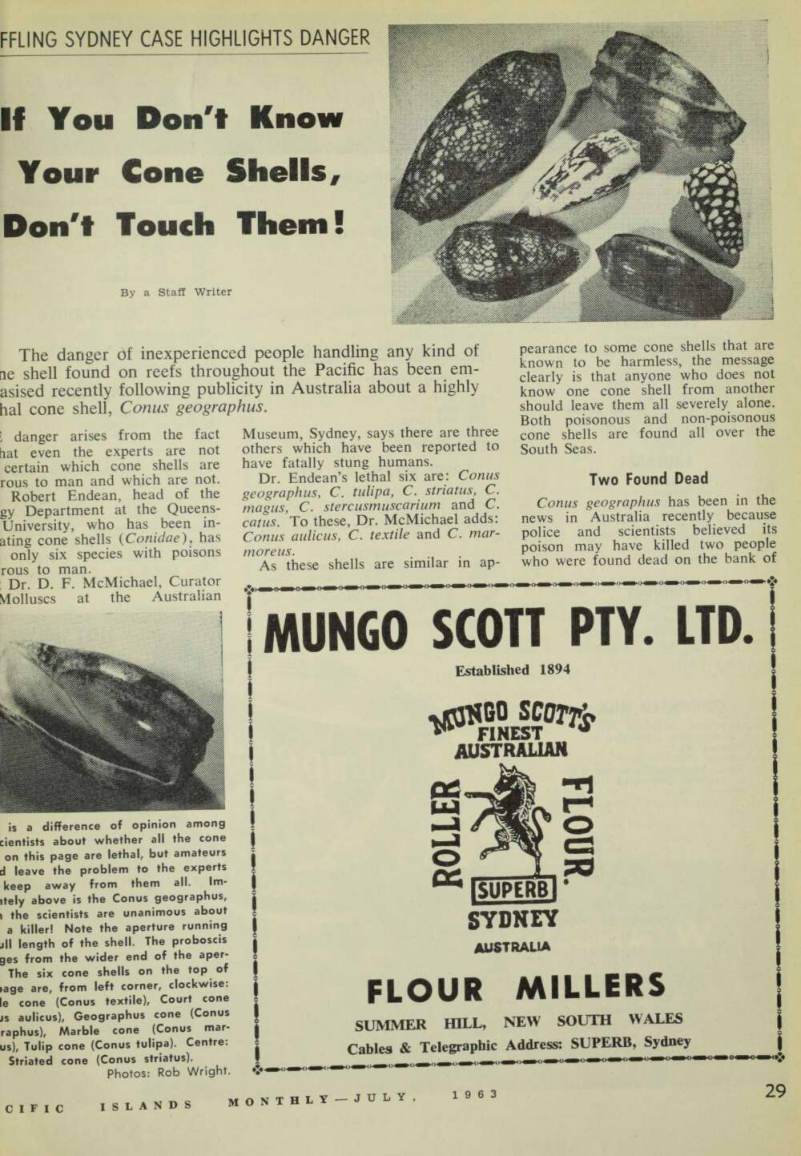
is a difference of opinion among cientists about whether all the cone on this page are lethal, but amateurs [?]d leave the problem to the experts keep away from them all. Im [?]tely above is the Conus geographus, [?] the scientists are unanimous about a killer! Note the aperture running [?]ll length of the shell. The proboscis [?]ges from the wider end of the aper- The six cone shells on the top of [?]age are, from left corner, clockwise: [?]le cone (Conus textile), Court cone [?]s aulicus), Geographus cone (Conus [?]raphus), Marble cone (Conus mar [?]us), Tulip cone (Conus tulipa). Centre: Striated cone (Conus striatus).
Photos: Rob Wright.
ane Cove River, Sydney, on •y 1. two people were Dr. Gilbert 38, a physicist, and Mrs. Mar- Chandler, 29, wife of a scientist, bodies were found a few hours ;hey had left a New Year’s Eve at a house less than a mile from me Cove River. Foul play was ted. jstigations by scientists revealed he two people had died soon leaving the party and that they Imost certainly been poisoned, o trace of a poison was found ir bodies. en the City Coroner, Mr. J. J. es, held an inquest into their ; in May, 50 witnesses gave ice over 14 days. The typed ice filled 590 foolscap pages and :d about 210,000 words. at the end of the inquest, Mr. es said he was no nearer estab y the cause of the two people’s > than he was when he started, hat they died “from unnatural > . is a baffling mystery,” he said, d that the two people died from circulatory failure. But as to ircumstances under which such atory failure was brought about, ddence adduced does not enable > say.”
Startling Development
out three weeks after Mr. ies announced his finding, there a startling new development in ogle-Chandler mystery when the jy police announced that the two e may have been killed by
n from Conus geographus.
e announcement said that the n could not be detected in post ;ms, that the poison killed in t an hour, and that it produced ly the same symptoms detected the bodies of Dr. Bogle and Chandler were found, is announcement followed a visit risbane by two Sydney detectives the director of the New South s Division of Forensic Science, John Laing, where they inter sd Dr. Endean who is seeking an lote to Conus geographus poison.
Laing brought back samples of joison to Sydney for testing, r. Endean, one of Australia’s lead experts on marine poisons, told ;e that Conus geographus poison :ed in a similar way to curare, South American poison, but tests not yet shown what the poison e said the poison was extremely erful, and that it was shot through
a tiny tube on the end of the shell.
A tiny drop, diluted thousands of times, could kill small animals within minutes.
Reporting Dr, Endean’s statements, Sydney newspapers said it was not known whether the poison of Conus geographus would cause death if taken orally.
Although it was announced on June 27 that tests on the poison had proved negative, the case served to underline the danger of the cones to the Australian public. PIM has warned against the shells for years, and in June Dr. Endean supplied PIM with details of his investigations that might be of further value
to people in the Pacific. He a!so asked for the co-operation of Islands residents in obtaining information about recent stingings caused by Conidae in the Pacific Ocean area, and in obtaining for him specimens of Conidae for his research work.
Dr. Endean told PIM: “Research on Conidae at the Uni versity of Queensland has followed several lines. First, it was necessary to ascertain which species of Conidae might be of danger to man.
“The American worker, Dr. A. J.
Kohn, has shown that the various species of Conidae appear to prey on worms, fish or other molluscs.
(Continued on p. 35)
xordingly, Miss C. Rudkin and f obtained the venoms from 40 species of Conidae and 1 these venoms on species of le worms, fish and molluscs, was found that the venoms of isc-eating cones (e.g., Conus e, Conus marmoreus ) will yse other molluscs, the venoms sh-eating Conidae will paralyse and the venoms of Conidae i prey on worms will paralyse is. urther, it was found that only enoms of fish-eating Conidae will yse mice and other vertibrates. is believed, therefore, that, of ipecies investigated, only Conus ' aphus , C. tulipa, C. striatus, C. is, C. stercusmuscarium and C. are of danger to man. [ext, the amount of venom from of these species required to kill was determined. It was found only minute amounts (micro s) of venom were required.
Paralysis
ien the symptoms resulting from njection of lethal and sub-lethal jnts of venom were studied. It found that the venom paralysed tal musculature (the muscular m) and that the prime cause of i in injected animals was paralysis ic muscles of the diaphragm, he diaphragm is the large circular :le separating the chest from the imen. Its most important tion is connected with breathing.] At. J. M. Whyte and myself studied the effects of the venom geographus on isolated phrenic e - diaphragm preparations. It ascertained that the venom acts :tly on muscle and not via nerve :le junction (as curare does), t was shown that artificial iration was effective in treating injected with lethal doses of im and it is believed that artificial iration (e.g. mouth to mouth) Id be an effective first aid sure in cases of severe stingings.
Providing that death does not ic, the paralysing action of the Dm wears off after one to three rs. , . .
Ehe possibility of using the Dm clinically as a muscle relaxant
.eing explored.
Research carried out by Mr. D. and myself is directed to ds elucidating the structure of the om apparatus and the histology sues) of the venom. Cells re nsible for venom production have n isolated and the granular nature the venom determined.
Further work is in progress on the mistry of the venom and it is ied to obtain, in a pure state, the ve fraction of the venom.
“I would be pleased to receive ac counts of recent cases of stingings from Conidae where the species of Conidae involved have been identified.
Also, if any of PlM’s readers could help me obtain specimens of C. geo graphies, C. tulipa, C. striatus, C. catus and C. magus, 1 would welcome hear ing from them.
“We require the specimens alive and accordingly they must be sent by air freight. We pay all freight charges and are willing to pay reason able prices for the specimens them selves. If readers of PIM can supply the required specimens of Conidae I shall endeavour to arrange the neces sary import permits after hearing from them.”
PIM has written to Dr. Endean about two cases of cone shell sting ings which have occurred in the Pacific recently. One concerned Conus geographus; the other Conus tulipa.
The Conus geographus case oc curred in Vila, New Hebrides, just before Christmas when a 23-year-old Vietnamese, Vu Nhu Ngos, who was fishing at night, put a Conus geo graphus inside his shirt.
On complaining of acute pains in his stomach soon afterwards, he was rushed to hospital where his condition rapidly deteriorated. But with treat ment, he improved, and within 24 hours he was on the way to recovery.
Tulip Cone
Rob Wright, of the Public Rela tions Office, Fiji, described the Conus tulipa stinging in an article in the quarterly South Pacific Bulletin for January. This case concerned Ron Pahl, a keen shell collector, who found a nest of seven tulip shells while on holidays in Samoa. Pahl, an Australian, is on the staff of the Seventh-day Adventist Fulton College at Tailevu, Fiji.
Although Pahl was aware of the danger of picking up tulip shells with out collecting equipment, he was so eager to gather them before they dis persed that he discarded caution.
One of them stung him on the hand, and his hand became as numb as if a local anaesthetic had been used. His whole arm was numb and his chest was constricted by the time he reached hospital half an hour or so later.
Doctors injected anti-histamme in the affected arm, followed by adrenalin in the other arm. The con striction in his chest vanished im mediately. But three months passed before he recovered full use of his arms, although even after six months he had a feeling of tightness m the muscles.