Tropicalities
pp. 27-30 · Read in the full issue
he British Crown Colony of Fiji has been having Is own morals problems lately, although with considerably o S s attendant publicity than the Profumo-Keeler affair i ack home. Scandal in high places in Fiji has xcited a great deal of comment, with most of the letails being bruited about in places of gossip.
lT have been published are he names of four Gov it officials who were given mtences on “charges involving icy”. One man has been gaoled months, another for 12 months o others for nine months, and lice don’t intend to let up on irive against local vice, even , as one senior police officer we’re getting to the stage when losing friends quickly”, e unfavourable comment has aused by the fact that one man las been associated with the f a high official, and whom the wished to interview, had earlier ibroad on a one-way ticket. re has been a disposition in Fiji the blame for all the scandal, ow, on the Government. But about as logical as blaming illan personally for the bedtime of former War Minister Pro- One feature of the Fiji cases t deserves credit; That is, the »s way in which the Fiji police, ; best colonial traditions, have about their job.
To Win Friends And
ence Bananas
:OMEDY-FARCE titled, “Yes, Ve Have No Bananas”, took the in NSW in June. Main actors from Suva and from the NSW coast banana growing areas.
ENE 1: Fiji’s new wide-awake iopment Commissioner, Mr. W. agers, inquires whether a market 'iji bananas could be established astralia. Colonial Sugar Refining pany, pursuing their policy of ng Fiji industries, assists the m at the Australian end.
TNE 2: NSW’s organised
na growers panic and demand of Parliamentarians that Fiji bana be kept out of Australia. They ;ct CSR of plans to handle the na trade and they are frightened
that Fiji bananas would jeopardise position of Australian growers.
SCENE 3: Suva businessmen hear that Australia is attempting to find a way into the New Zealand banana market, which has been traditional outlet for bananas from Fiji, Samoa and Tonga, and they are irate.
SCENE 4: NSW growers learn that CSR motor vessel Rona has gone into dock in Sydney. They say that she is about to be altered to carry banana cargoes to Australia. CSR re plies that Rona is merely going into dock for re-conditioning, as she has done regularly all her working life.
SCENE 5: Sydney Morning Herald, June 17, publishes letter from Mrs. Judy Tudor, joint editor of Pacific Islands Monthly, pointing out that Australia is supposed to let a nominal number of Fiji bananas into the country but that Australian growers have used every tactic over the years to keep them out. Australia sells Fiji goods worth more than £5 million each year, but buys from Fiji a little more than £1 million —and most of this is gold. Australians, as a result, know a banana only as a “dry and flavourless stick”. Australia has an agricultural bogy about “cheap black labour”, says Mrs.
Tudor, but the Fijian villagers con sider themselves neither cheap nor black. She adds; “Australia should do something to counteract its grow ing reputation among the small emer ging countries of the Pacific as a trading nation which wants to sell everything but buy nothing.
SCENE 6; Public debate. Some commentators insist that Fiji is en titled, on trade balance, to sell its produce to Australia. Others say a large, hard-pressed Australian in dustry must be protected gainst the cheap products of the Islands. NSW growers furiously defend the quality of their bananas, and demand that a tariff wall of 6d per pound be im posed. Somebody else writes to the
Herald proposing that Tongan bananas, as well as Fiji fruit, should be allowed into Australia. Further dialogue drowned in uproar.
End Of Act 1.
The Buka Building Up
For Trouble Again?
According to some New Guinea missionaries, the natives of Buka Island, Bougainville, whose rebellious activities caused so much trouble last year, are again working up to a stage of disorder.
Last year about 600 were actively involved, and most of the leaders were put in gaol. It is now calculated that at least 2,500 natives are in volved in new troubles.
A different set of leaders has taken control of the unruly community, and are trying to establish a new set of “laws”. They appear to have sep-
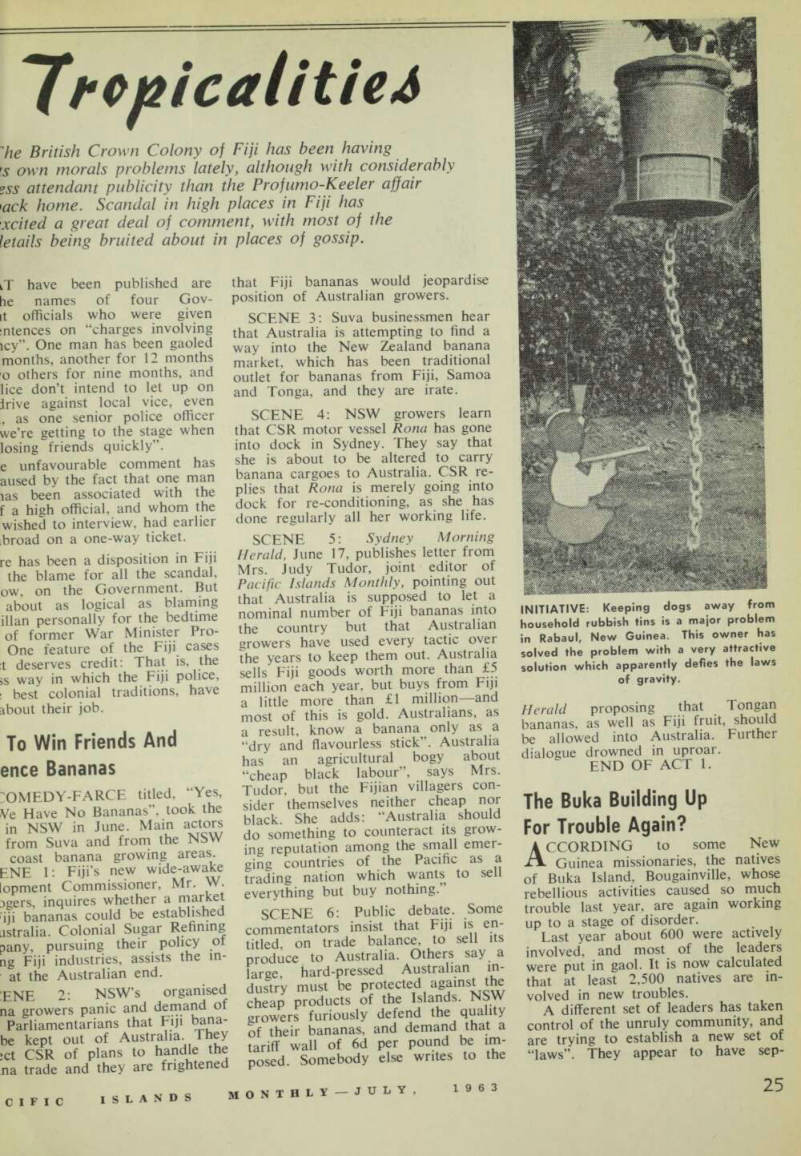
INITIATIVE: Keeping dogs away from household rubbish tins is a major problem in Rabaul, New Guinea. This owner has solved the problem with a very attractive solution which apparently defies the laws of gravity.
arated themselves from both the Methodist and Catholic communities controlled by the Missions, and their mam purpose seems to be the organ isation of a kind of Cargo Cult. They are reported to have established a breeding house, as was done last year, and a number of young girls already have been placed there.
The Missions, in May, reported that in their opinion these people have already made themselves liable to criminal prosecution, but that the Administration would not investigate.
The police did a good job 12 months ago in finding and gaoling the leaders and getting them out of the way; but some people think the Administration prematurely let these people out of gaol, and thus en couraged this further development.
Some of the Missions are very deeply concerned.
Masters Of The Rolls
A COLOSSAL task is being under . taken by the Administration offi cials in Papua and New Guinea in preparation of rolls for the election of the new House of Assembly next year, in which every person in the territory will be entitled to a vote.
The number of persons to be en rolled is, so far, anybody’s guess; but the figure generally accepted is in the neighbourhood of 600,000.
That gallant old work-horse, the corps of patrol officers of the Native Affairs Department, has been given the job of collecting the names and preparing the rolls. On June 5, the Director of Native Affairs, Mr. J. K McCarthy, assembled 44 patrol offi cers in Port Moresby, to instruct them and co-ordinate their work in the preparation of the rolls.
After the rolls have been written and gathered together, the further task of printing them will be under
taken. Contemplation of what volyed, it is reported, caused a panic in the Government Pr Office; and the Administratioi authorised the installation of ne\ special machines for the job.
The Foot mission in 1962 ma recommendation that parliame government, based on a commor be introduced in Papua and Guinea in 1964. What a pity tha little team of first-class theorists i not return for a while to the r tory to see the amount of tn and expense involved in carryini the idea!
The Peculiar Ways
Of Pacific Currency
fpHERE is a trap for unwary tr , lers in the currencies which culate in the French territory of Caledonia and the Condominiur New Hebrides.
In New Caledonia the Australi is readily interchangeable with P 2 francs, and it is easy to handle- Pacific francs equal 1/- Australi Pacific francs also circulate in New Hebrides, as does Austrs currency. Therefore, the trav. from New Caledonia to New I rides does not worry about his me —he reckons that the Pacific fran New Caledonia will be accepted v out question in New Hebrides.
That is not so. The franc issue* New Caledonia is marked in s« way which renders it undesirable the New Hebrides where the Fre Bank operating in New Hebrides a specially-marked New Hebr: Pacific franc of its own. The two not interchangeable, although app ently they are issued by the sa bank.
So the bemused traveller has hunt around in New Hebrides some other traveller who is prepan
See "Sport of Kings", opposi[?]
y for a consideration, to accept ew Caledonian francs, stralian money circulates easily ew Caledonia, New Hebrides, ions and New Guinea and there argument. is not very long since the travel ntering New Caledonia had to re the amount of money he ;d into the country, and disclose imount he was taking out with and God help him if the dif ee was, in the opinion of the Ex ge authority, not what it should That system apparently has now abolished; but the officials who •ol French exchange still have earned how to make friends and mce people. lother thing which distresses the ralian visitor to New Caledonia ic complacency with which the ch Consular authorities in Svd demand the sum of £l/2/11
Australian for affixing a visa to his passport. Apparently, there is some sort of armed neutrality between New Caledonia and Australia. A New Zea lander visiting New Caledonia re quires no visa, and is not charged any fee. But if a New Zealander is un wise enough to go to New Caledonia via Australia he is obliged to pay for the privilege!
They're Discriminating
Against NG Euronesians
THE extraordinary concern ex pressed by a section of the New Guinea Administration for native welfare is in sharp contrast with the indifference of Port Moresby’s top brass to the situation of the Terri tory’s numerous half-caste people (usually called Euronesians).
Again and again, appeals have been made to the Administration to aid the Euronesians by at least giving to them the Australian citizen ship status which has been granted to the New Guinea Chinese. As a result of official reticence there has been generated among the mixed race communities a resentment and bitterness which could provide a very ugly factor in the Territory’s political future.
Here is a typical example of the kind of thing of which officialdom is guilty: Some two years ago, a young Aus tralian man in the service of a non official organisation, serving a term of duty in Rabaul, met a very pretty girl of mixed blood. They fell m love, and decided to marry. A high official tried to persuade the Aus tralian against marrying the Euro nesian, but he failed. The couple married, very happily, and they now have a year-old son.
The Australian has tried repeatedly to get Australian naturalisation for his wife. He has submitted docu mentary evidence to show that her father was a British subject of mixed blood, resident in Singapore, and her mother was the daughter of a Scandinavian man and a New Britain woman. The mother’s family was of very good type, and highly respected in New Britain. The young wife was well educated —she got six “B” passes in examinations, and a scholarship entitling her to musical tuition. Her brother is an Australian citizen, well educated, and an officer in the RAAF.
This young Australian, in May, was
Sport of Kings
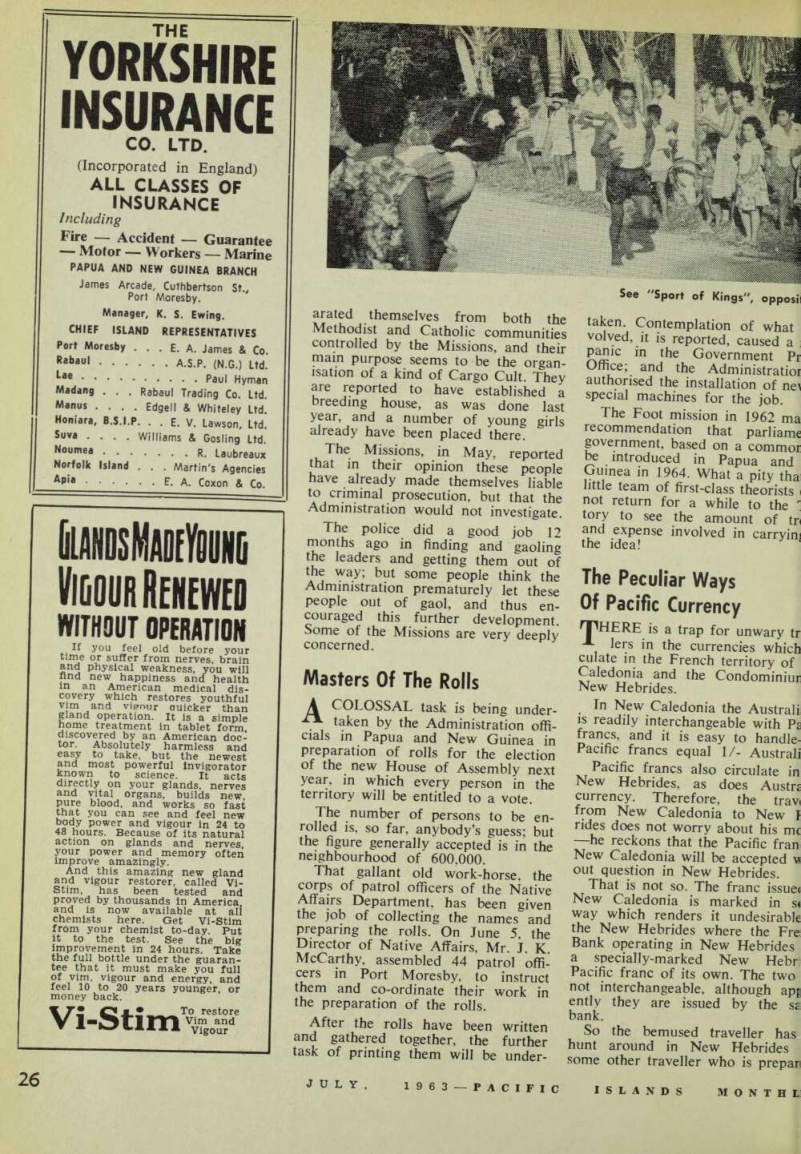
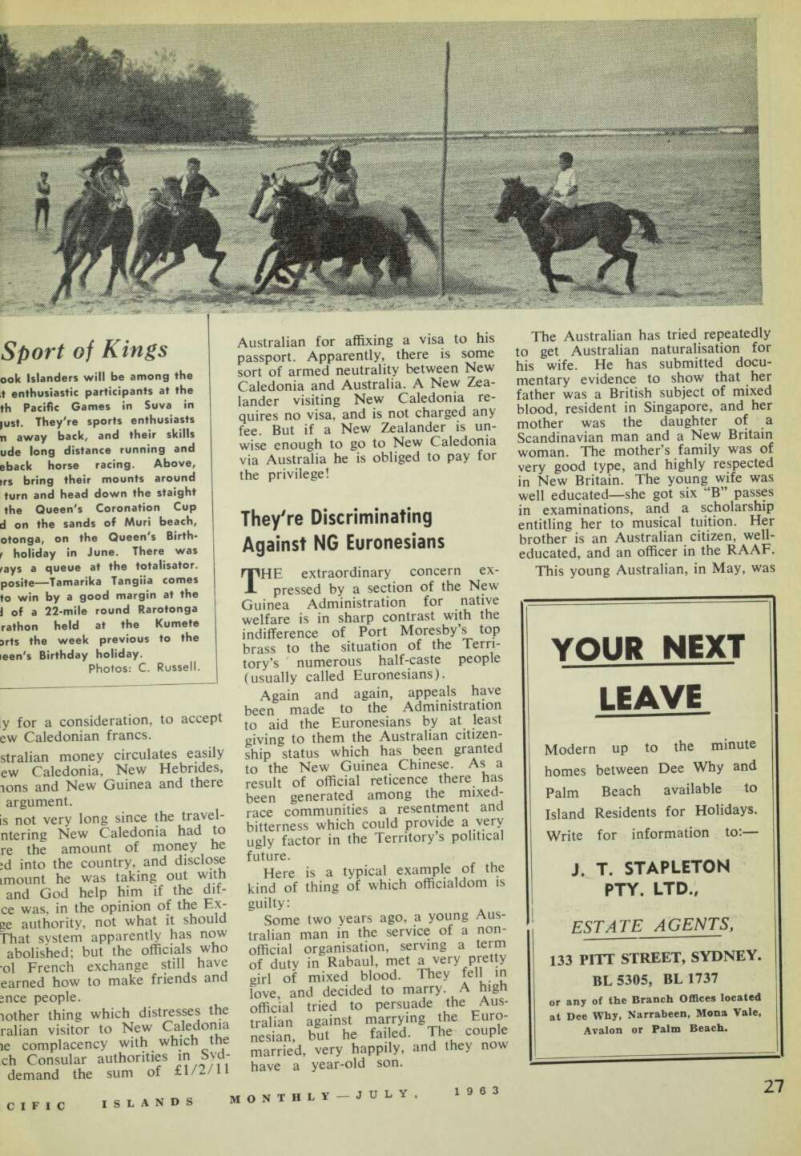
[?]ook Islanders will be among the [?]t enthusiastic participants at the [?]th Pacific Games in Suva in just. They're sports enthusiasts [?]n away back, and their skills [?]ude long distance running and [?]eback horse racing. Above, [?]irs bring their mounts around turn and head down the staight the Queen's Coronation Cup [?]d on the sands of Muri beach, [?]otonga, on the Queen's Birth [?] holiday in June. There was rays a queue at the totalisator. posite —Tamarika Tangiia comes to win by a good margin at the [?] of a 22-mile round Rarotonga rathon held at the Kumete [?]rts the week previous to the [?]een's Birthday holiday.
Photos: C. Russell.
about to go on long leave. His ap plication for naturalisation for his wife, although lodged months before was still unanswered. Unless it was granted, he would proceed to Aus tralia with his papers showing him and his small son as “Australian citizens , and his wife as “NGAPP” (which means New Guinea Australian Protected Person).
This is no isolated case, A Rabaul man asks: “Why does this Administration, which is going to such remarkable lengths to discourage ‘discrimination’ against natives adopt this policy of heaping reproach and humiliation upon per sons of part native blood?”
The New Guinea Rock
fpHE recent challenges to New , Guinea land titles (see p. 19 and June, p. n, for the details) has cer tainly rocked many New Guinea people. Some property owners have gone to the extreme of viewing all Administration moves about land with the deepest suspicion, for they believe the Administration is de liberately devaluing land and coconut palms for the time when political changes mean that European planters have to be compensated for properties that will be transferred to native ownership.
“How Port Moresby manages to fit this m with their howls about ‘maxi mum opportunities and security for investors is something that we have not been able to work out,” one Rabaul landholder told us the other day.
He said anyone interested should make a comparison between recent Administration records and the re cords of the Expropriation Board, and asserted that the Expro Board in one place shows the valuation of a seven-years-old cocoa tree at 19/4,
whereas the Administration no’ valuing the same asset at 11/-.
Of course, it may be one of bogies thought up by Rabaul r mists wherewith to scare holders. Again, there could be en< smoke about the report to give picion that somewhere is a real But the real point is that nowa no one seems to trust the NG ministration when it comes to a ] ter of native rights as against E pean rights.
Postcript : For what it’s wc when the ABC decided to men its staff in Rabaul, and let it known that it might require twe three more houses, no less than residences were offered within a days. The prices quoted gener were on the low side, and there a grim note of urgency about s< of the communications.
Art (Abstract and Otherwii
In New Hebrides
TN a hall off Vila’s main street, New Hebrides, in May, found a “Polynesian Collectio presided over by a courteous i enthusiastic Mr. de N. Midi touchkine. There were some teresting artifacts, mainly from Wallis and Futuna islands; but backbone of his collection was assembly of abstract paintings.
Having inspected them with sn able horror—and hurt the feelii of the kindly director by describi one of them as an impression of over-coloured octopus having a —we were comforted to find alor side an exhibition of Captain Br Hilder’s paintings. New Hebridea seemed to be taking a practical j terest in the fact that most of the or 40 products of the BP navigatoi tireless brush were for sale.
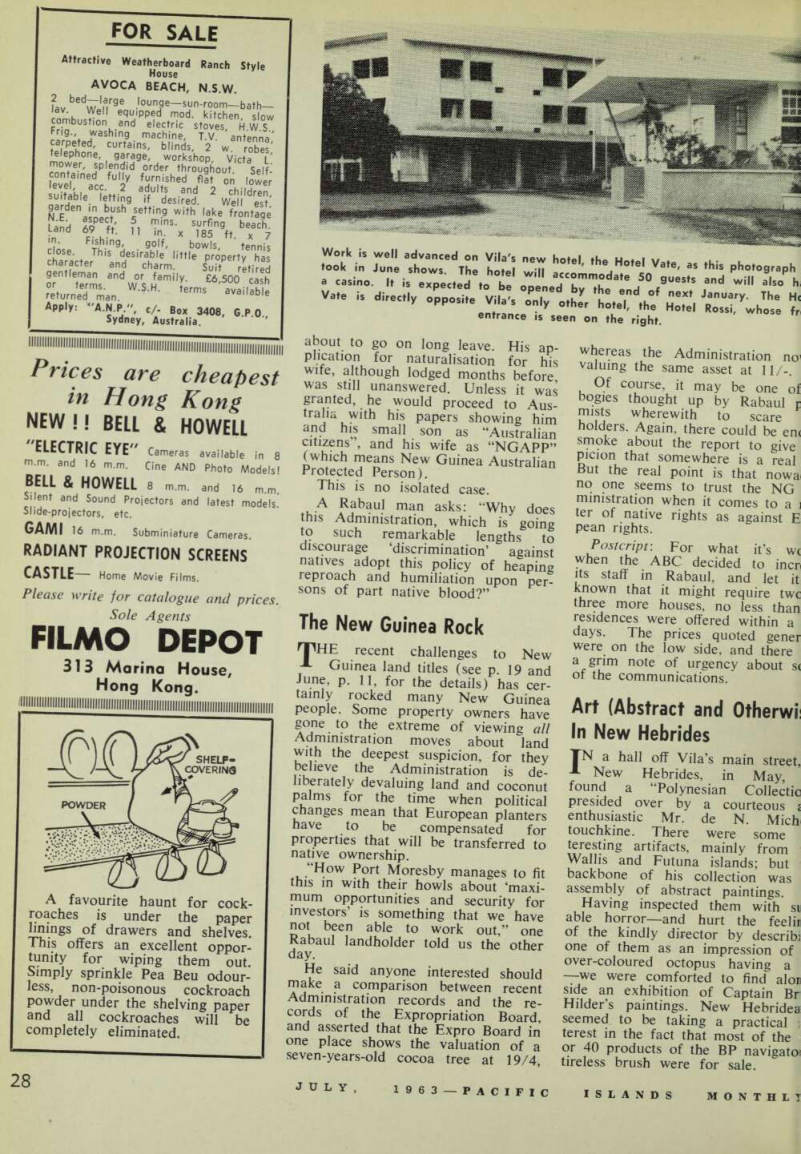
took* in jTnVs d h V ows Ced Ihe hotel will 35 pho, °9 ra P h a casino. It is expected to be ooenod k *u ate 50 guests and will also h, va.e „ - H. entrance is seen on the right.