New Guinea's New House Of Assembly
p. 17 · Read in the full issue
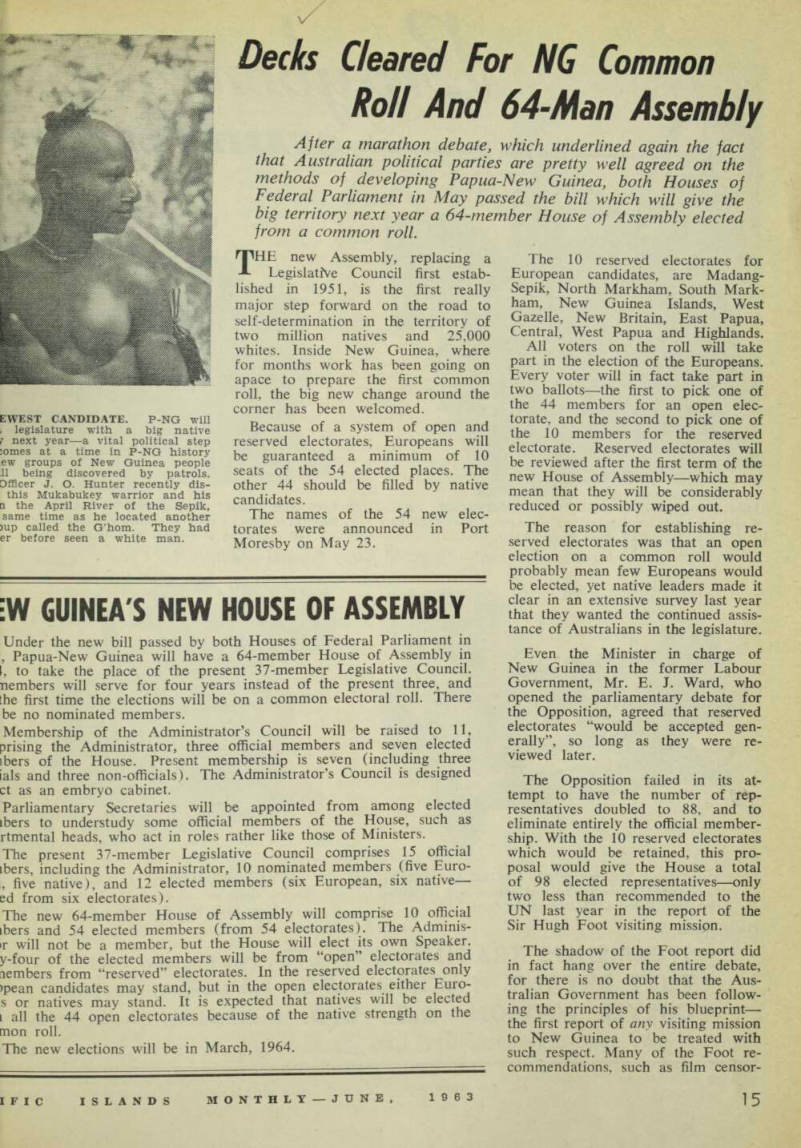
Under the new bill passed by both Houses of Federal Parliament in , Papua-New Guinea will have a 64-member House of Assembly in [, to take the place of the present 37-member Legislative Council, nembers will serve for four years instead of the present three, and the first time the elections will be on a common electoral roll. There be no nominated members.
Membership of the Administrator’s Council will be raised to 11, prising the Administrator, three official members and seven elected ibers of the House. Present membership is seven (including three ials and three non-officials). The Administrator’s Council is designed ct as an embryo cabinet.
Parliamentary Secretaries will be appointed from among elected ibers to understudy some official members of the House, such as rtmental heads, who act in roles rather like those of Ministers.
The present 37-member Legislative Council comprises 15 official ibers, including the Administrator, 10 nominated members (five Euro , five native), and 12 elected members (six European, six native— ed from six electorates).
The new 64-member House of Assembly will comprise 10 official ibers and 54 elected members (from 54 electorates). The Adminis >r will not be a member, but the House will elect its own Speaker, y-four of the elected members will be from “open” electorates and nembers from “reserved” electorates. In the reserved electorates only )pean candidates may stand, but in the open electorates either Euro s or natives may stand. It is expected that natives will be elected i all the 44 open electorates because of the native strength on the tnon roll.
The new elections will be in March, 1964.