Roll And 64-Man Assembly
pp. 17-19 · Read in the full issue
Decks Cleared For NG Common Roll And 64-Man Assembly
After a marathon debate, which underlined again the fact that Australian political parties are pretty well agreed on the methods of developing Papua-New Guinea, both Houses of Federal Parliament in May passed the bill which will give the big territory next year a 64-member House of Assembly elected from a common roll.
THE new Assembly, replacing a Legislative Council first estab lished in 1951, is the first really major step forward on the road to self-determination in the territory of two million natives and 25,000 whites. Inside New Guinea, where for months work has been going on apace to prepare the first common roll, the big new change around the corner has been welcomed.
Because of a system of open and reserved electorates, Europeans will be guaranteed a minimum of 10 seats of the 54 elected places. The other 44 should be filled by native candidates.
The names of the 54 new elec torates were announced in Port Moresby on May 23.
The 10 reserved electorates for European candidates, are Madang- Sepik, North Markham, South Mark ham, New Guinea Islands, West Gazelle, New Britain, East Papua, Central, West Papua and Highlands.
All voters on the roll will take part in the election of the Europeans.
Every voter will in fact take part in two ballots—the first to pick one of the 44 members for an open elec torate, and the second to pick one of the 10 members for the reserved electorate. Reserved electorates will be reviewed after the first term of the new House of Assembly—which may mean that they will be considerably reduced or possibly wiped out.
The reason for establishing re served electorates was that an open election on a common roll would probably mean few Europeans would be elected, yet native leaders made it clear in an extensive survey last year that they wanted the continued assis tance of Australians in the legislature.
Even the Minister in charge of New Guinea in the former Labour Government, Mr. E. J. Ward, who opened the parliamentary debate for the Opposition, agreed that reserved electorates “would be accepted gen erally”, so long as they were re viewed later.
The Opposition failed in its at tempt to have the number of rep resentatives doubled to 88, and to eliminate entirely the official member ship. With the 10 reserved electorates which would be retained, this pro posal would give the House a total of 98 elected representatives—only two less than recommended to the UN last year in the report of the Sir Hugh Foot visiting mission.
The shadow of the Foot report did in fact hang over the entire debate, for there is no doubt that the Aus tralian Government has been follow ing the principles of his blueprint— the first report of any visiting mission to New Guinea to be treated with such respect. Many of the Foot re commendations, such as film censor
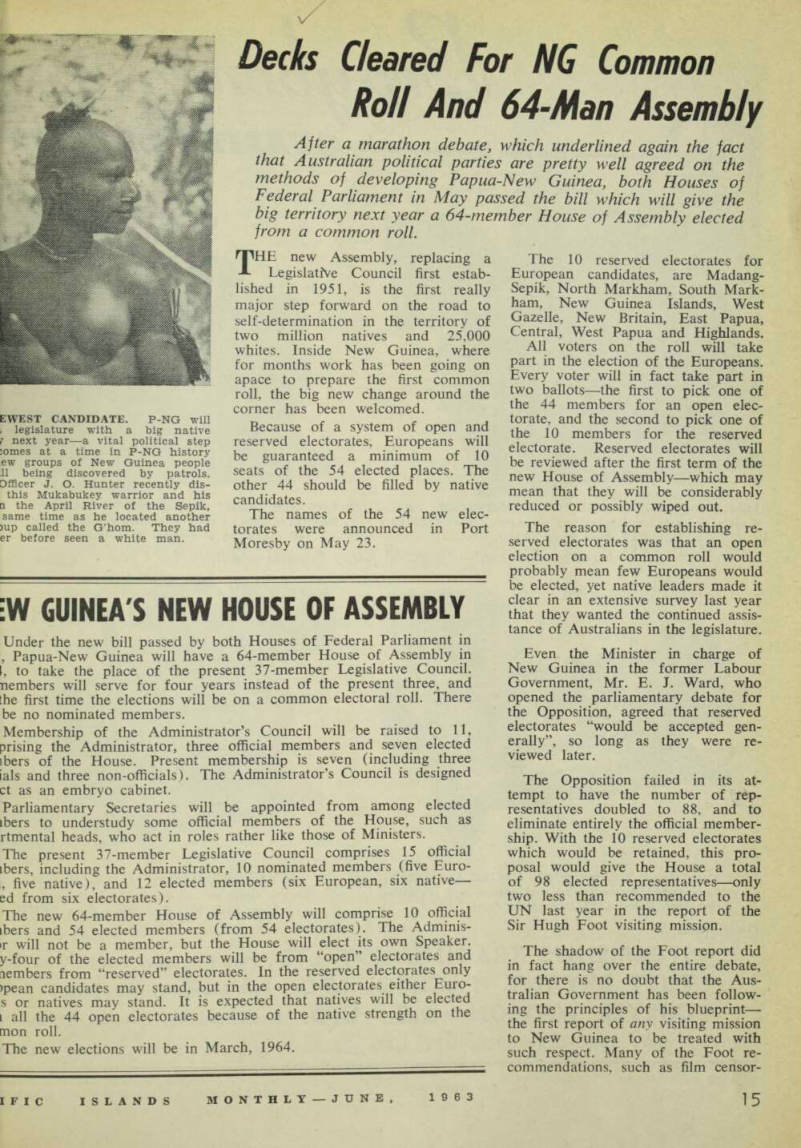
[?] Ewest Candidate. P-Ng Will
[?] . legislature with a big native [?] next year—a vital political step [?]comes at a time in P-NG history [?] ew groups of New Guinea people [?]ll being discovered by patrols.
Officer J. O. Hunter recently dis [?]this Mukabukey warrior and his [?] the April River of the Sepik, [?] same time as he located another [?]up called the G’hom. They had [?] er before seen a white man.
md liquor for natives, were put practice last year, there was one weakness in the ntion’s arguments it was in the hat a number of members re- Uy adopted the attitude that 5 man” was a dirty phrase and 10 white man could be living w Guinea for any purpose but >loit the natives.
Minister for Territories, Mr. :k, replied to these attacks in ited defence of Territorians, of ensity not before seen in the er when speaking on this sub- Ir. Hasluck has at times in the iven the impression that he is ach interested in the welfare of juinea whites. this occasion he told the House any white inhabitants had dedi themselves to the advancement ; natives; many of those in >s there were just as devoted Administration in this task. at we have to ensure,” he said, at reform is something with the white inhabitant of the ry will also work with enthu and with the same devotion as past. We do not want the sort ation which has been so tragi amiliar in some of the African . . . We are getting political ement in New Guinea without ash of race.”
Hasluck added that in the Ter
ritory there were Australians who were Territorians in a true sense.
“Their grandfathers went there and their fathers went there and they themselves were born there and the Territory is their home,” he said. “It is the place in which they have the whole of their possessions and the whole of their future interests, the place to which they have dedicated their lives and to which they want to dedicate the lives of their children.
“We cannot just disregard this and say we are going to betray these people, ot ignore them.
“They, too, are inhabitants of the Territory and when we think of the term “inhabitants of the Territory” we have to think not only of the vast majority of the indigenous people but also of that minority of the inhabi tants who have their own legitimate rights and interests there and whose record is by no means shameful but is rather an honourable one that de serves some consideration on our part.”
Mr. Hasluck said that the Austra lian Government was not planning withdrawal from NG “by 1970 or any other date” and had not sanc tioned any planning to that end. He said the Government was aware there would be increasing international pressure for self-determination in New Guinea, and that there would be changes year by year within the Territory itself.
However, the “end of a journey is not onlv a matter of going faster but of arriving safely . . .” he said. “We are not working just to come to an end in New Guinea. We are working to reach an end that will be good for the inhabitants of the Territory and will not damage Australia’s legitimate rights and interests.”
That was the nearest thing to a pledge given by the Minister in in troducing the bill, although unfor tunately, as many New Guinea people noted, it did not adequately dispose of the UN General Assembly resolution No. 1514, of December 14, 1960, which reads: “Immediate steps will be taken in trust and non-self-governing terri tories, or in all other territories which have not yet attained independence, to transfer all powers to the peoples of these territories, without any con ditions whatever. Inadequacy of poli tical, economic, social or educational preparedness should never serve as a pretext for delaying independence.”
Exactly what the Australian Gov ernment would do if the new House of Assembly, with its big native majority, decided in a year or two to ask for self-determination, is a billion dollar question.