arty English Missionaries
p. 119 · Read in the full issue
Honoured At Lifou Centenary
• Fred Dunn's New Caledonia Round-Up
About 1,000 people took part in ceremonies to mark the centenary of the Pastoral School of Bethanie, at Chepenehe, Lifou Island, in New Calendonia’s Loyalty Group on Sunday, March 10.
MONG those who attended were k Pastor Peteru Ihily, president of native Protestant church; Pastor bert Murray, of the Presbyterian urch in the New Hebrides; and iresentatives from surrounding is ds.
Bethanie is a school for the train of native Protestant missionary itors. It was opened in 1862 by nuel MacFarlane, a Methodist mis nary from Manchester, England.
VlacFarlane and his wife, formerly sabeth Ursula Joyce, taught at the tool until 1867 when they left ou after a dispute with the French ivernment. In 1866, MacFarlane npleted a Lifouan translation of New Testament.
Some time after the MacFarlanes jarture, the Bethanie School—like er schools started by British mis naries in the Loyalty Islands—was en over by French Protestant mis ns.
Fhese schools date back to the time the famous LMS missionary John lliams, who, in 1839, left Samoa the brig Camden with a number Samoan teachers to spread ristianity throughout the south st Pacific.
Missionaries Landed Williams was killed when he ded at Erromanga, New Hebrides, ; the Camden went on and landed Samoan teachers at the Isle of ics, the Loyalties, and the Bay of Vincent on the west coast of New ledonia.
Phe first church on Lifou was built a Samoan called Fao at Ahrare d, near Mou, on the island’s ithern coast. English missionaries ne later.
Hostility developed between the iverts of the English missionaries 1 those of French missionaries who »an work in the Loyalties in 1868. en, in 1884. a decree was promul ;ed making the teaching of French npulsory at all schools established the Group.
Phis resulted in the English mis
sionaries being forced out of the Group, and it is on record that when they passed through Noumea, they were sneered at as “English Tar tuffes.”
Even so, Lifou, and the other Loyalty Islands still retain a good deal of the influence of the English missionaries—the game of cricket, plum puddings, jam tarts and many English words.
Until World War 11, the natives spoke almost as much English as French, and the French authorities did not look on this with a very friendly eye. However, with the ad vent of compulsory schooling, the French language has become more or less universal. But the survival of English words in the natives’ vocabu laries is a point of great fascination to visitors.
Members of a Vietnamese Associa tion in New Caledonia have written an open letter to the French authori ties demanding immediate repatriation to North (Communist) Vietnam.
The letter pointed out that Mr.
Rock Pidjot, Vice-President of New Caledonia’s Government Council, had stated on his return from Paris some weeks ago that repatriation of the Vietnamese might be resumed “in the near future” (PIM, Feb. p. 135).
The letter called on the French authorities to honour their promises, given some years ago, that the Viets would be repatriated. ❖ * * A noted ornithologist, Mr. Etche par, of the Paris MuseunT of Natural History, spent several days in New Caledonia recently, en route to In donesia and Malaya, where he will advise on measures to protect bird life.
During his stay, Mr. Etchepar urged that every effort should be made to protect New Caledonia’s flightless bird, the cagou, which is also the country’s emblem. He said resen es should be created so it could breed in security.
At present, the cagou is in danger
of extinction. One of its greatest enemies is the domestic dog gone wild. Apart from its running speed, the cagou has no means of defence.
Shimura Kako, a Japanese nickel smelting firm with plants in Tokio and Osaka, has entered into a long term contract with Noumea’s Societe le Nickel. It will soon take delivery of some 480 tons of refined nickel, followed by another 1,000 tons in September. $ $ $ As a result of public indignation, the New Caledonian Government has lifted its recent ban on the importa tion of all foreign fruits except apples ( PIM, March, p. 130).
However, there is a catch in the lifting of the ban, as only apples may be imported by ship. All other fruits must come by air.
This, of course, means that only limited quantities of fruit other than apples can be imported and these fruits will be very expensive. The Government’s decision seems to say, in effect: “If the public wants fruit, let them pay for it.” sf! sfs One hundred young men, called up to do their military service this year, have volunteered to do their “time” in Metropolitan France. Two-thirds of the conscripts are Melanesians.
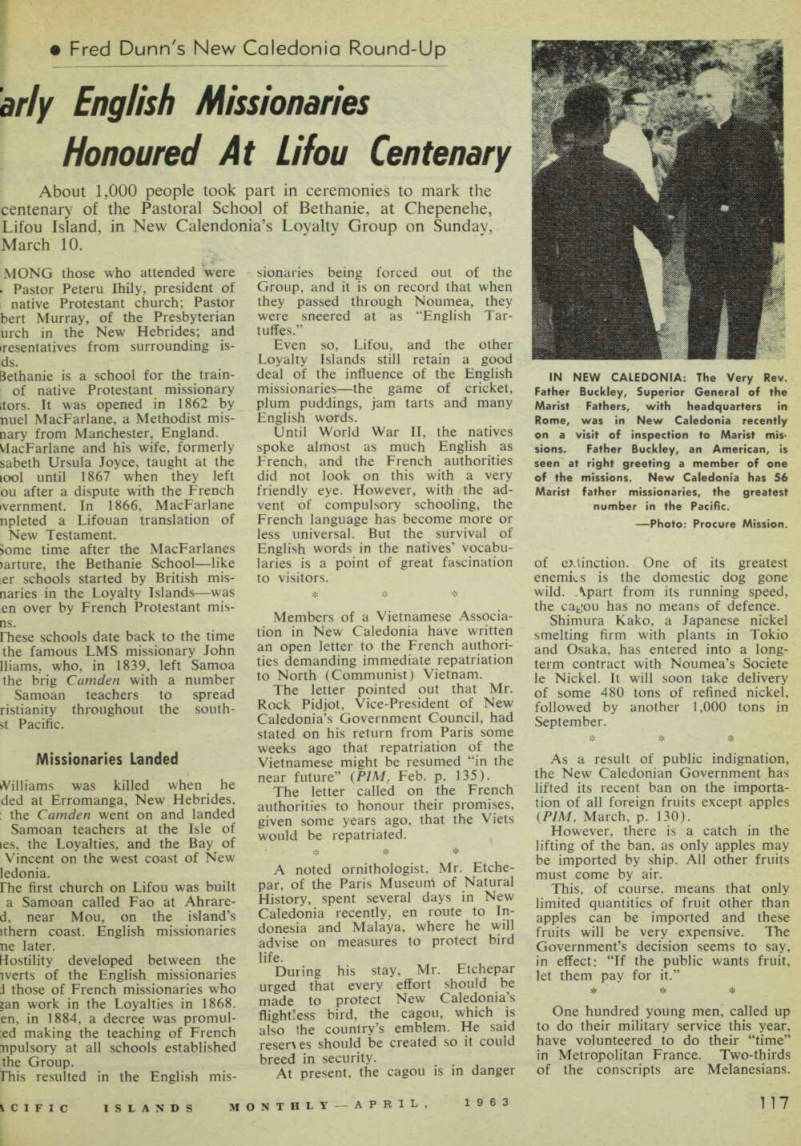
In New Caledonia: The Very Rev.
Father Buckley, Superior General of the Marist Fathers, with headquarters in Rome, was in New Caledonia recently on a visit of inspection to Marist mis sions. Father Buckley, an American, is seen at right greeting a member of one of the missions. New Caledonia has 56 Marist father missionaries, the greatest number in the Pacific.
Photo: Procure Mission.