Cruising Yachts
pp. 101-116 · Read in the full issue
Pacific Shipping And
The MV Matua was hove to in a hurricane for nearly 12 hours on Wednesday, March 13, during a voyage from Suva to Nukualofa. The hurricane forced the ship to make for Apia, which she reached on March 15.
[ER skipper, Captain P. Bennett, said in Apia it was the worst storm ; had ever experienced and that : had never known such low sibility. Between 9 and 11 p.m. (thing could be seen but spray lipping horizontally through the air. ic ship was hove to from 6 a.m. 2 p.m.
The Matua encountered the hurri ne near the island of Tofua in the )nga Group, where the Bounty utineers cast Captain Bligh adrift 1789. The maximum speed of e wind was estimated at 90 knots, e wave height at 45 ft and the ip’s roll at 35 degrees. Barometer adings fell to 28.5 degrees.
The wind blew the awning off e starboard bridge and poop decks id the waves stove in the steel ilwarks and twisted and broke the ;el railings and ladders. All deck rgo was washed overboard.
The Matua was carrying 63 saloon issengers and 25 deck passengers, le saloon passengers were confined their cabins during the worst of
the storm, and the deck passengers were transferred to the music room.
Neither the crew nor passengers suffered major injuries.
• Commercial Fishing
OFF DARU ISLAND: Administra tion Papuan and New Guinean fisheries trainees and workers helped to catch the first commercial load of fish delivered by sea from Daru re cently.
The fish were caught on a com mercial fishing trip organised by Mr.
D. Pederson. Previously commercial consignments of fish have been delivered by air from Daru.
The fisheries trainees are working with Mr. Pederson to gain practical experience in commercial fishing.
Mr, Pederson, in his own ship Mercia and using Administration nets, made test hauls in creeks and other fishing grounds where nets had not previously been used. During about five days of fishing, the men caught 3,500 lb of fish, mostly barramundi. They fished off Daru Island, at the mouth of the Oriomo
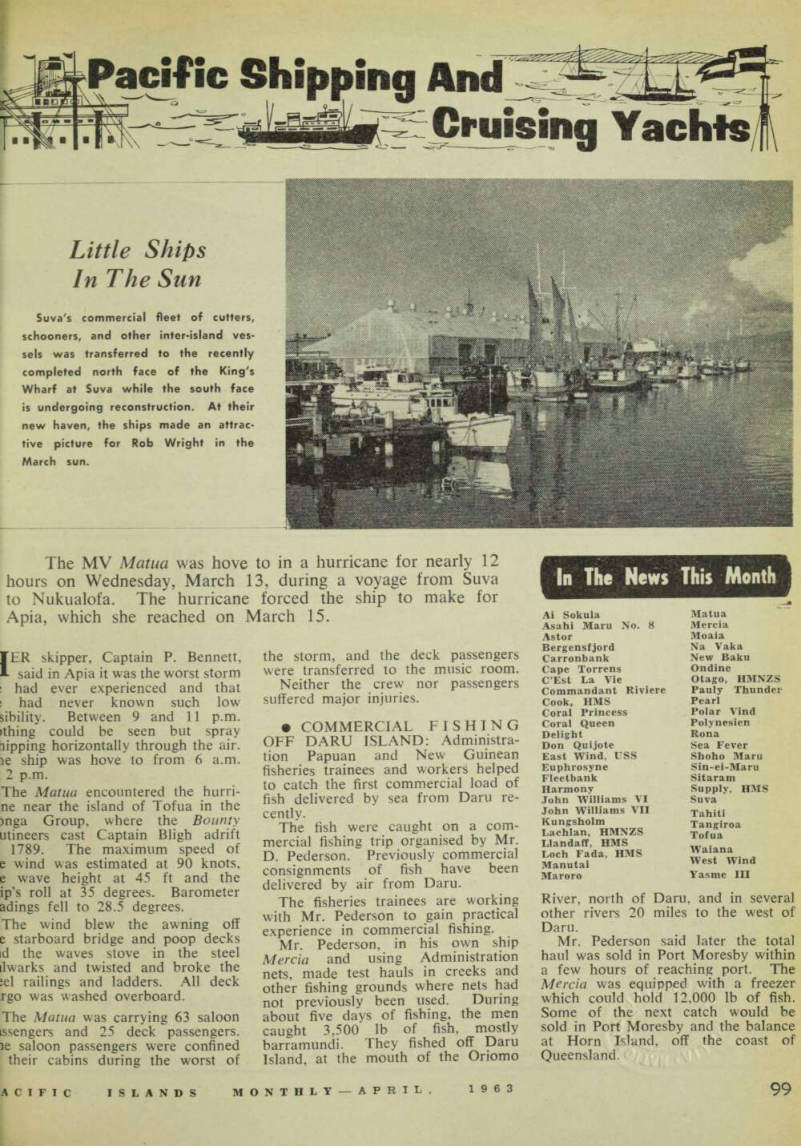
Little Ships
In The Sun
Suva's commercial fleet of cutters, schooners, and other inter-island ves sels was transferred to the recently completed north face of the King's Wharf at Suva while the south face is undergoing reconstruction. At their new haven, the ships made an attrac tive picture for Rob Wright in the March sun.
• Britain’S Oil Tanker
LEAD; The British tanker fleet has regained its place as the largest in the world. In the second half of last year it increased by 620,000 tons to 11.162,794 tons.
The world tanker fleet stood at 3,321 ships, of 70,352,697 tons, at December 31 last—a rise of 4.8 per cent, for 1962.
• Visit To Norfolk
ISLAND; The Royal New Zealand auxiliary Tui revisited Norfolk Island in March. The ship, commanded by Lt.-Commander Harrison, carries seven other offices, crew of 16 and four scientists. She is engaged on oceanographic surveys between New Zealand and Norfolk Island.
The Tui visited Norfolk Island in luly last year and collected marine and biological specimens from the surrounding waters.
• Coaster Turns Up
SAFELY. The 40ft. coastal vessel Delight, which was overdue for sev eral days early in March on a voyage From Mussau Island, in the St. Mat- Lias Group, to Kavieng, New Ire land, turned up safely at Emirau Island on March 5. Delight was apparently adrift for some time, but temporary repairs enabled her to reach Emirau. An air and sea search For the ship had begun when the Delight turned up.
• Kieta Wharf Progress.
Work on the new wharf at Kieta, Bougainville, BSIP, i s progressing satisfactorily, according to Mr. C. W, Crouch, construction manager of the P-NG Department of Works and Housing, who visited Kieta recently.
Mr. Crouch said that a large amount of earth, forming a head land, had been blasted away. The earth had been pushed into the sea to form earthworks for the new wharf.
He said a copra shed and two other large steel sheds would be erected on the built-up area. Piles would be driven in at the end of the earthworks to form a T-shaped wharf.
• Ship Overloaded: The
owner of a Malaita cutter-boat New Baku was convicted in the Central District Magistrate’s Court in March on a charge of carrying 41 persons when the vessel’s certificate of sea worthiness limited the permissible number to 10.
The owner, who is also the bosun, said that after a conversation with a BSIP Marine Department officer last year, he thought he could carry 25 passengers and five crew, and he thought his licence would be issued on those terms. He said he got his
new certificate of seaworthiness in January but nobody had explained it to him.
The 41 passengers were carried on a night voyage from Makwanu to Honiara. Mr. J. L. Bergelin con victed the accused and ordered him to pay a fine of £lO.
• Deep-Water Berth For
HONIARA: It looks as if Honiara is going to get its deep-water berth at last. The High Commissioner for the Western Pacific, Sir David Trench, said at the February sittings of the BSIP Legislative Council that
all obstacles to the Port Authority’s wharf scheme had been overcome and the Government had given un qualified approval to proposals for the construction of a deep-water berth at Honiara.
The estimated cost of the projecl is about £170,000, and funds will come partly from the Ports Authority and partly from a loan from the Commonwealth Savings Banks. The berth will allow the largest ships visiting the BSIP to discharge cargc alongside, and will mean a quicker turn-around than is possible with the present lighterage system.
• Voyage In Own
JAWLER: Harmony, a 58 ft [wler, reached Auckland at the end ’February after a si-month voyage England. The master, Mr. Bill rris, of Northcote, New Zealand, ught the trawler during a trip to igland last year because he “wanted make a voyage in a small boat”, s crew of 10 included his son [I, who celebrated his 14th birth y at sea. The trawler called at ain, the Canary Islands, the West lies, Trinidad, Panama, and the ilapagos, Marquesas and Society oups. The passage from the ciety Islands took 12 days.
• Back To Survey: The
yal Navy survey ship, HMS Cook, nt back to her survey of Bligh iter early in March after Royal ir duties in New Zealand. The ok took part in the centennial emonies at Waitangi, in the Bay Islands, on February 6, the day ! Queen arrived there, and then nt on to Auckland to take on )plies. f\fter her Bligh Water survey she s due to leave for Auckland in ril to give the crew a fortnight’s ve, and then return to Fiji.
• Warship At Moresby:
brief visitor to Port Moresby in bruary was HMS Llandaff, based Singapore, which had been detailed standby duty during the Queen’s ht over the Pacific. She is a thedral - class aircraft - direction *ate, and, with HMNZS Otago, s responsible for monitoring the yal flight between Honolulu and di. fhe Llandaff is capable of operat offensively in anti-submarine and ivoy escort roles. She was launched 1956 and has a displacement of 00 tons. She is 340 ft long, has
a 40 ft beam, and a complement of 15 officers and 210 men. In her armament are a three-barrelled anti submarine mortar, a twin 4.5 in. gun forward, and a twin 40 mm. gun aft.
©Copra For South
AMERICA: A modern Norwegian ship Polar Vind arrived at Santo on March 1 to load 2,000 tons of copra for South America. The loading of the cargo was impeded by bad weather, which was general through out the New Hebrides during the first week-end of March.
• New Look Tourists: The
Union Steam Ship Company has found the pattern of tourist traffic changing, according to the company’s acting manager, Mr. E. R. Horn.
The change has been brought about by the introduction of duty free shopping for a limited range of items in Fiji.
Mr. Horn, whose company’s ships, Tofua and Matua, call regularly in Fiji, Tonga and Samoa, said recently that at Suva tourists went shopping instead of sightseeing. But at Nukualofa, for example, more than two-thirds of the passengers went sightseeing.
• Suva Visitors: Hms Loch
Fada, a Royal Navy frigate, and the USS East Wind, an American ice breaker, visited Suva in March.
Officialdom was quiet about the purpose of the Loch Fada’s visit, but the inference was that she would be one of the safety patrol ships during the return flight to London of the Queen and the Duke of Edinburgh.
The East Wind, which has a complement of 15 officers and 190 enlisted men, was on her way back to the United States from duty in the Antarctic.
• Sold For Scrap: The
4,873-gross ton ship Suva, which was well known in South Pacific waters, will be delivered to a Hongkong
Big Timber Cargo;
The "Sin-ei Maru" recently called at Rabaul with the big gest consignment of timber to leave New Britain for Japan— 1,448,000 super feet of mixed New Guinea timbers from the Talasea area. A few days later the "Shoho Maru" took another 1,000,000 super feet. This ship is from Nitto Line, which will call regu larly at Rabaul.
And Now Up For Sale!
The Japanese fishing ship "Asahi Maru No. 8", which was refloated from a reef near Sigatoka, Fiji, on February 25 is now up for sale and has already brought inquiries from potential buyers. The ship was abandoned by her former owners and was bought by former hotel entrepreneur, Mr. Barry Philp, and a PWD engineer, Mr. Graham Dewes, for £1,600. It took them more than a year to refloat her. Salvage operations started about nine months before their efforts were successful.
Photo; L. J. Wilkinson.
ihipbreaker’s yard in April or May ; or breaking up. The ship has been icld to a Hongkong scrap firm and s reported to have realised £l3/12/i ton on her light displacement, rhe Suva, which was owned by >acific Shipowners Ltd., was built at Junderland, England, in 1938. Pacific Jhipowners own two other ships, the r ,459-ton Lakemba and 400-ton ii Sokula (see this page for further eference to the latter).
• Young Stowaway: When
he CSR ship, Rona, arrived at Suva m her March voyage she had on >oard a 15-year-old boy who had towed away at Sydney. He hid in i lifeboat until the Rona was about (0 hours out of Sydney, and was hen discovered walking along the leek.
In the lifeboat were an air rifle, icveral sheath knives, a map of the South Pacific, and a piece of luncheon ;ausage.
The boy had to work for the re minder of the voyage, and while he Rona was in port he was con ined to his cabin.
• Award For Com
MISSIONER: The Royal Australian Mavy recently awarded its Volunteer Reserve Decoration to the Resident Commissioner in the Gilbert and Cilice Islands Colony, Mr. V. J.
Midersen.
• Luxury Cruise: The
Sergensfjord, a luxury cruise liner, vhich called at Suva recently, was he second visitor of its kind within i month “laden with American nillionaires”. The Bergensfjord was Dn a three-month cruise of the Caribbean, Pacific and the Far East jorts. She arrived at Suva from Mew Caledonia, and then sailed for Fonga. Suva duty-free traders were lisappointed with the visitors. Instead Df buying cameras and radios, they seemed more interested in curios.
File first luxury liner with American ;ourists was the Kungsholm. Each iner had previously made Pacific :ruises.
• On Solomons Reef: It Was
reported from Honiara in March that the ship Cape Torrens had gone aground on a reef on the eastern side of Manaoba Island, at the north eastern tip of Malaita, BSIP, early an February 28.
The ship was abandoned after the Coral Princess had made five attempts to refloat her.
• Ai Sokula Strands: The
inter-island trader, Ai Sokula, ran on a reef between Nasautabu Passage and Mubulau Island about 2 a.m. on March 10 while on a voyage from Savusavu to Suva. She was refloated about two hours later under her own steam, and reached Suva about 7i hours later.
She was carrying a number of deck passengers and the usual crew.
Seas were moderate and there was no panic. As the tide was rising, the master, Captain Robert Croker, decided to wait till high water before attempting to free the ship. At high
tide, with her kedge anchor out, the Ai Sokula floated off.
The Ai Sokula is owned by Pacific Shipowners Ltd., a subsidiary of W.
R. Carpenter & Co. (Fiji) Ltd.
O Meat For Visiting
SHIPS: The Syndicat Agricole, a consortium of plantation owners and agriculturists of Efate, New Hebrides, has recently completed the construe tion of a cold storage unit in Vila.
It is hoped that all meat slaughtered on Efate plantations will be stored in the building for sale to Vila
I Visit To Kadavu: The
S Company trader, Waiana, was eduled to call at Naikorokoro, iavu, Fiji, in March for a cargo timber. It was the first time the npany had sent an ocean-going r to the island, but if the experi it is successful it will not be the he Waiana was scheduled to load ut 50,000 super feet of sawn ber and logs, and then sail for :toka, Apia, Nukualofa and ddand. he company decided to send the ana to Naikorokoro after NZS Lachlan surveyed the lorage and found it suitable for s of up to 6,500 tons, efore the turn of the century, avu was a regular calling place ocean vessels and had a port of y, Galoa, on the opposite side he island from Naikorokoro.
New Mission Ship In
P: The London Missionary ety’s new 125-ton ship John iams VII, which was officially ed by Princess Margaret in don on November 29, has now hed the Pacific. Late in Feb iry, she was en route to Honiara ;et a radio repaired before con her maiden voage to Tarawa, eanwhile, her predecessor, John iams VI, which has been bought Burns Philp and renamed
Manutai, was in Vila. The Manutai, which will be used as a trader in the New Hebrides, has been consider ably altered. A store has been built amidships.
• Voyage Banned: The Fiji
police intervened early in March to prevent a voyage by a 15-ton motor launch, the Sitaram, from Lautoka to Pago Pago. They ordered the crew to take the launch from Ellington, about 60 miles east of Lautoka on the north coast of Viti Levu, back to Lautoka.
The owner, Mr. Andrew Singh, said the police told him they had reason to believe the launch was on its way to Pago Pago. He told the police he knew nothing about the projected voyage, and took the advice of the police who interviewed him at Suva, to return to Lautoka as quickly as possible.
The Sitaram had returned by the
time Mr. Singh arrived. He said later he believed a relative in whose charge he had left the Sitaram had decided to go to Pago Pago for some reason, and had stocked the launch with food, a large supply of fuel, and water. He had left Lautoka on February 28.
The Sitaram had called at Elling ton before leaving for the high seas, and a member of the crew had told the Rakiraki police of the projected voyage. It was then that the police intervened and ordered the Sitaram back to Lautoka.
Mr. Singh said: “The passage would have been disastrous. The Sitaram is a well-built vessel, but they had no charts and only a com pass on board, and none of the crew has any experience of the sea outside Fiji waters. This, coupled with the recent bad weather, would have meant a serious risk”.
Mr. Singh normally uses the
[?]tchers and to visiting ships. The [?]ding will hold up to 60 carcases three refrigerating chambers. The [?] Polynesien was expected to bring freezing unit to Vila on March 8.
Friendly Girls:
When the French Navy's fast escort ship "Commandant Riviere" arrived in Noumea in February, the local girls, such as the one at left, lost no time in mak ing friends with her crew.
Photos; Fred Dunn.
Sitaram for pilotage work. T launch was formerly one of t Natovi-Levuka ferries, providing daily connection between Suva a Levuka.
• Fill-In Skipper: Mr. T(
Lowe, well-known New Hebric trader and shipowner, is acting master of the RCS Euphrosyne di ing the absence on leave in the I of her regular skipper, Captain Ki: wood, from March to July.
• Launching Of New Co
Dominium Vessel: Mada
Delauney, wife of the French R( dent Commissioner in the N Hebrides, is expected to launch i new Condominium vessel Na Vt in Sydney in April when she pas through on her return from holid; in France. The ship is being bi by Messrs. Lars Halvorsen Ltd. is 47 ft long, and will replace Condominium vessel Don Quijote
• New Ship For Tong;
According to a report circulating Nukualofa, Tonga’s Premier, Prii Tungi, is to go to Norway soon buy a small steamer, said to c £500,000, for Tonga’s new coco processing project (with the Am cans in Pago). It is also rumou that a loan is to be negotiated London to build a new wharf Nukualofa. Old hands in Tonga somewhat amused by the fact t it was only five years ago that new treaty of Friendship was sigi with Great Britain giving Tonga freedom to look after its c financial affairs. Now, it see Tonga is to put the hard word the Old Country for a loan!
• Lost Boat’S Long Drii
Two fishermen fishing off the v coast town of Bourail, New C donia, found a small waterlog boat late in February which pro to be one that had disappeared Noumea, about 100 miles away, December 24.
The boat, Pauly Thunder, built be powered by an outboard mo had belonged to a 20-year-old sai Daniel Charles, who was serving military time at the Naval base Noumea.
On the morning of December Charles expressed the intention changing the mooring place of boat—an operation that should b taken no more than 20 mini: He was never seen again.
It now seems probable that he t: his boat for a run on the lagoon that the boat either hit a sun object or was turned over by a wave.
rhe wrecked boat must then have ;n carried out through one of the f passes and drifted up along the ist with the currents, probably ped by prevailing winds. \fter Charles disappeared, an air rch was made for him a consider e distance up the west coast, as it 5 presumed that the boat may have fted towards Bourail.
» Fleet Consolidation:
; P and O Line will consolidate passenger fleet by the end of this r, according to the company’s lual report. All pre-war ships will withdrawn from service to leave combined P and O-Orient Line i a fleet of high-class, post-war >s, all air-conditioned. t FIJI REUNION: Captain Stan wn, owner of the Fiji cruise lit Maroro (formerly the Hifofua ) a two-day reunion in March with r oung brother, Ralph, whom he not seen for 25 years. The nger Brown, who used to work mow and ice at Antwerp docks, Jenly decided recently to go to v Zealand, where he obtained a lion with the USS Company. For years he was chief engineer of South American Saint Line, for the 18 months before leaving New Zealand he was engineering ;rintendent for a Norwegian ping company. /here did these two “old salts” 1 their reunion—at Nadi Airport!
Grant For Kia Wharf:
BSIP Government recently ap red an application by the Ysabel ncil for a grant of £2OO from mial Development and Welfare ds to pay one-third of the cost ebuilding the Kia Wharf. The rf will be reconstructed to take s of the size of the Coral Queen Coral Princess.
Native Rescues Five
1IES: A young native in a speed : rescued five babies after a ►e overturned in heavy seas 200 s from Rabaul, in late February, le native, named Thomas, later ribed how cries like “lonely 5 in the night” led him to where babies, their five mothers and a were floundering near their dogged canoe. lie accident occurred in Buka Pas , between Buka Island and Bou ville Island. ie group were Bougainville iders attempting to go from one ge to another when heavy seas nped their canoe, lomas set out in a speedboat
from Boms Plantation when he heard cnes above the noise of the waves.
Thomas twice endangered his own life by cutting the speed boat’s motor so that the cries could direct him He took the five babies into the speed boat and showed the six adults the direction of the shore so they could start swimming.
A huge wave overturned the speedboat on the return trip and Thomas rescued the five babies single-handed.
• Collision In Suva. A
Bank Line ship, the Fleetbank, had
a brush with the Union Steam Ship Company’s Matua at King’s Wharf Suva, on March 11.
XT 4 , , , Net result was a dented plate and a broken stern flag mast for the vr , u ? some scratched paint on Fleetbank s starboard side, The Fleetbank, which had come from Tarawa the previous night, and anchored in the stream, was mov ing t 0 her berth.
She came in on an angle to the Matua, which was alongside the main face of the King’s Wharf with
t stern almost level with the corner the Walu Bay Wharf, There was a grinding of plates as e ships touched. The starboard le of the Fleetbank lurched against £ Mama’s stern, and the former's ngway carried away the Matua’s rn flagpole.
The Matua shook and men work l in her hold dashed on deck, but few seconds later the Fleetbank is past without further mishap.
• Lae Wharf Damaged:
ie Bank Line ship Carronbank maged 60 ft of Lae’s wharf on arch 9. and five double fender es and some fendering were pushed 0 the sea. If the piles can be vaged and are not too badly darn ed, they will be used to rebuild : wharf. If they can’t be used, is estimated that repairs to the arf will cost £2,500.
• Shark Fishing Has
»TENTIAL: Experimental catches P-NG Administration fishery inees indicate that shark fishing ir the Trobriand Islands could be :ommercial proposition.
Vlr. K. I. Tomlin, Agricultural icer, Milne Bay District, said in irch that recently three trainees, ristopher and Milali, from Dobu, 1 Albert Kaka, of Kiriwina, fished h a set-line anchored at each end d held up with glass floats.
The set-line used 13 large hooks baited with small fish, each hook being fastened with 600 lb breaking strain trace wire.
Half an hour after setting the line, the trainees caught a 6 ft shark weighing 135 lbs. While it was being hauled in, sharks broke the heavy trace wire on three of the hooks.
Later another shark weighing 90 lbs was hauled in.
The next morning the set-line was inspected. A large stingray and a small 80 lb shark were hooked.
Several more trace wires were broken.
While these wires were being re paired, a large 13 ft shark circled the line. The trainees noticed the
shark had lengths of trace-wire hang ing from its mouth.
Later in the day, the line was again inspected and a 12 ft shark weighing 450 lbs was hauled on board the fisheries vessel, MV Pearl.
Another 14i ft shark, weighing between 800 and 900 lb. broke the trace-wire and escaped while being hauled on board.
• New Lighthouses For
LAUTOKA: Two new lighthouses are to be built at Vio Island, off Lautoka, this year. They will “place*’ the island, which is a navigational hazard, for vessels approaching the new wharf from the south-west.
The new lanterns, lit by acetylene
IN SUVA: Yachtmsan Danny Weil, of [?]asme III", who has been making his [?]ird attempt to sail around the world, [?]ached Suva on February 20 with gai [?]ns of water pouring into his yacht [?]rough a worm-riddled hull. He has had much bad luck on his voyages that [?] is giving up his efforts at circum vigation. (PIM, March, p. 129.) Photo: Stan Whippy.
and automatically controlled by valves, were ordered last Jan y and delivery, in Fiji, is expected t August. he Public Works Department will t by driving six (three for each thouse) heavy steel box piles into coral reef off Vio Island.
Cylindrical reinforced concrete ithouses will then be constructed these foundation piles.
'he new lighthouses have not been ned yet, but are known as Lau a Red and Lautoka Green at their sent design and construction stage, he outer light, will act, in con ation with the existing wharf head t, as a lead for vessels approach from the south-west, and will ne a safe course for a vessel reaching the new wharf, f all goes well, another light se will be constructed on Curacao :k. later in the year.
'his structure will replace the tie Rock buoy, which is liable to I its moorings during heavy ther and could well break adrift t hurricane.
L “reconnaissance in force” will made by the Public Works •artment floating pile driver, and
an attempt made to drive a very heavy steel box pile into the solid coral at Curacao Rock.
If this pile-driving attempt is suc cessful, two more piles will be driven and thus form the essential, three legged foundation for a new light house there.
The United Kingdom is providing 90 per cent, of the funds required to build these new lighthouses by way of a Colonial Development and Welfare Fund grant.
News Of Cruising Yachts
• SEA FEVER, 42 ft ketch, with Larry and Margaret Alexander, which spent six months or so in the Pacific in 1961-62, turned up in Athens just before Christmas. Sea Fever left Syd ney on April 1 last year and later called at Mombasa, Aden, Massawa, Shadwen Island, Suez, Port Said, Beirut, Cyprus, the Greek islands of Castelrosso, Rhodes, Seini, Kos, Levita, Amorgos, Mikonos, Delos, Siros, Kea and finally Athens. The Alexanders, who are Americans, reckon on getting back to the United States about June.
Back To The
Tropics
Mr. and Mrs. John Rothery and their children, Philippe, 14, Helene, 11, and Eric, 8 (above) were among the passengers in the Matson liner "Mon terey" when she left Sydney on a recent voyage to the United States.
The Rotherys were on their way home to Noumea after a six-weeks holiday in Sydney. Mr. Rothery, an Austra lian, is manager of the Pentecost Travel Service in Noumea. His wife is a New Caledonian. They have lived in Noumea for the past 14 years.
Below are Mr. and Mrs. Richard Seymour, formerly of Tasmania, who left Sydney in the "Monterey" for Fiji via Noumea. Mr. Seymour has been appointed to the position of powerhouse superintendent of the Suva City Council. The couple have two daughters, Lynda, 9, and Nancy, 7, who were asleep when the picture was taken. Mr. and Mrs. Seymour spent many years in Malaya and are looking forward to living in the tropics again.
• ASTOR, 73 ft Australian schooner, which was defeated by the American yacht Ondine in the last Sydney-Hobart yacht race, left Sydney on March 9 to take part in the trans-Pacific race from Los Angeles to Honolulu, which begins on July 4. Astor’s owner-skipper, Mr. Peter Warner, 32, of Cammeray, New South Wales, planned to sail via New Zealand, Tahiti. Honolulu and San Francisco. The schooner carried a crew of seven Australians, a New Zealander and an American for this voyage. She will take on another five Americans for the race, Mr. Warner said in Sydney before leaving that Astor would use a super size ballooner sail called a golly wobbler in the race. It was three and a half times as big as Astor’s mainsail. It would be set on the opposite side to the spinnaker and all other sails would be taken down.
Mr. Warner added that the spin naker and gollywobbler had a total area of 6,000 square feet, which gave the schooner tremendous lift and speed when running before the wind. • MOAIA, 36 ft ketch, with skipper Ray Overton and A 1 Blanchette, arrived in Honolulu re cently after a 30-day voyage from Papeete, Tahiti. Ray reported a routine trip. Moaia had quite a spell in the Marquesas last year after a voyage from Manzanillo, Mexico. • WEST WIND, an American yacht, called at Honiara, BSIP, in late February in the course of a world tour which began in 1961 and has already taken her to a dozen or so countries.
West Wind is a 99-footer, skippered and owned by Captain Cochran. She began her cruise in Germany and has visited Lapland, the Scandinavian countries, the Mediterranean, Africa and the West Indies. After passing through the Panama Canal, the yacht took a party of scientists to the Gala pagos Islands to collect animals and birds for the Philadelphia Zoo. This resulted in a cargo of lizards and penguins being shipped to Mexico.
Later, West Wind called at the Society Islands, Samoa and Suwar row. At Suwarrow, according to the first mate, Mr. John Parkinson, the passengers and crew enjoyed three days of the best fishing they had ever had—with the atoll’s only inhabitant, New Zealander Tom Neale.
From Honiara, West Wind in tended to go on to New Guinea and then Bangkok.
C’EST LA VIE, Lyall Price’s tiny sloop, arrived in Honolulu re cently 24 days out of the Marquesas, with Lyall grumbling about five days of calms following 19 days of very good sailing. With Lyall was crew man Tu Mihi. PIM last had news of C’Est La Vie in October, 1961, when she arrived in Nelson, New Zealand, from Sydney, bound ultim ately for Tahiti.
TAN GIRO A, aNZ sloop, which Pete Byam, of Maui, Hawaii, bought recently in New Zealand, reached Honolulu recently. Pete plans to use the vessel in Hawaiian waters.
TAHITI, 30 ft ketch, with her well-known skipper Lorin (Smitty) Smith, left Honolulu early in March for Papeete and Rarotonga with Leo Wayshner, of Honolulu, as crew.
Tahiti seems to have been out of circulation or out of the South Pacific (or both) for some time, as this is the first news we’ve had of her since November, 1960, when she arrived in Honolulu from Tahiti.
HISTORIC SHIP: HAAS "Supply", the first ship to enter Sydney Harbo[?] (with the First Fleet in 1788) was seen again in Sydney in March for Australi[?] 175th anniversary celebrations which the Queen attended. The 1963 versio[?] half the original's size, was built by RAN shipwrights on the flight deck the aircraft carrier HMAS "Sydney". She wasn't seaworthy—she was built ov[?] an Army duck—and drove, not sailed, into the Sydney Showground. Belo[?] Rear Admiral G. G. O. Gatacre, Flag Officer-in-Charge, East Australia Area, han aboard a small cannon before the "Supply" heads for the pageant.