The “Bounty” Mutiny
pp. 97-98 · Read in the full issue
Kon Tiki Man’s View Of The “Bounty” Mutiny
Swedish writer Bengt Danielsson, who has lived mainly in Tahiti since he took part in the Kon Tiki expedition in 1947, served as a special adviser to Metro-Goldwyn-Mayer two or three years ago during the making of the Marlon Brando film version of the Mutiny on the Bounty.
JUDGING by the book on the famous mutiny that he has now written, M-G-M must have ignored a good deal of his advice because the character of Bligh, as portrayed by Danielsson, differs considerably from that in the film, as portrayed by Trevor Howard.
Possibly it was because the film makers did not see eye to eye with Danielsson on what sort of man Bligh was that Danielsson felt obliged to add yet another book to the already voluminous literature on the Bounty.
Danielsson’s book bears the rather lame title: What Happened on the “Bounty”. But the author says, somewhat arrogantly, in a foreword that it should really be called The True and Complete Story of All that Happened on Board the “Bounty” on her Voyage to the South Seas 1787- 1789 with an Account of What Happened after the Mutiny to the Protagonists in the Drama.
The book is, in fact, a very fair account of what did happen, or probably happened, in the Bounty
before, during and after the mutiny —probably the fairest account that has yet been published, But it would not be true to say that Danielsson’s account is “true”, as any account of the Bounty’s celebrated voyage must necessarily be based on the word of partial witnesses, Danielsson, for instance, accepts the story that two of the Bounty’s midshipmen—Thomas Hayward and John Hallett—were asleep on duty when the mutiny broke out.
He also accepts the story that just before Bligh was forced into the open boat, he appealed pathetically to Christian: “I’ll pawn by honour, I’ll give my bond, Mr. Christian’ never to think of this if you’ll desist!
Consider, I have a wife and four children in England, and you have danced my children on your knee”.
Now, it is quite possible that both Hayward and Hallett were asleep when the mutiny broke out. It is likewise possible—although it would have been completely out of char acter—that Bligh did make the
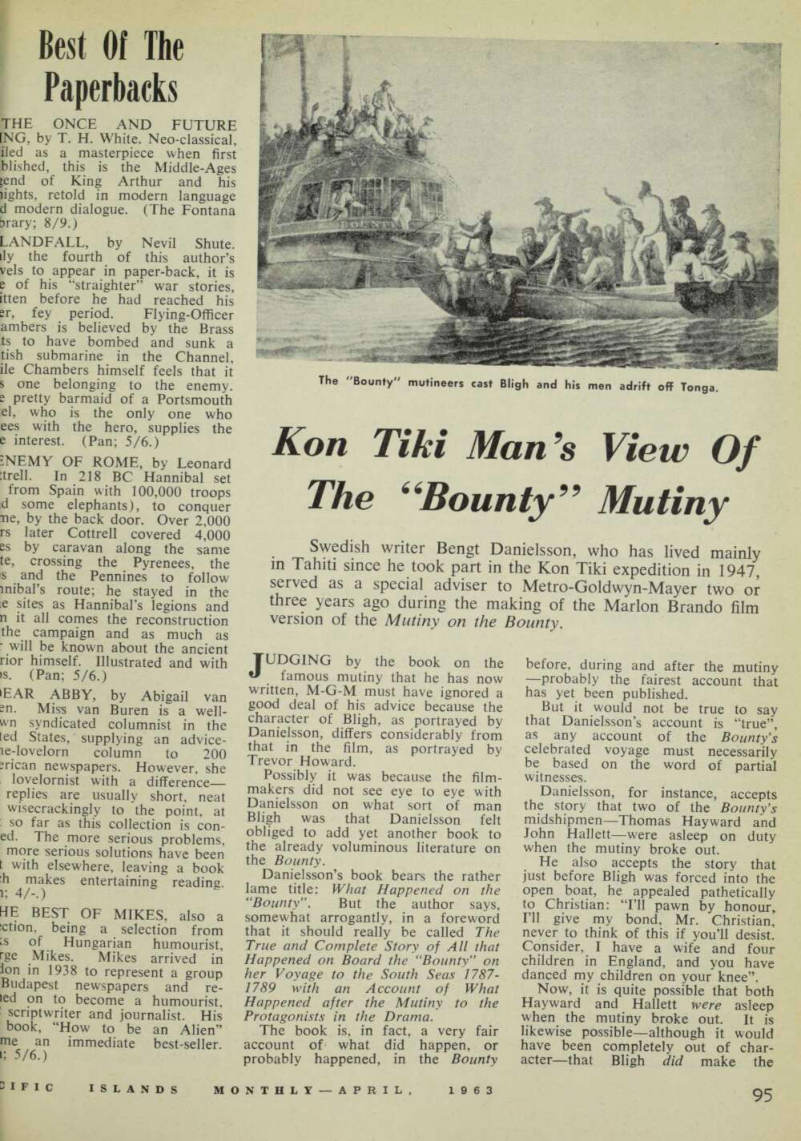
The "Bounty" mutineers cast Bligh and his men adrift off Tonga.
pathetic appeal attributed to him.
But there is no certainty that either of the stories is true. The man responsible for them—James Morrison, the Bounty’s boatswain’s mate —wrote them down several years after the events allegedly occurred, and he then had good reason to be bitter towards Hayward, Hallett and Bligh, as they had almost had him hanged.
Many other instances could be given of Danielsson’s acceptance of stories as truth which are not necessarily true. There are also a number of instances where his re search was not as “complete” as he claims it to have been.
He says, for example, that the sending out by the Admiralty of HMS Pandora to hunt down the mutineers was “a rather wild project”.
This was not really the case, as, before the Pandora was com missioned, the Admiralty had re ceived information (incorrect, as it turned out) that the mutineers had settled on the island of Aitutaki.
The information about Aitutaki came from a Lieutenant George Mortimer, who visited Tahiti in the ship Mercury in 1789, shortly after the mutineers called there to collect livestock for a settlement at Tupuai.
Mortimer wrote an account of the Mercury’s voyage which was pub
lished in London in 1791 and was later translated into other languages.
Yet Danielsson says that “the activities of this ship have always been a mystery to maritime historians” and that only recently has the mystery been solved.
Even so, Danielsson does not men tion the fact that on August 9, 1789, the Mercury passed within two miles of Tupuai, where the mutineers were then living, and “fired two guns to draw the attention of the in habitants”.
Fortunately for the mutineers, it was dark at the time, so the Mercury's people did not detect the presence of the Bounty at the island.
If they had, the story of the Bounty would no doubt have ended very differently: There may have been no Pitcairn settlement and no later transfer of the mutineers’ descendants to Norfolk Island.
Literal Errors This brings up another quite serious fault in Danielsson’s book — the great number of literal and care less errors. The mutineers’ descend ants, for instance, are said to have been transferred to Norfolk Island in 1836 whereas the date was 1856.
On the other hand, because of Danielsson’s personal knowledge of Polynesia and its inhabitants, he gives a much better picture of the Bounty people’s life in the islands than any writer before him.
As for Bligh, Danielsson pictures him as a brilliant seaman, navigator and leader; one who was more than ordinarily kind to his men compared with most sea captains of his day.
His chief faults, in Danielsson’s view, were his quick temper, violent tongue and overbearing manner; and it was these faults, in a dispute over coconuts on April 27, 1789, that sowed the seeds for the mutiny on the following day.
Summing up, Danielsson says: “The mutiny on the Bounty can be interpreted almost as a class struggle; a revolt of the oppressed, neglected, poverty-stricken and homeless seamen against a privileged and overbearing gentleman-class, the chief repre sentative of which in their eyes was Captain Bligh.
“Had not the leader of the mutiny himself been a gentleman, it is more than likely that the latent hatred which existed among the wretched seaman-class for their superiors at this time would have resulted in a bloody massacre rather than the astonishingly quiet and courteous affair that the mutiny in fact was.”— RL.
(What Happened On The
BOUNTY. Published by George Allen & Unwin. 41/6.)