Magazine Section
pp. 85-87 · Read in the full issue
Pacific Islands Monthly
Metal Detector May
Reveal Important
La Perouse Relics
By Robert Langdon
When Mr. Reece Discombe, a maritime salvage expert of Vila, New Hebrides, goes to Vanikoro in the southern Solomon Islands later this year to complete the salvage of a cargo of jetti soned brass, he hopes to make a thorough investigation on land for relics of the expedition of the famous French navigator La Perouse.
A PEROUSE, in the ships i Astrolabe and Boussole, was ■ecked at Vanikoro 175 years ago. jmains of the Astrolabe was found Captain Peter Dillon, an Irish aman, in 1827; and Discombe, mself, found the wreck of the mssole last year (see story p. 87).
But there are still several mysteries nnected with La Perouse that have >t been solved. One is: What be me of the ship that survivors of s Astrolabe and Boussole are said have built at Vanikoro? Another Did the survivors of the two ships iry articles ashore at Peu, the esent headquarters of the Kauri mber Company, of Melbourne? ad a third mystery is: Did they so bury some treasure?
It is these last two mysteries that iscombe —with the aid of a metal lector —hopes to throw some light i. He has good reason to hope at his investigations will be fruitful icause: • It is on record that each of La mouse’s ships carried “a million of
French livres in the coins of different nations”. ( PIM, Dec., p. 83). • Coins of different nations have been coming to light at Vanikoro for more than 130 years. • Many relics of the La Perouse expedition have been found on and under the ground at Peu and else where since 1924. • The captain of a Japanese pearl ing lugger put into Vanikoro about 30 years ago with a map which purported to show where La Perouse’s treasure was hidden.
The fact that there were some survivors of the Astrolabe and Boussole who lived on Vanikoro for some time and built a ship there is well authenticated.
Even before Dillon visited Vanikoro in September, 1827, he was told a story to this effect by a native called Rathea at the island of Tikopia. Rathea, a Tikopian, had lived on Vanikoro for about five years and had returned home at about the beginning of 1826.
According to him, the ship that
the La Perouse survivors built was a two-masted vessel and was made from the remains of one of the French ships that had been wrecked on the reef off Peu. The French men had lived within a wooden fence while they built their ship, and had had to contend with continual hostility from the Vanikorans during its construction.
Rathea’s story was confirmed by an old man of 60 to 65 whom Dillon interviewed when he reached Vanikoro. This man said that the French had taken “plenty of moons” to build the ship and that one man had kept watch at the fence during its construction. Two men had re mained behind after it sailed. One had died about three years before Dillon’s visit; the other had fled to another island.
Another Vanikoran called Owallie told a similar story, but put the time for the construction of the ship at “five moons”.
Later, one of Dillon’s officers visited the spot at Peu where the ship was said to have been built. He said it was about an acre in extent, fronted on the south by the sea, on the east by a river (now called the Laurence), and on the north and west by woods.
“It is the best adapted spot on the island either to build or launch a vessel at,” the officer said, “there being no rocks in the vicinity of the shore, and the banks of the rivulet abounding with timber.
“It is the only clear spot on the whole coast, and evidently made so by human hands; and as the islanders could not have any object in clearing it, I naturally conclude it must have been cleared by the wrecked persons who resided here and built their ship.
“I examined all the place care
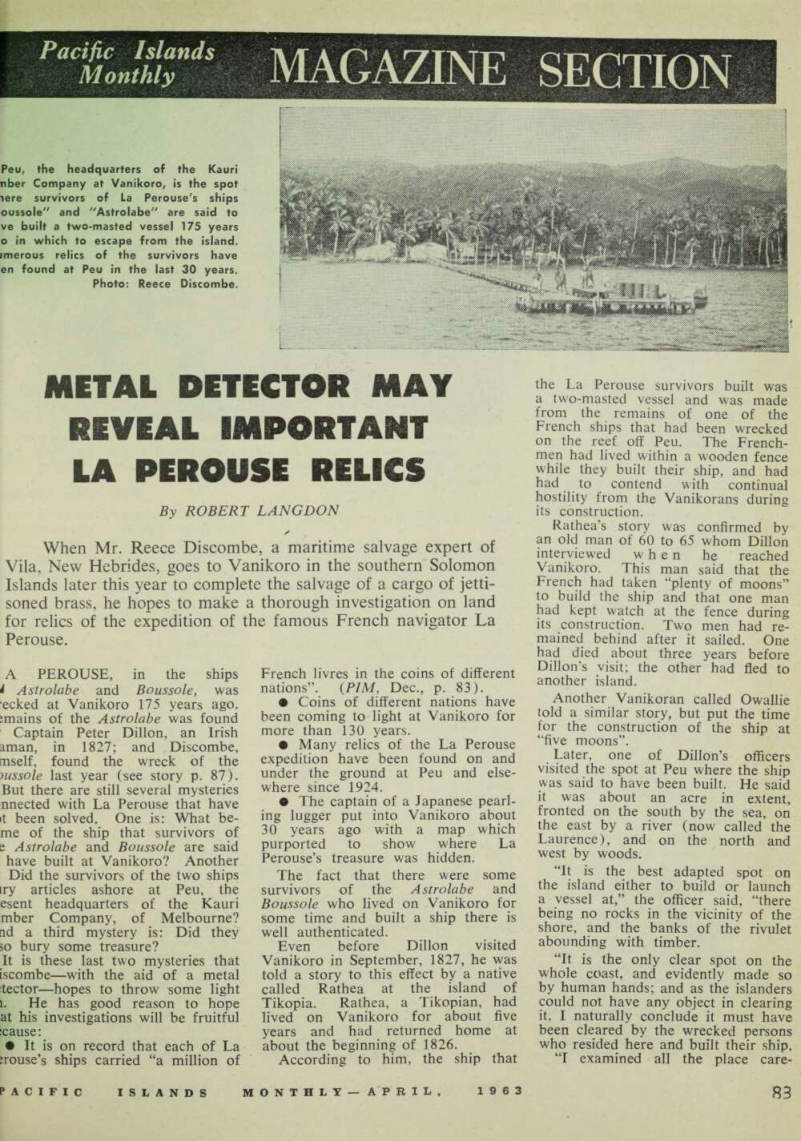
Peu, the headquarters of the Kauri number Company at Vanikoro, is the spot
[?]nere survivors of La Perouse's ships
[?]oussole" and "Astrolabe" are said to [?]ve built a two-masted vessel 175 years [?]o in which to escape from the island, [?]merous relics of the survivors have [?]en found at Peu in the last 30 years.
Photo: Reece Discombe.
fully for the remains of a stone or wooden fortification, but could not trace anything of the kind. If the fence was built of wood, it has had time enough in 39 years’ exposure to the weather to be rotted away and totally annihilated; and there is neither a stone nor rock in the neighbourhood with which to build one more durable.
“My search for inscriptions was equally fruitless, as the trees about the clear ground are not sufficiently large to admit of one, and, as I have stated, there are no rocks about there.
“I examined very minutely every spot around, but could not discover the least trace of Europeans ever having been there. I also examined the trees on the banks of the river, but found neither inscription, nor plate of brass, copper or lead on any of them.
“I saw up the river, however, the stumps of trees that had been cut down with axes many years ago, and of which I have no doubt the vessel was built which the natives speak of.
“I learnt that the wood with which the vessel was built was cut up the river and rafted down the stream to the clear spot where the vessel was built.”
No inscriptions
Dillon learned nothing more about the construction or fate of this ship, nor did he find any inscription or record anyhere else on the island to tell of what La Perouse’s men had done there or where they intended to go on leaving it.
However, he did obtain numerous relics of the expedition which the natives said had either been washed ashore or had been recovered by them at low tide from the wreck off Peu.
One of his officers also got a number of relics from the Peu wreck, including a Spanish dollar. The Spanish dollar was the only coin that Dillon came across.
In the following year, the French navigator Dumont D’Urville visited Vanikoro in search of further relics of La Perouse. He made a point of showing the natives coins and asking them if they had ever seen such objects, and although these enquiries did not produce any treasure, several of the natives told him that gold, silver and copper money had been found at Vanu, some six miles north of Peu.
During the next 100 years, French expeditions visited Vanikoro in 1848 and 1883 in search of more La Perouse relics and brought away
some anchors and other odds and ends.
Apart from these expeditions, Vanikoro had few European visitors —the island being given a wide berth because of its bad reputation for malaria. Meanwhile, the fact that La Perouse’s ships had been lost there was pretty well forgotten.
Then in 1921, there was a new awakening. In that year, Captain A.
Middenway, an officer of the BSIP Government and a Fellow of the Royal Geographical Society, went to Vanikoro with a party of timber experts to investigate the possibility of exploiting the island’s stands of kauri.
Captain Middenway was well in formed about the La Perouse story, and during the 11 days he spent on the island, he questioned the natives thoroughly about the survivors of his two ships.
“I found that although they were in possession of a quantity of old iron, bolts, old hammers and ship’s gear,” he wrote later, “they could give no information at all on the fate of the survivors. They, how ever, could show me the spot where the vessels were wrecked and stated that they themselves had revovered some of the articles they had in their possession.
“They also produced a number of Spanish Pilar dollars, one of which, dated 1784, I was fortunate enough to secure. They informed me that
some of the coins had been hand down to them by their own peop and others had been found at P and on the banks of a river on t Temua coast, where once had be the largest village on the island.”
About three years later, a compa called San Christoval Estates L sent a party of timber-getters Vanikoro to begin exploiting t island’s kauri, and during their st of several months another Spani coin and other traces of La Peroi were found.
Mr. Frederick Ashby, who, 1955, was living at Nadarivatu, F: and who was a member of the timb< getting party, wrote about the d coveries in PIM for June, 1955.
Mr. Ashby said that his party h found a clear space of about 10 aci which they were led to believe w cleared by La Perouse’s men wh they built a boat to escape fro Vanikoro.
He also referred to stories th La Perouse had carried “a large sto of gold and Spanish coins which deposited on the island,” and to how a Japanese pearler with a lugg and half a dozen divers had cor to Vanikoro in search of this treasu while he (Ashby) was there.
“I find it hard to believe that f Frenchmen left bullion behind,” V Ashby wrote, “but Eto, the Jap, h a map which he afterwards sa showed where the gold was burie “Anyway, he had his dive
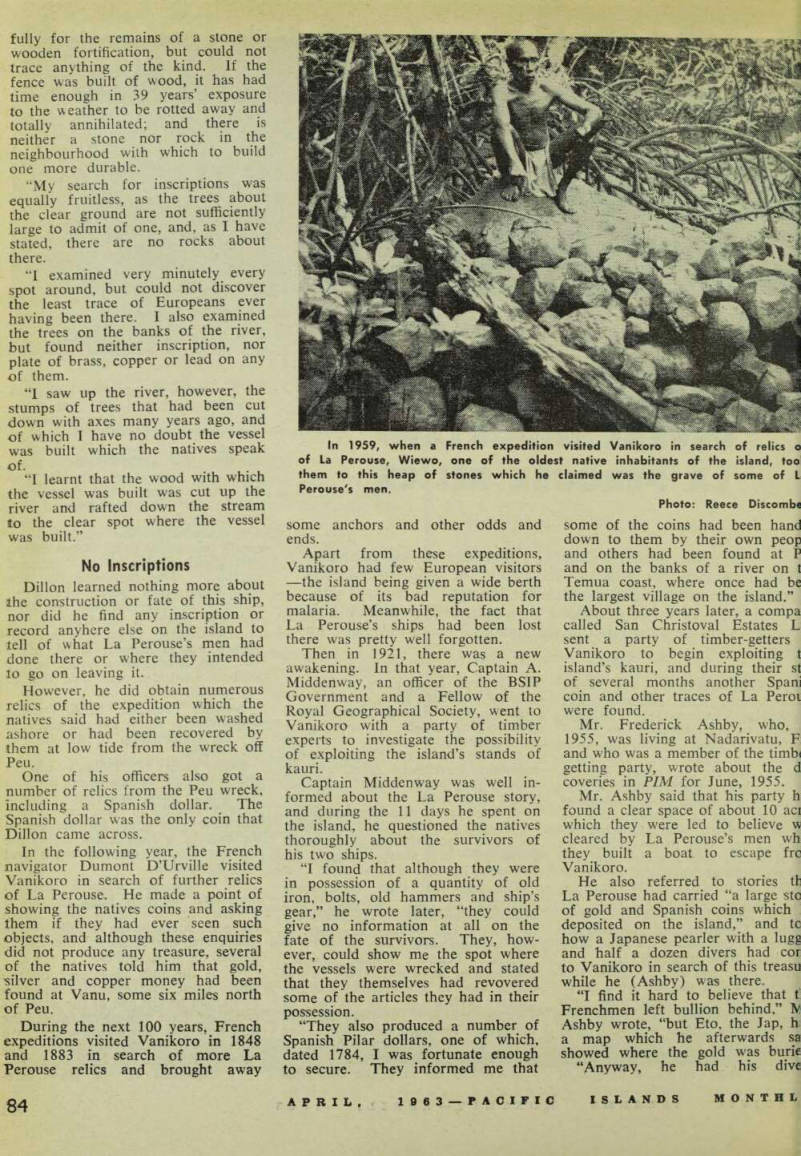
In 1959, when a French expedition visited Vanikoro in search of relics o[?] of La Perouse, Wiewo, one of the oldest native inhabitants of the island, too them to this heap of stones which he claimed was the grave of some of L[?] Perouse's men.
Photo: Reece Discombe[?]
excavating near the place where, i believe, the present settlement (of Peu) is situated. Certainly they dug jp a large silver coin like a Spanish loubloon. It was much pitted, but t caused a little gold rush among is.
“However, I think it unlikely that he wily Jap would have shown it o us unless he had exhausted every possible avenue that might have led 0 wealth.”
Another member of San Christoval Estates who found relics of La *erouse at Vanikoro was a Mr. C. 2. Kirk, whose discoveries were [escribed in an article in the Aus ralian Museum Magazine for anuary-March, 1924.
Among Mr. Kirk’s discoveries was 1 shoe buckle, which, according to he article, was found “on the surface it a spot where a forge had been reeled, fire clinkers and small pieces if lead being found in the neighbour ed”.
“Moulded bullets were found with he shoe buckle,” the article went on, and spanners and the head of a omahawk were picked up about four hains away, likewise other buckles, Ipanish dollar pieces, and various dds and ends.”
A short time after this, the timber etting rights of San Christoval Estates were taken over by the Vanikoro Kauri Timber Company nd another band of timber-getters /ent to the island.
The foreman of this party was one id Cross, who, according to the lydney Bulletin of April 2, 1925, /as also the finder of a Spanish coin.
It is a silver coin of Charles V of Ipain dated 1773”, the Bulletin said.
It is about the size of a dollar and xceptionally well preserved. It was ound near the surface at a spot /hich tradition alleges to have been .a Perouse’s camping ground”.
Two Coins Another man who acquired some Ipanish coins at Vanikoro about this ime is Mr. C. L. Dawe, of Smith Itreet, Epping, New South Wales, /ho went to the island in October, 924, as storekeeper and radio perator.
Mr. Dawe told me recently that bout three years after his arrival, a lative came to his store with a [uarter dollar of Ferdinand VI of ipain dated 1754 which he tried to ise to buy a bag of sugar. The lative said he had found the coin it Tanema, about five miles east of *eu.
About three weeks later another lative brought him a coin dated 1781 >earing the head of King Charles 111
of Spain, which he said he had found at the Ambi River, about a mile to the north-west of Peu.
Mr. Dawe added: “At the end of 1924 or early 1925 when we were putting down the foundations for a blacksmith’s shop at Peu, we found a number of other La Perouse relics about 50 yards from the water’s edge.
“Among these were four metal drums about 3 ft high and 15 in. across some 2 ft below the surface which disintegrated when we touched them, some musket balls, 118 grains of shot, two musket flints, a copper ornament probably used on a belt, and a lot of pieces of broken crockery about three-eighths of an inch thick, Mr. Dawe said.
“Later, after a hurricane which washed part of the foreshore away, I found a piece of copper about 2 ft long and 1 ft wide sticking out of the ground.”
Yet another man who has a story to tell about the discovery of Spanish coins is Mr. Fred Jones, of Clifton Gardens, New South Wales, who ran a store at Vanikoro from 1926 to 1957.
Mr. Jones told me recently that some time between 1928 and 1930, a Santa Cruz Islander uncovered a lot of Spanish coins in rows when he was digging near a mound at Peu.
The native told him this story several years after the event when he brought three of the coins to Mr.
Jones’ store which Mr. Jones bought from him for five or six shillings.
“This native,” Mr. Jones went on, “said that when he made his dis
covery he called a Chinese gardener, Ah Fook, who was working nearby, and just as he did so, the District Officer walked by.
“Ah Fook told the native not to say anything about the coins, and later he persuaded the native to give them to him by saying that he would get into trouble if he kept them.
“The native, who kept three of the coins, told me that the hoard he found would have filled about three-quarters of a kerosene tin.
Allowing for some exaggeration, it still sounds like a lot of coins.
“As for Ah Fook, he left Vanikoro during the depression, and I heard many years later that he had sold the coins in Hongkong as old silver.”
Mr. Jones also told me that after heavy rain he had found a number of musket balls at Peu over the years.
In September, 1926, Captain Middenway, who had visited the island in 1921 (as described above) returned to Vanikoro as an admini strative officer of the BSIP Govern ment.
He stayed on the island this time for 13 months, and during this period the natives showed him five mounds of stones in the vicinity of Peu and two prominent mounds near the former village of Temua, which the natives claimed were the graves of white men.
Old Mounds “These mounds were in no way connected with the native burial grounds,” Captain Middenway wrote, “and their condition supported the natives’ contention that they were very old.”
In 1959, when Reece Discombe visited Vanikoro with a French expedition searching for relics of La Perouse, he was also shown some heaps of stones which an old Vanikoran native claimed were the graves of white men.
Digging beneath these mounds revealed no relics or bones; but earlier, at Vanu, some pieces of crockery were dug up after the natives had led them to the spot.
In the lieht of all these discoveries (and probably many others that have not been reported), there seems to be little doubt that extensive work with a metal detector could uncover many further relics of the La Perouse expedition.
And who knows? There may yet remain to be found an inscription on metal or even a diary in a metal con tainer that will finally tell the world what really happened to La Perouse’s men after their ships met disaster 175 years ago.
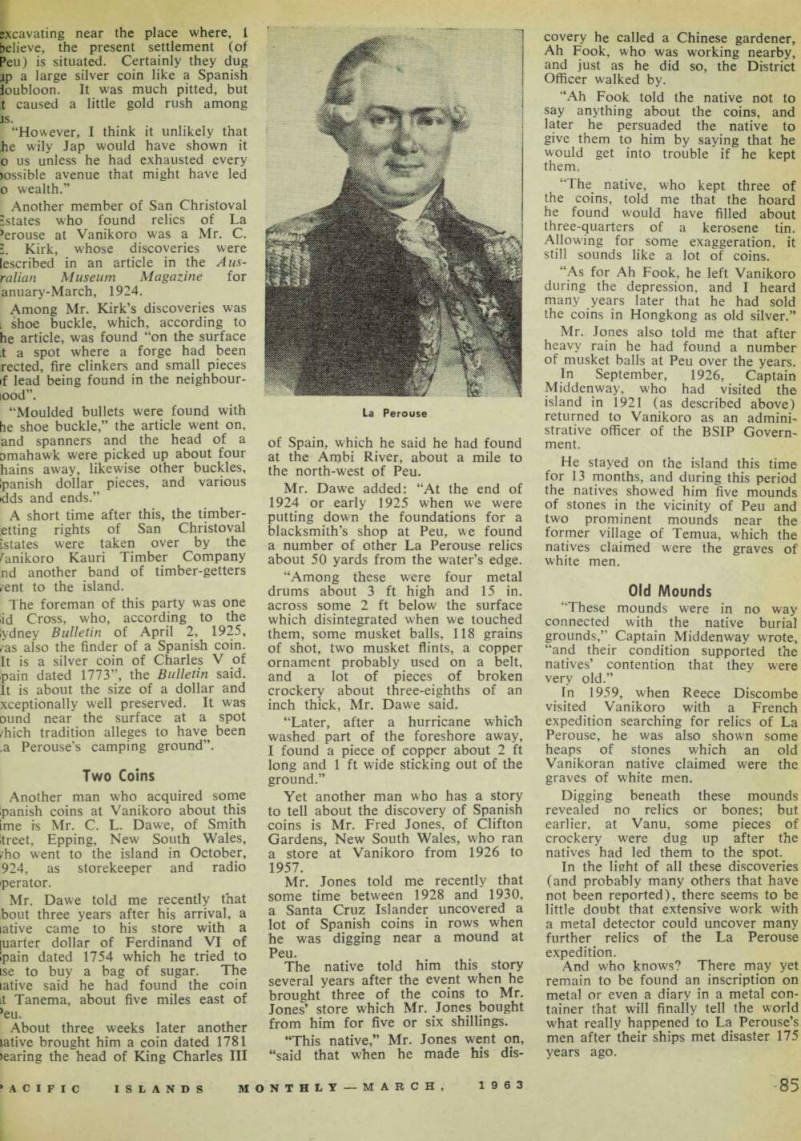
La Perouse