Territories TALK-TALK
pp. 49-53 · Read in the full issue

Whether politicians are becoming more susceptible to criticism and crying “touche” when a point finds its mark, or whether crystal-gazing journalists are becoming more outspoken is a matter, I suppose, time alone can tell.
February issues of the p-ng newspapers were agog over a statement from Minister Hasluck concerning the published remarks of journalist Osmar White, in which it was stated Australia would try to give P-NG representative government by 1968 and political independence by 1972.
Osmar White’s article appeared in Melbourne and Brisbane papers and brought forth a stout denial from the Minister, who described the re port as “sheer speculation by a singularly ill-informed person”.
With Tolala
Osmar White, in commenting upon the Minister’s statement, is reported as describing him as “politically dis honest”, giving his reasons and con cluding with: “The only way Mr.
Hasluck will restore confidence is by announcing what the Commonwealth Government will do—not by telling us tediously what it will NOT do”.
NG Coastal MLC, Somu Sigob, in the Legco, on the other hand, said there was not one man anywhere who could say in how many years the people of the country would be ready for self-government.
I am inclined to think that Osmar White made a gaffe when, in an interview with the NG Times-Courier, he said he had spent a total of seven years in the Territory since 1933.
“In fact I suppose you could call me a genuine ‘B-4’ ”.
He should know by now that any one rating as a “B-4” is looked upon with a jaundiced eye, especially where officialdom is concerned!
Taking a broad view of the in cident it would seem that it is little more than a storm in a tea-cup and methinks the Minister doth protest too much. Let us hope it does not assume the dimensions of the English Vassal spy inquiry.
Perhaps if Osmar’s pigmentation had not been the same as his name there would have been less fuss about the whole thing. Some native MLC s say some unkind things and get away with it.
Optimists and
Pessimists Quite a lot of printer’s ink has been spilled by diligent public relations officers of the Department of Territories in publishing brochures and handing out Press statements dealing with P-NG’s natural potentialities, and its educational,
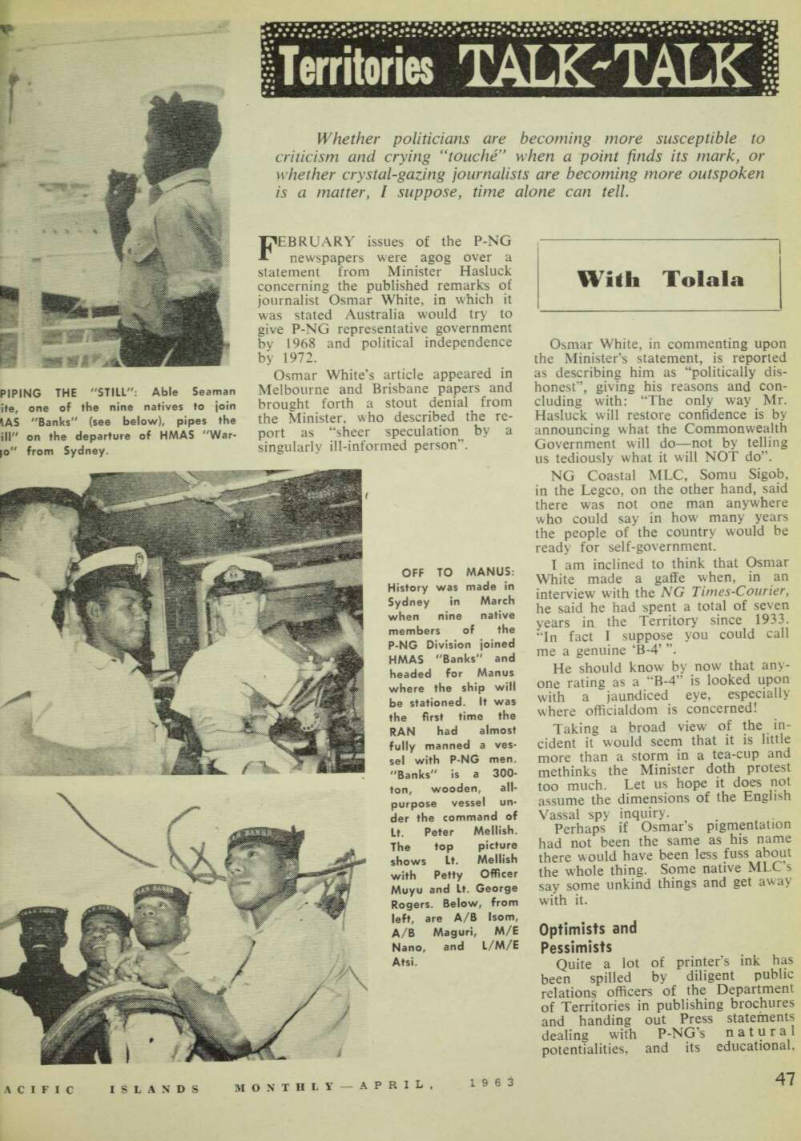
PIPING THE "STILL": Able Seaman [?]ite, one of the nine natives to join [?]AS "Banks" (see below), pipes the [?]ill" on the departure of HMAS "War
[?]o" from Sydney.
Off To Manus:
History was made in Sydney in March when nine native members of the P-NG Division joined HMAS "Banks" and headed for Manus where the ship will be stationed. It was the first time the RAN had almost fully manned a ves sel with P-NG men.
"Banks" is a 300ton, wooden, all purpose vessel un der the command of It. Peter Mellish.
The top picture shows Lt. Mellish with Petty Officer Muyu and Lt. George Rogers. Below, from left, are A/B Isom,
A/B Maguri, M/E
Nano, and L/M/E Atsi.
lomical and social development, ut this being an age of promotion the public having become more ess immune to sales talk, I hied to the fountain-head and asked :ral old-time NG planters for their vs on current conditions. [ere is what an Optimistic New ain planter, of over 30 years’ srience, wrote to me: Jative drinking : Generally speak the Tolais (hardened and ex enced drinkers that they are) are / well behaved; the ones that se trouble are the Papuans and iks.
Tie Rabaul police close all bars at ) p.m, Friday and Saturday; native ice wear riot helmets and carry ans; European police have side is. This is a result of several lent attacks on police since the oduction of native drinking, fhe “battle-dress” is only worn, course, when closing the bars, ts off to the police for the excellent they’re doing.
Education: Some village schools running two shifts a day to cope h the insatiable demand for educa n.
Chinese : The position of the inese community in a future in- Dendent state is very precarious leed. There is a very deep under went of resentment amongst the lais against the Chinese.
Administration : There are a lot dedicated public servants, par ularly amongst District Services, 10 really take an interest in the hire of the country.
Native Labour : Generally speaking there is less trouble now-a-days than in the Good Old Days. Casual labour seems to be more settled too; as a matter-of-fact, half of my plantation strength is now casual. This is a result of too much labour competing for too few jobs, which in my opinion is a good thing!
Indonesians : This is where our main trouble lies, and I think we’ll have a few incidents with “Menzies’
Allies” before the decade is out. It is getting very hard to distinguish between the “half-castes” and the local Tolai girls who now wear skirts and blouses and the usual trimmings that all females are prone to.
In conclusion, he adds, “I can sum up by saying that the local populace is friendly towards us, and now treat us as partners, not master servant relationship. This, I think is a good thing and I have no fears at all when independence does come, I hope my predictions are correct, because I love the country and its peopl€ ;\ u r„ • And the following from another planter, with over 40 yea penence in the Territory, an over-all view of conditions, “You’ll see what Paul Hasluck says about private investment. As 1 see it all this talk about encouraging private investment is all hooey; they
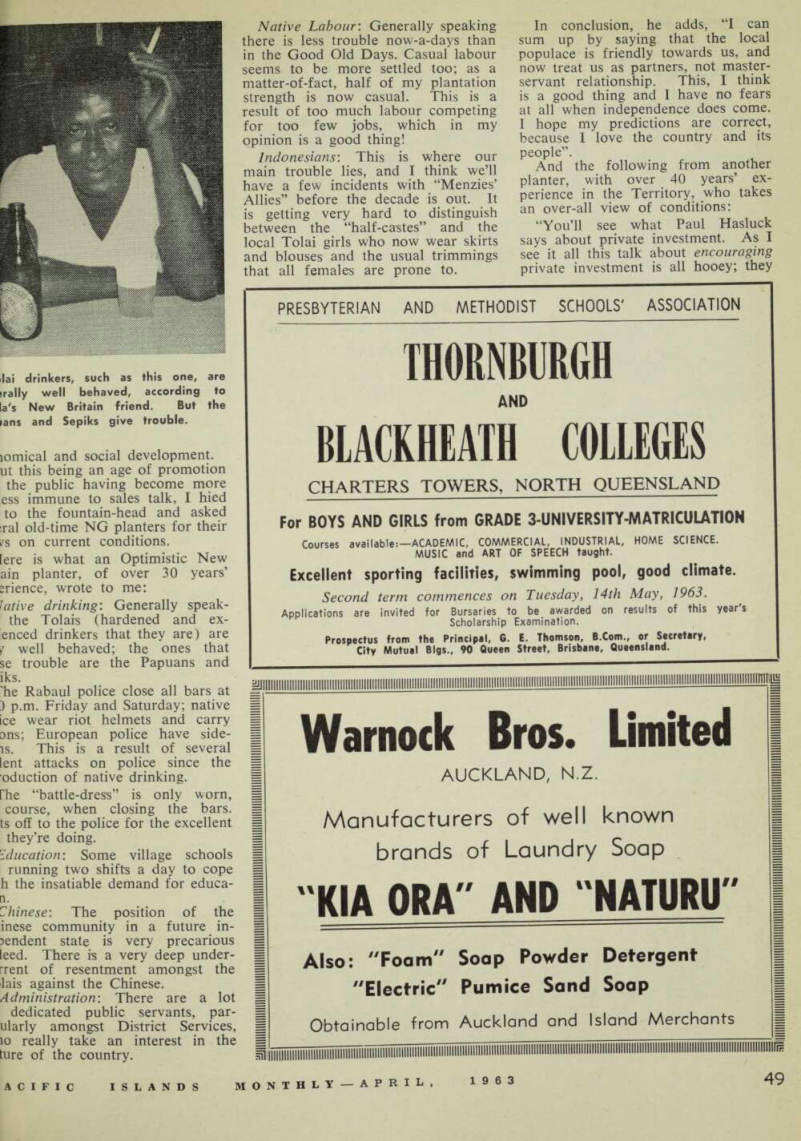
[?]lai drinkers, such as this one, are [?]rally well behaved, according to [?]la's New Britain friend. But the tans and Sepiks give trouble.
are actually wanting to discour and so get the Europeans out of way before independence, or \ yo u will!
“Mr. X (naming a resident ' oyer 40 years’ in the Territory) the Government tendency is to value land all the time—and political conditions are helping— so, there is less for the expatri to worry about if they do get pus out, or they may see the writing the wall and quit sooner than ot wise! I have no delusions about matter.
“I sometimes wonder if indigene might wake up to the that he needs the private enterp merchant as a means of demonst ing how a business, or plantation such, can be developed and made pay, instead of just capsizing th sands into a project; like the Adm stration does, with wastage of fu and over-capitalisation apparent along the line.
“But I think the indigenes imaj this money comes along throi some magic process and will c tinue to do so after independer These days I look upon myself an observer only—whilst the s sinks!”
I make no comment on eit opinion, but leave it to readers make their own assessment. . . 1 opinions were expressed without writers’ knowledge that they mi be published.
A New World With our changed manner living it is not to be wondered t] we find new words added to (
dictionary.
Latest word that has come to notice is “nong-nong”, mentioned a Sydney Sunday paper column He says that the word “nong” has popular meaning of “a noodle, dope, a brainless person” and as for further information.
Author Olaf Ruhen (not unkno’ to P-NG folk) in giving him answer refers to John Murphy’s bo on Pidgin and suggests its derivati is “an Australian confusion of t word long-long, derived from one the native languages of the Gaze: Peninsula”.
Long-long (sometimes spe log-log ) is a Blanche Bay diale word meaning “crazy, mad, foolish Intoxicating liquor is (or, perha one should say was ) referred to tava na long-long (water of fooliss ness, or mad water).
Olaf Ruhen is probably rig! especially with regard to the “Au tralian confusion”.
We seem to have the unhapi knack of confusing our consonants
live words as, for instance “lap i” (a loin cloth) which is a con cted form of lava-lava (Samoan gin) and “pul-pul” (a flower) im the Blanche Bay dialect pur-pur.
In German times lava-lava only erred to the long, gaily-coloured iterial, usually fringed and worn >re as a status symbol by socialite irys and boss-boys. The ordinary n cloth (2 yards of calico) —which s usually called Turkey Red and ?plied in bolts of 10 to 20 yards d was a monthly issue to native >ourers —was called a mal.
I remember when a Rabaul hostess, :ently arrived from Australia, was plaining to some guests from a ip in port: “The word lap-lap, my ar, comes from the fact that it is apped about the lap. You see? id the words for flower is “pul-pul”, cause you pull it. So simple, isn’t 59 Most P-NG folk realise that dif ■ent native tribes pronounce the nsonants differently. The pro mciation used in the original dialect ould be the one adopted generally.
Perhaps now that the Territory has few students of linguistics travelling out they will put things right, lough I doubt it. Common usage, iwever inaccurate, takes precedence this slap-happy age. ie Police Band It was in the middle thirties that first heard the police band march g along the Rabaul streets playing e “Invercargil March” with all the irve, inspiration and martial atmos lere which regimental bands create i the more civilised parts of the
world. The display was an un qualified success and Sergeant Dan Crawley (as he was then) was a very happy man. The months of train ing he had forced upon his bands men had been repaid.
A news item from Port Moresby tells of his retirement this month (April) and Sir Donald Cleland at a Press conference had said that Dan’s successor would most likely be Sergeant (First Class) Eramus, “a native of New Britain who joined the constabulary 20 years ago”.
Sir Donald then went on to extol the musical capabilities of Eramus, which are not at all surprising in view of the training which Dan Crawley insisted upon with all his bandsmen from the start, I remember attending several practices of the band in the middle thirties and was surprised to notice that Dan insisted all members should have a thorough knowledge of the theory of music as well as being able to blow into a mouth-piece and work the right fingers.
It might be apropos here to men tion that the real originator of the band was a schoolteacher —J. H. L.
Waterhouse—who was in charge of the Nodup Village School, at the eastern foot of Mount Mother and just down from Namanula, JHL was somewhat of an Imperialist. For some years he was collecting botanic specimens for Kew Gardens (London) travelling extensively through the BSIP and later published a book of Solomon Island linguistics.
He was connected with mission work for a while and eventually took over the government school at Nodup, which became a show-place in the thirties for any passing VIP and tourists.
His students were outstanding singers and wizards at mental arithmetic and several of them were “mirror handwriters”.
In the mornings when school opened there was a general parade outside the building, the flag was raised and two or three buglers sounded a fanfare.
These buglers became the nucleus of Rabaul’s police band, and it was here that the seed was sown, en couraged by the Administrator (Tom Griffiths) and diligently developed by Dan Crawley—in the face of much discouragement from his colleagues and veiled ridicule from the public generally!
Thank you, Dan. You have had the patience of Job over these long years and I hope the Territory shows its gratitude to you in some concrete form. And I mean just that; Some lasting, visible token for the work you have done.
of Ruhen . . . Nong-nongs are long-long.