BSIP Enthusiastically Tackles
pp. 35-37 · Read in the full issue


Wet Rice Project
From a Staff Writer
The present Ilu Farm rice-growing project, about 14 miles from Honiara, BSIP, has raised considerable interest in the Protectorate —and some scepticism. It is the successor to a few other BSIP rice-growing schemes that proved abortive but, in spite of the fact that there are still a couple of ifs about this attempt, it has a better chance of success than the others.
pHE present scheme is based on the L knowledge—painfully gained in SIP, P-NG and elsewhere —that [elanesians are not interested in owing the crop; and that to es blish a successful industry that can educe rice to compete with an im )rted product, it is necessary to be illy mechanised.
The rice grown at Ilu has been echanically planted and harvested, he rice previously grown there has sen dry rice; the present experiment -and it still cannot be considered uch more than that—is with fully rigated rice.
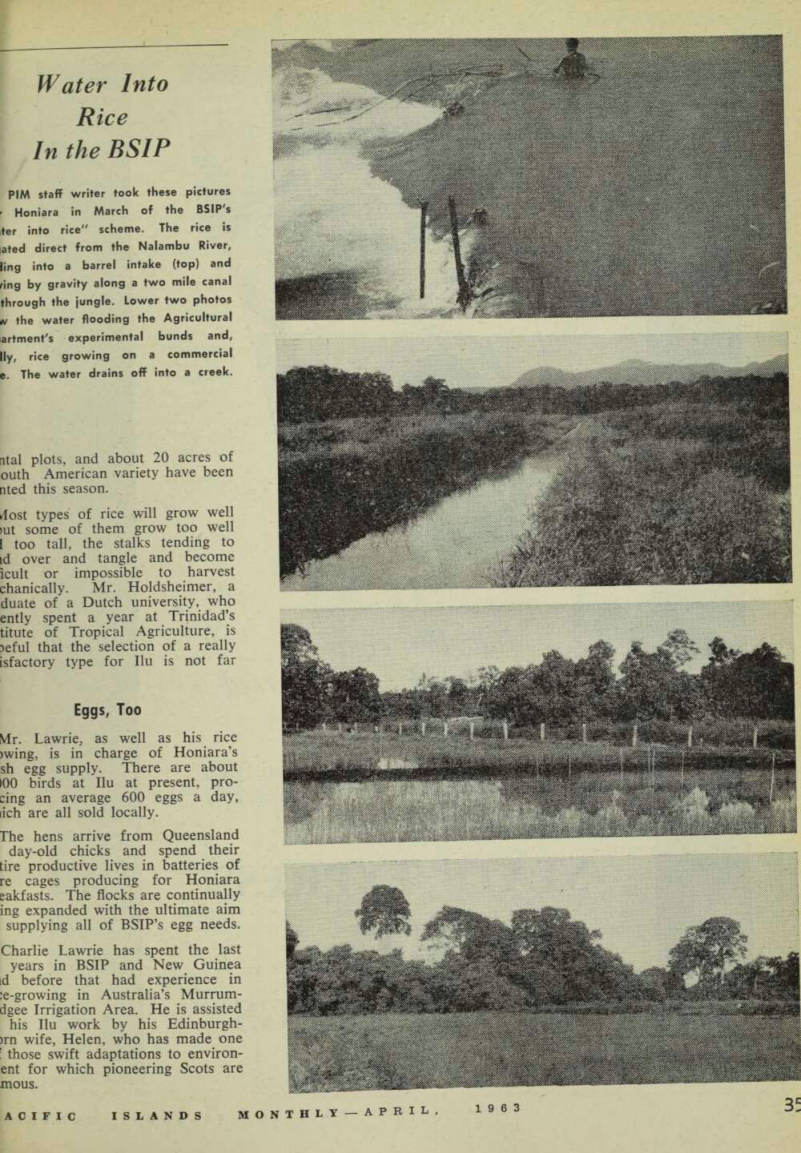
Two Mile Canal Water is brought onto the rice fids through a two-mile canal dug om the Nalambu River and com leted at the end of 1960 on the Ivice of agricultural scientist Dr. A. . Ballantyne, who was sent out by ic Colonial Office to study BSIP’s ce potential. From the canal the ater is run into the prepared mnds” through gates that regulate le level of water and after use it nally drains off into a nearby creek.
Ilu Farm, which is owned by Mr.
'. Dalrymple-Hay, is 348 acres, but illy 20 acres and the five acres at resent used by the Department of agriculture for field trials, can be rigated from the present water jpply and even that has its lapses.
Water is Vital Ilu Farm is in a 60-80 inch annual linfall area, but like most other acifie areas in these latitudes, it can Dmetimes have a dry wet-season and n uncomfortably wet dry-season.
Too much rain when the grain is eady for harvest can mean disaster; 30 little water during the growing eriod of the rice can be just as un ortunate. So the water-supply is the irst “if’ in the present scheme.
The Nalambu River, even in the
dry season, produces ample water but the present barrel intake is inadequate when the river falls below a certain level.
In a photograph, taken after heavy rain in the hills, the barrel is taking its full capacity but the river has got to fall only a little before an in adequate amount is fed into the barrel. What is required is an efficient weir that would keep the level of the river at a depth that could be run off through the intake and down the canal in sufficient volume all the year through.
The whole business of the weir has now, however, developed into some thing of a vicious circle: No one seems prepared to build the weir until it is proved beyond doubt that large-scale production of rice is possible; at the same time, it is pretty impossible to prove that rice can be grown commercially until there is something more reliable than the stop-go water supply at present in existence.
Enthusiasts The two men most concerned with the scheme are Mr. John Holsheimer, the agricultural officer in charge of the experimental side of Ilu rice project; and Mr. Charlie Lawrie, manager of Ilu Farm, who is in charge of the commercial side of the development.
Both are enthusiastic and are hop ing that, failing more practical help, Nature will produce the right com bination of weather just once and allow them to show that rice can be grown commercially at Ilu.
The second “if” in the scheme is the type of rice grown. Ideally, a great deal more experimentation in types should have been undertaken before any variety was planted com mercially but the owner of the farm was naturally anxious to do some thing more ambitious than sow experi-
ntal plots, and about 20 acres of outh American variety have been nted this season. dost types of rice will grow well »ut some of them grow too well I too tall, the stalks tending to id over and tangle and become icult or impossible to harvest chanically. Mr. Holdsheimer, a duate of a Dutch university, who ently spent a year at Trinidad’s titute of Tropical Agriculture, is jeful that the selection of a really isfactory type for Ilu is not far
Eggs, Too
Mr. Lawrie, as well as his rice >wing, is in charge of Honiara’s sh egg supply. There are about 100 birds at Ilu at present, pro sing an average 600 eggs a day, lich are all sold locally.
The hens arrive from Queensland day-old chicks and spend their tire productive lives in batteries of re cages producing for Honiara eakfasts. The flocks are continually ing expanded with the ultimate aim supplying all of BSIP’s egg needs.
Charlie Lawrie has spent the last years in BSIP and New Guinea id before that had experience in :e-growing in Australia’s Murrum dgee Irrigation Area. He is assisted his Ilu work by his Edinburgh )rn wife, Helen, who has made one ; those swift adaptations to environ ent for which pioneering Scots are mous.
Water
Rice
In the BSIP
PIM staff writer took these pictures Honiara in March of the BSIP's [?]ter into rice" scheme. The rice is [?]ated direct from the Nalambu River, [?]ling into a barrel intake (top) and [?]ing by gravity along a two mile canal through the jungle. Lower two photos [?] the water flooding the Agricultural [?]artment's experimental bunds and, [?]lly, rice growing on a commercial [?]e. The water drains off into a creek.