No "When" For Drinkers
pp. 31-33 · Read in the full issue
Sydneysider Goes Walkabout No "When" For Drinkers
Most of the things the experts predicted would happen, have happened, since the lid was taken off native drinking in Papua-New Guinea; but, paradoxically, it has all turned out
better than expected.
lUROPEANS have flown the public I bars; native savings-bank acants have gone down instead of ; sales of such basic commodities bread in towns like Port Moresby, ye fallen by some thousands of ives a week; public bars have ived inadequate for anything even notely resembling civilized drink- ;; and there are about six times ire arrests for drunkenness per •nth than during blanket prohibin However, native drunks have ived amiable rather than riotous; re have been no brawls on racial mnds—to the contrary, the native itleman in his cups is likely to im far more friendly relationships
:h his European opposite-number
om he happens to encounter than would when cold sober; and there aear to be no more indecent asilts, rapes or general mayhem than rmal—possibly because the major of native drinkers still drink to drunk rather than to boost their jrage or their spirit of adventure.
Nonetheless, few observers could edified by the sights to be seen any hotel, most evenings and parularly on Fridays and Saturdays, ring the present phase of mass
wallow. Recently, during a visit to the Territory, your Sydneysider went along to make some observa tions on the spot, It was Saturday afternoon and a roar of sound and the occasional crunch of a breaking glass came out of the public bar. In , , the , E ll1 ™ and the tobacco smoke, black faces loomed up like something peering out of a jungle and the centre of the room was full of moving bodies crowding several deep round the bar.
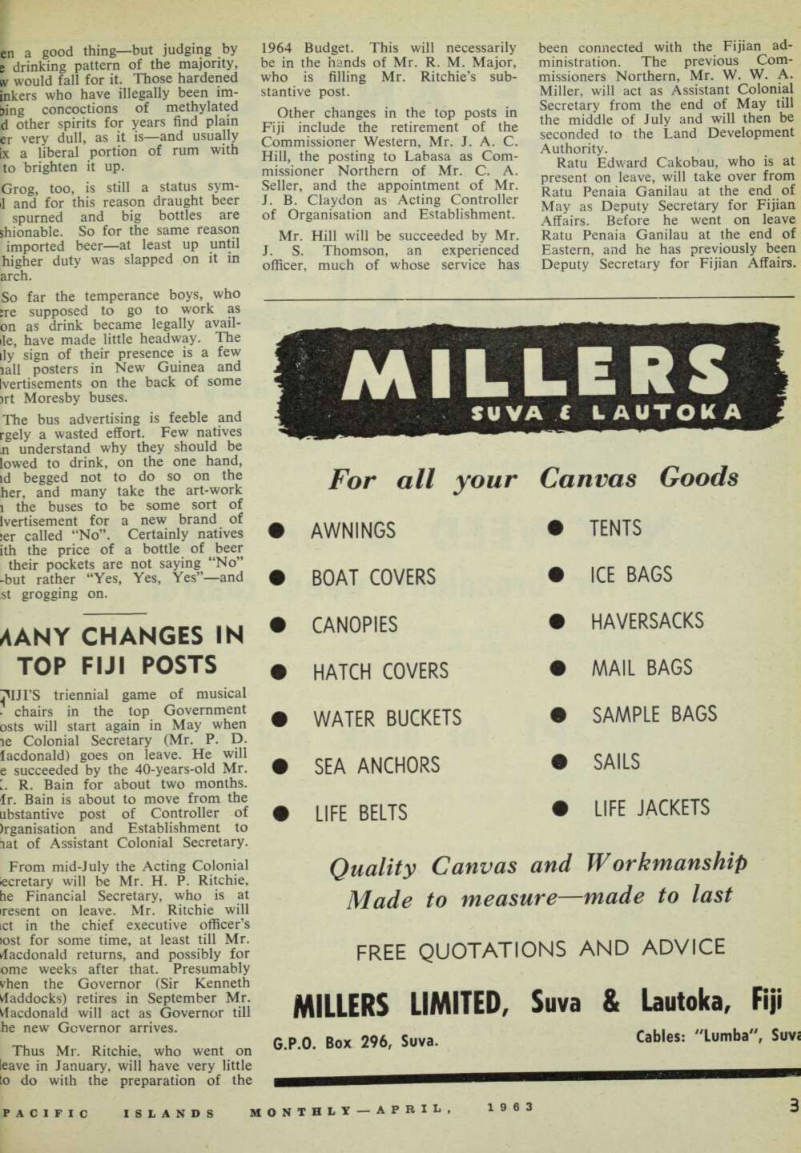
Out in the beer-garden, once ex clusively the meeting place of Euro pean drinkers, were seated the over flow—or those who like to sit while drinking, or preferred air to smoke, with their beer. But no natives sat on the higher terrace or m the lounge marked Resident Guests only (although few of the Euro pean drinkers there were guests in th e house),
"Pretty Brisk"
Finally, we detached an acquamt ance who serves in the public bar “to help out” and he came, bringing a glass of beer and mopping his face, to join us.
“Pretty slow today,” he said, smk-
ing down exhausted. “You should have been here last night.”
We said trade looked pretty brisk to us but, he said, no —nothing out of the ordinary. The evening after pay-day was the time.
Native drinkers were, he said, not more difficult to deal with than Euro peans—not quarrelsome or anything —but they were different, and the ways they were different took some getting used to.
“A European,” he said, “will come up to the bar and say ‘Three middies, mate,’ pay for them, take them, and go.
“A native will stand there for a bit, produce a few bob, shove them at you and say he wants a bottle of beer. You’ll get it for him. Then he’ll produce another few bob and say he wants another bottle. You’ll get that. He’ll fossick around in his pocket, get some more coins and say he wants a can of beer. So you’ll get that —then he’ll produce a bit more dough, push it over and say he’ll have some rum!
“This is old trade-store fashion, of course, but when there are people six deep round the bar it nearly drives us up the wall and slows down serving practically to stalling speed.”
We watched a couple of happy in digenes get up from the tables in the beer-garden, meet in the middle of th« gravelled walk, prop each
The native patrons in this beer garden at Boroko, Port Moresby, are generally well-behaved. Biggest trouble in most P-NG hotels is that many native drinkers aren't yet house-broken. But they're learning.
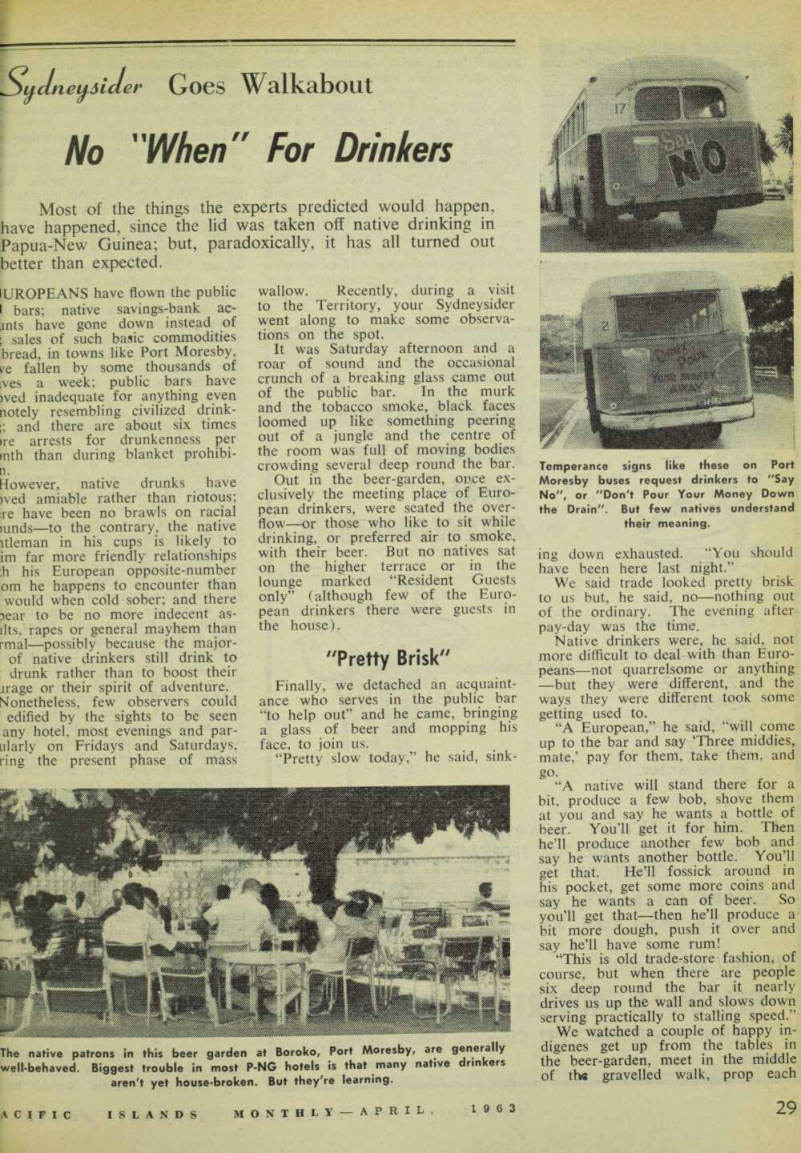
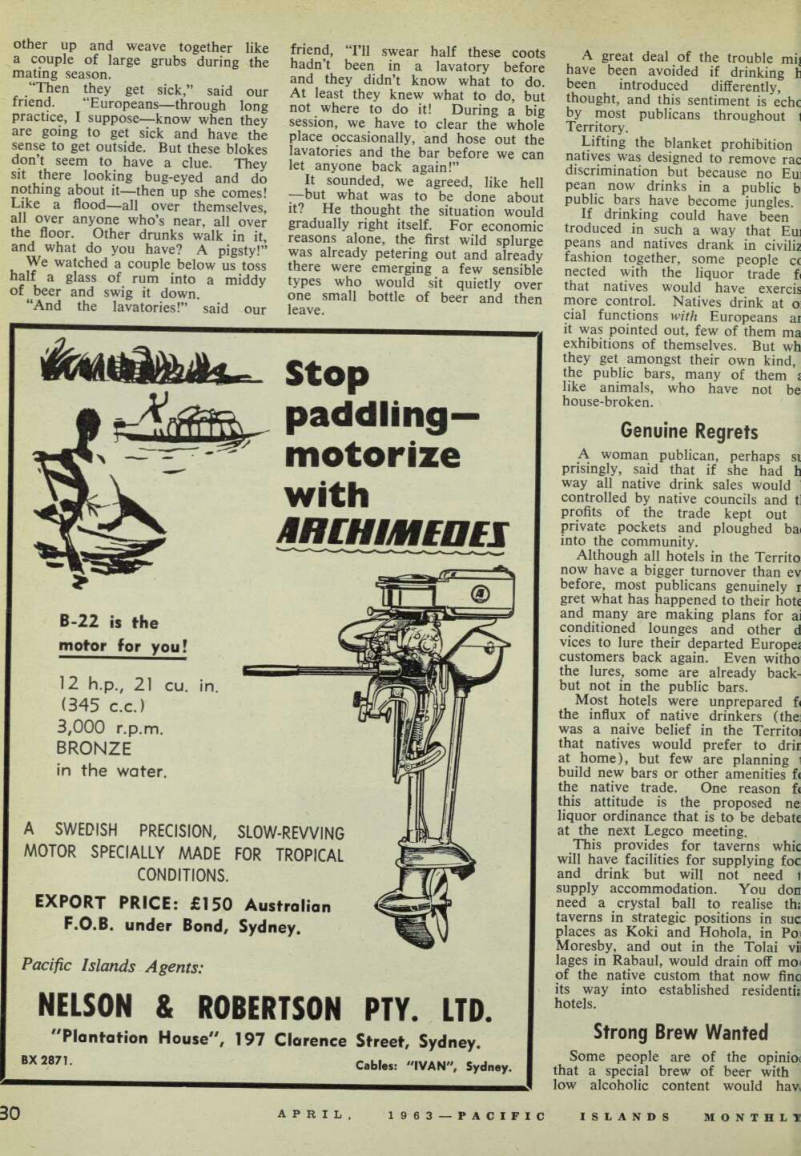
Temperance signs like these on Port Moresby buses request drinkers to "Say No", or "Don't Pour Your Money Down the Drain". But few natives understand their meaning.
other up and weave together like a couple of large grubs during the mating season.
“Then they get sick,” said our mend. “Europeans—through long practice, I suppose—know when they are going to get sick and have the sense to get outside. But these blokes don’t seem to have a clue. They sit there looking bug-eyed and do nothing about it—then up she comes!
Like a flood—all over themselves, all over anyone who’s near, all over the floor. Other drunks walk in it, and what do you have? A pigsty!”
We watched a couple below us toss half a glass of rum into a middy of beer and swig it down.
“And the lavatories!” said our
friend, “I’ll swear half these coots hadn’t been in a lavatory before and they didn’t know what to do.
At least they knew what to do, but not where to do it! During a big session, we have to clear the whole place occasionally, and hose out the lavatories and the bar before we can let anyone back again!”
It sounded, we agreed, like hell —but what was to be done about it? He thought the situation would gradually right itself. For economic reasons alone, the first wild splurge was already petering out and already there were emerging a few sensible types who would sit quietly over one small bottle of beer and then leave.
A great deal of the trouble mij have been avoided if drinking h been introduced differently, thought, and this sentiment is echc by most publicans throughout 1 Territory.
Lifting the blanket prohibition natives was designed to remove rac discrimination but because no Eui pean now drinks in a public b public bars have become jungles.
If drinking could have been troduced in such a way that Em peans and natives drank in civiliz fashion together, some people cc nected with the liquor trade f( that natives would have exercis more control. Natives drink at o: dal functions with Europeans ar it was pointed out, few of them ma exhibitions of themselves. But wh they get amongst their own kind, the public bars, many of them * like animals, who have not be house-broken.
Genuine Regrets
A woman publican, perhaps si prisingly, said that if she had h way all native drink sales would 1 controlled by native councils and t] profits of the trade kept out private pockets and ploughed bai into the community.
Although all hotels in the Territo now have a bigger turnover than ev before, most publicans genuinely r gret what has happened to their hote and many are making plans for ai conditioned lounges and other d vices to lure their departed Europe* customers back again. Even witho the lures, some are already hack but not in the public bars.
Most hotels were unprepared f« the influx of native drinkers (thei was a naive belief in the Territoi that natives would prefer to drir at home), but few are planning t build new bars or other amenities f« the native trade. One reason fc this attitude is the proposed ne: liquor ordinance that is to be debate at the next Legco meeting.
This provides for taverns whic will have facilities for supplying foe and drink but will not need 1 supply accommodation. You don need a crystal ball to realise th« taverns in strategic positions in sue places as Koki and Hohola, in Poi Moresby, and out in the Tolai vii lages in Rabaul, would drain off mo< of the native custom that now fine its way into established residents hotels.
Strong Brew Wanted
Some people are of the opinioc that a special brew of beer with low alcoholic content would haw
en a good thing—but judging by g drinking pattern of the majority, w would fall for it. Those hardened inkers who have illegally been im ping concoctions of methylated d other spirits for years find plain er very dull, as it is—and usually ix a liberal portion of rum with to brighten it up.
Grog, too, is still a status sym il and for this reason draught beer spurned and big bottles are shionable. So for the same reason imported beer—at least up until higher duty was slapped on it in arch.
So far the temperance boys, who ;re supposed to go to work as on as drink became legally avail ile, have made little headway. The ily sign of their presence is a few lall posters in New Guinea and [vertisements on the back of some >rt Moresby buses.
The bus advertising is feeble and rgely a wasted effort. Few natives n understand why they should be lowed to drink, on the one hand, id begged not to do so on the her, and many take the art-work i the buses to be some sort of Ivertisement for a new brand of ;er called “No”. Certainly natives ith the price of a bottle of beer their pockets are not saying “No” -but rather “Yes, Yes, Yes”—and st grogging on.