NG Aviation Must Consolidate,
pp. 19-22 · Read in the full issue

Not Reconstruct
From a Special New Guinea Correspondent
Five years ago, Shane Paltridge, Senator of the Common wealth of Australia, Minister of State for Civil Aviation, paid a visit to Papua-New Guinea. On his return to Canberra, he nulled Qantas out of New Guinea, and put in instead the dual airline system of Trans-Australia Airlines —Ansett-A.N.A. that Dperates in Australia.
Enator Paltridge In March
completed his latest inspection r of the Territories, complete with retinue of top-ranking Depart ntal advisers, and Territorians are >nde r i n g what revolutionary mges will follow the Ministerial estigation this time.
Well, the answer is—none.
Fhe dual system has proved itself, the opinion of the Minister, and ; job ahead is one of consolida te not reconstruction. ‘There is not the slightest doubt it Papua-New Guinea is enjoying ;ter service, better comfort, and safer safety than ever before,” he terated throughout his tour.
As the Department of Civil iation sees it, the regular airlines * doing a good job, the charter erators still have their place in the rritory, the carriage of freight, one the most important tasks in Papua ;w Guinea, is well under control, sts, though rising, are still reason le.
To round off the rosy picture, new CA facilities will be provided in a
few places (see p. 122), and every thing will be got ready for the intro duction of Electra aircraft on the main route from Australia, when they are discarded in favour of jets on the inter-capital runs.
Humming their hymn of praise for the two-airline system. Shane Paltridge and his officers were in no mood to listen to criticisms of the scheme. (Main beefs are irregular
freight services with constant off loadings, and failure to transfer off loaded freight to the opposition line for the next day’s service.) They glossed quickly over the high capitalisation involved when two companies moved in to do the work of one. This cost TAA and Ansett Transport Industries together £400,1)00 last financial year, , taking their total capital investment in Papua and New Guinea to more than £3 million.
And Minister Paltridge, happily looking forward to the arrival of Electras on the trunk service late in 1964, overlooked the fact that Qantas, had it stayed in New Guinea, had planned to have Electras on the run three years earlier than that.
But everything was not sweetness and light on the visit. The Ministerial party handed out some sharp cuffs during its tour.
In Goroka, “Junior” Buchanan, the traffic clerk who rose to own his own fleet of five Cessnas, flying under the banner of Territory Air Lines, was
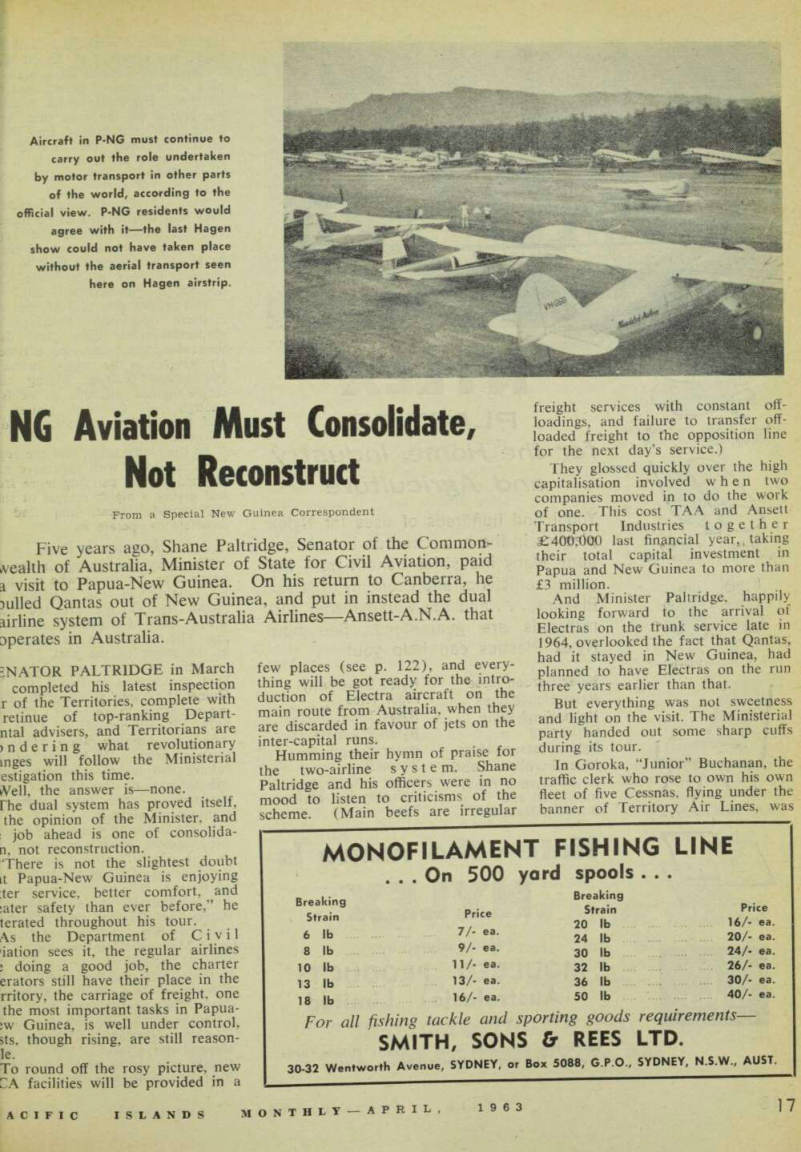
Aircraft in P-NG must continue to carry out the role undertaken by motor transport in other parts of the world, according to the official view. P-NG residents would agree with it—the last Hagen show could not have taken place without the aerial transport seen here on Hagen airstrip.
told to get out of the Southern H lands, the province of “Junior’s” Cessnas have been s ping in and out of Mendi and o Southern Highlands ports, skimc the cream off the runs that An MAL hold the licence for. (An MAL inherited the licence f MAL, who in turn took it < from Bobby Gibbes’ Gibbes-S< Airways.) Said Director-General Ander “We told Buchanan that he must cut the heart out of the reg operator flying airline routes. He be given a reasonable time to ad himself to his proper role—if doesn’t, the shutters will fall.”
The proper role of TAL and ol charter operators, Paltridge Anderson made quite clear dui their visit, was to develop a taste air services in the rugged outback Papua-New Guinea. Flying chc single-engined aircraft, to fields enough only for such planes, t had the task of pioneering and velopment.
As the traffic grew, and the regi lines moved in with expensive mi engined planes, carrying more frei and giving a bigger margin of saf« they must retreat, and find r frontiers to operate in.
Romance is Past There lay the message in the M ister’s tour for those who would it—aviation in the Territory grown up. Gone are the belt skelter days of cut-throat charter ing. The romance in the industry ] in the pages of the past.
There are now more than I land aerodromes in Papua and N Guinea. (As well as about 20 alig ing areas for flying boats.) Of the only 17 are owned by DCA— others are Administration, Mission private strips. DCA acts as c« sultant and technical adviser to Administration, and also licenses aerodromes used for landings commercial aircraft.
In the financial year up to June 1962, almost 300,000 passengers flf in and out of Territory airports, a freighter aircraft lifted 56,000 to of freight. The extent to which freight remains th e lifeblood Papua-New Guinea’s remote highlas areas is shown by the fact that II year, Madang airport handled 17,1 tons of freight.
This figure was exceeded by or two airports in Australia—Melbourr 21,400 tons, and Sydney, 19,400 to< Goroka, the crossroads of t Eastern Highlands, received as shipped out a total of 9,800 tons freight, almost as much as the a, ital city of Brisbane (11,700). Aj
his with a fleet of planes in which Bristol freighter is the biggest aft! his freight is carried today in sup of steady economic growth, not, n the romantic record-shattering ; of the goldrushes, to ship in i heavy dredges. Then, the planes rned to the coast empty, oday they carry out an increas y important cargo of coffee, :tables, and highlanders to pro the essential labour on coastal tations and in the towns, he magnitude of the aerial trans task in New Guinea is under i by the statistics of the fleets, nere 40 aircraft in the three air 5, TAA, Ansett-MAL and Papuan ine Transport, carry the vast bulk he traffic. nd the front-line aircraft, for ;enger and freight haulage, re n the 23 DC3’s that are used •ywhere there are fields big ugh to let them land, lost of the DC3’s used in the ritory were built during the war, have been flying for about 20 rs. Few of the parts in them are / original equipment, but the ply of spares never seems to dry How Much Longer?
Nevertheless, many people are
idering how long the DC3’s can p going, and what will take their ce when they have to go. At pre t, there is no replacement in sight hin the financial reach of the •ritory’s airlines. The book value a DC3 is around £15,000, and ;rest on its capital cost is there e an insignificant part of the line’s cost structure. The modern livalent of the DC3, the Fokker iendship, can cost, with spares, up
to £300,000, and interest repay ments become a staggering burden.
At this point, the utilisation of the aircraft becomes the critical factor.
There is no night-flying in Papua- New Guinea. Cumulo-nimbus clouds towering up to 60,000 feet dominate the mountains, and can tear a plane to shreds should it venture into them.
Only some few key coastal aero dromes are equipped with runway lighting, and for many years to come, it will not be possible to provide navigational facilities capable of guiding planes automatically into dangerously-situated airports, even if they can safely negotiate th e mountains and the storms.
The 23 DC3’s in Papua and New Guinea average, throughout the year, a bare 2i hours flying time a day.
In Australia, the major airlines manage to keep their front-line planes, Electras, in the air for more than nine hours a day. Ansett-ANA and TAA average about 6i hours daily with their Fokker Friendships, while small airlines do even better.
The Australian record for utilisa tion at the moment is held by Mac- Robertson Miller Airlines of Western Australia, which manages to keep its own Friendship flying an average of more than KH hours a day, all through the year.
These figures make it quite plain that Papua and New Guinea cannot hope for planes like the Friendship for a long time to come.
Senator Paltridge puts it this way: “When a small aircraft manufac turer sees the need for a replace ment for the DC3 for countries like Papua-New Guinea, and other similar parts of the world, and at the same time, sees the possibility of making it at acceptable cost, you will get the plane you want.”
Until then, the people of the Territory will bump around the country on the mixed freight runs, continue to strip the mudguards off their cars to get them into planes for the Highlands, and become even more familiar with the old DC3’s.
But if the planes remain the same, the safety standards are vastly im proved. It is now some years since the Department of Civil Aviation put an end to the old post-war per formance standards that permitted
DC3’s to take off with 30 or more passengers. There was a storm of protest at the time over this action, but in a quite unspectacular fashion, it has been responsible for saving many lives.
The fact is, the old standards allowed a DC3 to be loaded so heavily that it could not maintain
height on one engine, if the other failed during take-off. This might have been an acceptable risk when there were only two or three aircraft flying, but today there are 46 engines that can fail on take-off.
The Department of Civil Aviation sees the immediate future as a time of steady growth and development for aviation in Papua and New Guinea. It is not so sure about the long term.
Air transport, in the long run, it believes, will not fully develop an area. Aviation brings “pocket” but not “area” development.
In his annual report to Parliament last year, Senator Paltridge pointed out that because of the immense capital cost of pushing road projects through rapidly in New Guinea, it was clear that air transport must continue to substitute for the largely non-existent surface transport, and must provide communications to new or slowly developing outposts, “However,” he said, “the air transport industry must be developed now towards its correct ultimate role of providing safe, fast and regular passenger services; the fast and frequent distribution of mail; and the
fast freighting of items which their value or the required urge of their delivery can absorb higher cost of air transport.”
The Territory can look for development of aviation along th lines.