The Editors Mailluay
p. 16 · Read in the full issue
Vote 1, A. C. Yava
,- r» .
Mrs. Thomas B Davis, of Camanl- 10, California, writes ; For about a year now, I have been an interested reader of the Pacific Islands Monthly, which we receive in our Technical Library at the United States Naval Missile Center at Point Mugu, where I am employed.
One reads interesting bits about persons whom one would not normally know about, i.e., missionaries, teachers, and other usually considered unimportant people. PIM is like a small town news-sheet.
For this reason, I have looked through each issue as it arrived, fully expecting some mention of a young Fijian who spent some six years studying in this country and who has returned with a Bachelor of Science degree from the University of Colorado and a Bachelor of Theology degree from the Western Bible Institute, both institutions of learning located at Denver, Colorado.
In addition, he served as South Pacific delegate at a Christian Literature Seminar held at Green Lake, Wisconsin last summer, has taught at the Western Bible Institute, and was ordained prior to his departure from this country.
In addition to all this, Alifereti C.
Yaya returned as South Pacific Gen eral Secretary of Christian Literature under the Methodist banner and is, at this moment, principal of the first in digenous high school located at Nau sori which has facilities for some 400 students and 10 teachers.
Mr. Yaya spent nine days in Cali fornia before his sailing on the Oriana, December 3, spoke some 24 times, both formally and informally and was well received by all who heard him.
Mr. Yaya has done work on his Master’s degree which he hopes to complete in Australia soon.
I have been under the impression that this young man, through no word of his, however, is most unusual. It does not seem a casual thing for the average young 19-year-old to receive a scholarship and travel some 5,000 miles or more to study. Great things can be expected from this young man in the future years. Perhaps in not the way that some would like since he has dedicated his life to God for the extension of His kingdom.
I trust that this brief bit of in formation will incite you to get busy and investigate this young man and present him to the people, too. The January issue of PIM has just been received here and I would have en joyed seeing the picture of this man on the cover instead of Aggie Grey’s.
Let’s give the coming personages a bit of attention, too.
How Many Dollars
Make a £?
Apropos a panel in PlM’s Feb ruary issue, page 75, the Bank of American Samoa has sent us a copy of its latest rates of exchange, US dollars against the £Stg. It shows that the bank pays $13.75 for a £5 Stg. traveller’s cheque, not $12.50 like the Rainmaker Hotel. The Bank said also; “You are correct in stating that our bank is open for business from 8 a.m. to 12 noon daily, Monday thru Friday, but our staff is on duty from 7.45 until approx. 5 p.m. daily.
“In many instances we have ac commodated tourists requiring US dollars in the late afternoon when they have approached us.” • We are very glad to hear it.
We didn’t say that the bank gave the same rate as the Rainmaker—only that we were told [by the Rainmaker ] that it did, and that we had no way of finding out because while we were
there, Friday afternoon thru week-end, the bank was closed, don’t know how tourists “approi the bank” and get accommoda when it’s closed. When we were t it ‘shut up at noon” we didn’t e\ try. We patronised, instead, a gene store up the street where the rate also $2.75 to the £Stg. While were there getting it, an Amerh came in to cash what looked to his pay cheque.
He said that in the four years h been in Pago the bank had ne once been open during the hours could have used it and he theref had never been inside it. This fell might also be talking through his h if so it proves that not only are th people in Pago who don’t know h many dollars make a £, but so who don’t appreciate the facilh offered by their local bank.
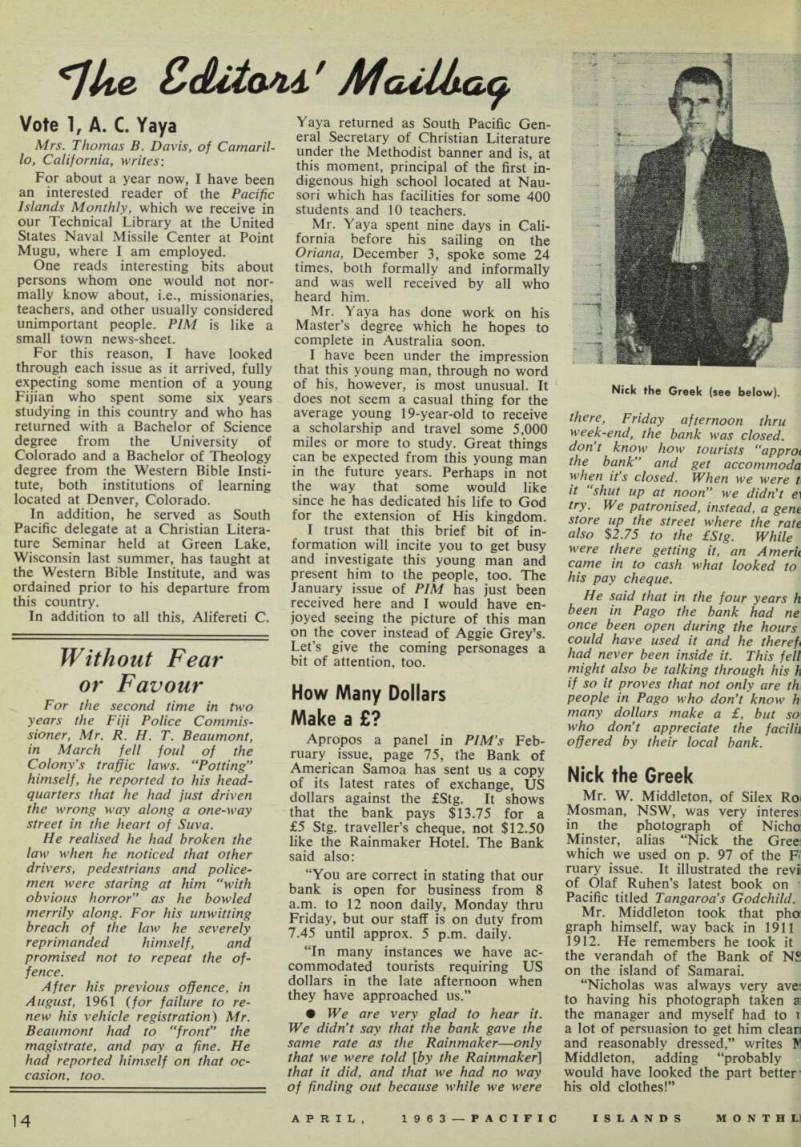
Nick the Greek
Mr. W. Middleton, of Silex Ra Mosman, NSW, was very interes in the photograph of Nicho Minster, alias “Nick the Gree: which we used on p. 97 of the F ruary issue. It illustrated the revi of Olaf Ruhen’s latest book on i Pacific titled Tangaroa’s Godchild.
Mr. Middleton took that pha graph himself, way back in 1911 1912. He remembers he took it the verandah of the Bank of NS on the island of Samarai.
“Nicholas was always very ave; to having his photograph taken a the manager and myself had to t a lot of persuasion to get him clean and reasonably dressed,” writes K Middleton, adding “probably would have looked the part better his old clothes!”
Nick the Greek (see below).