Indonesian Take-Over Poses
pp. 10-11 · Read in the full issue
Flying Trouble-shooters for Border:
Indonesian Take-Over Poses Serious Problems For P-NG
From Stuart Inder, in Canberra Indonesia has told Australia that it will not necessarily accept the present boundaries of the P-NG-West NG border after Indonesia officially takes over West New Guinea on May 1.
ALTHOUGH high Australian offi cials regard this as merely a “routine legal” statement with no ul terior motive (for the border was fixed by the Dutch) they are appre hensive that a dispute may arise very soon in one particular area, known as the Waris enclaves.
This is an area in the Sepik where West New Guineans have for years been living on the Australian side of the border and where even the Dutch flag was flying until the Netherlands left last October.
Since last October West New Guinea has been under the control of the United Nations but it will be officially handed over to Indonesia on May 1.
Treaty of 1895 The border between the two Terri tories generally follows the 141st meridian. At one stage it follows the Fly River where the Fly bulges into West New Guinea territory—a device made so that the whole of the Fly was got into the Australian side .
Under the Treaty that fixes this, made between Holland and Britain in 1895, both sides are entitled to
navigate on the Fly at this point, al though they are not permitted to use the river “for the carriage of warlike stores”.
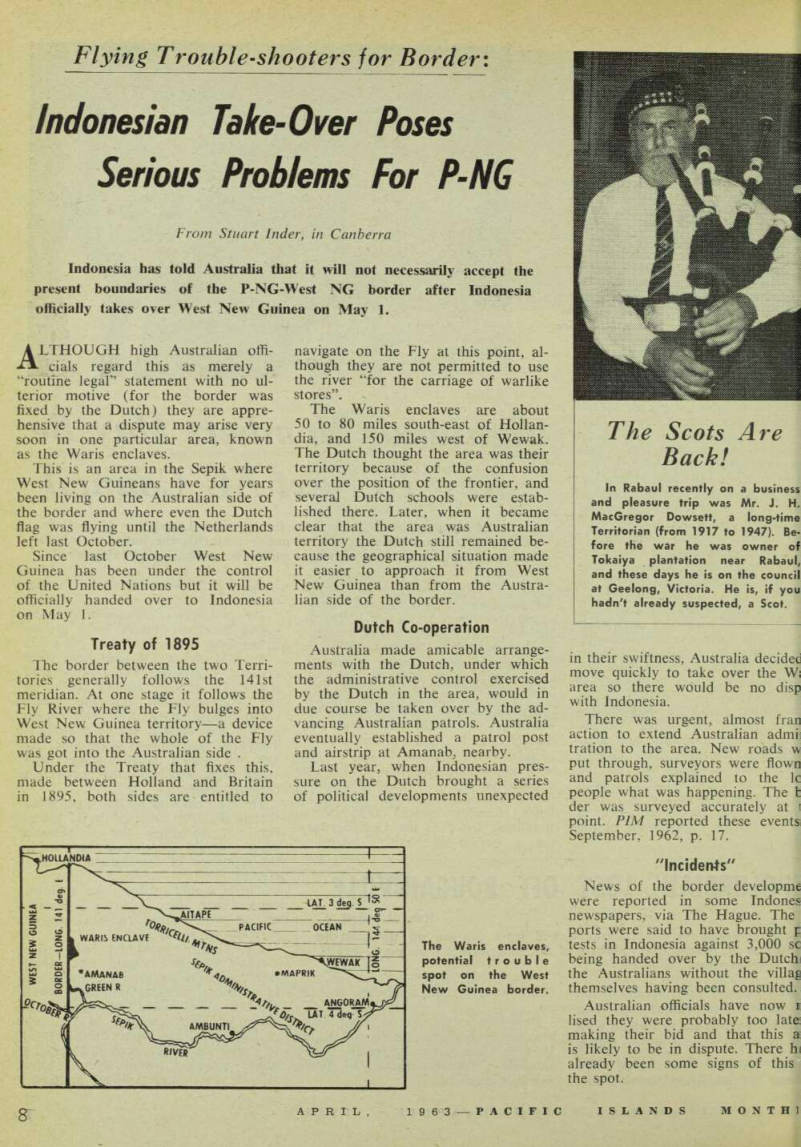
The Waris enclaves are about 50 to 80 miles south-east of Hollan dia, and 150 miles west of Wewak.
The Dutch thought the area was their territory because of the confusion over the position of the frontier, and several Dutch schools were estab lished there. Later, when it became clear that the area was Australian territory the Dutch still remained be cause the geographical situation made it easier to approach it from West New Guinea than from the Austra lian side of the border.
Dutch Co-operation
Australia made amicable arrange ments with the Dutch, under which the administrative control exercised by the Dutch in the area, would in due course be taken over by the ad vancing Australian patrols. Australia eventually established a patrol post and airstrip at Amanab, nearby.
Last year, when Indonesian pres sure on the Dutch brought a series of political developments unexpected
in their swiftness, Australia decided move quickly to take over the Wi area so there would be no disp with Indonesia.
There was urgent, almost fran action to extend Australian admii tration to the area. New roads w put through, surveyors were flown and patrols explained to the 1c people what was happening. The t der was surveyed accurately at i point. PIM reported these events; September, 1962, p. 17.
"Incidents"
News of the border developme were reported in some Indones newspapers, via The Hague. The ports were said to have brought p tests in Indonesia against 3,000 sc being handed over by the Dutchi the Australians without the villag themselves having been consulted.
Australian officials have now it Used they were probably too late making their bid and that this a is likely to be in dispute. There hi already been some signs of this the spot.
The Waris enclaves, potential trouble spot on the West New Guinea border.
The Scots Are
Back!
In Rabaul recently on a business and pleasure trip was Mr. J. H.
MacGregor Dowsett, a long-time Territorian (from 1917 to 1947). Be fore the war he was owner of Tokaiya plantation near Rabaul, and these days he is on the council at Geelong, Victoria. He is, if you hadn't already suspected, a Scot.
here should be no reason why all present border, as confirmed by Treaty in 1895, should not be jgnised by Indonesia. But abbles over the people in the ris area could well create embar ment, lobody wants any border inci ts, and Australia is not likely to dally admit that they are a pos lity but I am convinced there are le worried people in high places ause of the imminent take over in st New Guinea. ; is no coincidence that the P-NG ninistration chose Wewak, in the ik, as the site for its second 0 broadcasting station (the other n Rabaul). The new station was ned by the Administrator, Sir laid Cleland, on March 25. It bring news in Pidgin several ;s a day. 1 opening the station the Adminis or did not mention that its trans ;ers would soon be replaced with e powerful ones ordered in Aus lia. They are required so that lio Wewak can better compete i the powerful transmitter at pre operated by the UN across the der in Hollandia.
Quarantine Problem he UN station presents plenty of fit music and is popular in the ik. But in May, Hollandia will be imed Kotabaru and the Indo ans may well change the tune of transmitter too.
Indoubtedly the biggest cause of rehension by the Australian Gov nent is the matter of quarantine rictions. hree of the most feared animal ases are firmly established in In esia—foot and mouth disease, ch attacks all cloven-footed ani s, Newcastle disease, which at :s poultry, and rabies, which at ts all warm blooded mammals, in ling man.
If these diseases pass to West New Guinea and then across the border there is also a possibility of them getting to Australia. But they would cause vast damage in New Guinea— foot and mouth disease could deci mate the native pig population.
Australia wants Indonesia to tigh ten quarantine restrictions between Indonesia and West New Guinea, but has met with a great deal of diffi culty. There have been published re ports that Indonesia has “rejected” the Australian moves, and Australia has officially denied this. While it is certainly true that avenues have not been closed. I understand that Indo nesia has not been showing much co operation and understanding and that Australian health authorities are more concerned about this than they will admit publicly.
Special Plan
To help meet the position Austra lia has got under way a scheme of
border quarantine control using specially trained teams of trouble shooters who can be flown to border areas at 24 hours notice.
The teams, based in Port Moresby, would operate in fully-equipped DC3 aircraft, and would be able to carry out spraying and vaccination cam paigns.
Six airstrips along the Australian border, from Vanimo on the north coast to Morehead on the south coast, are now being brought to DCS stan dard (Vanimo is already at a suitable standard) so that this scheme can operate as soon as possible.
Australian officials do not delude themselves that these teams can be 100 per cent, effective. The border is too long and too rugged to be adequately controlled, either from a defence or a quarantine point of view.
Much will depend on the goodwill, sincerity, and co-operation of Austra lia’s big new neighbour.
Off To See The Queen
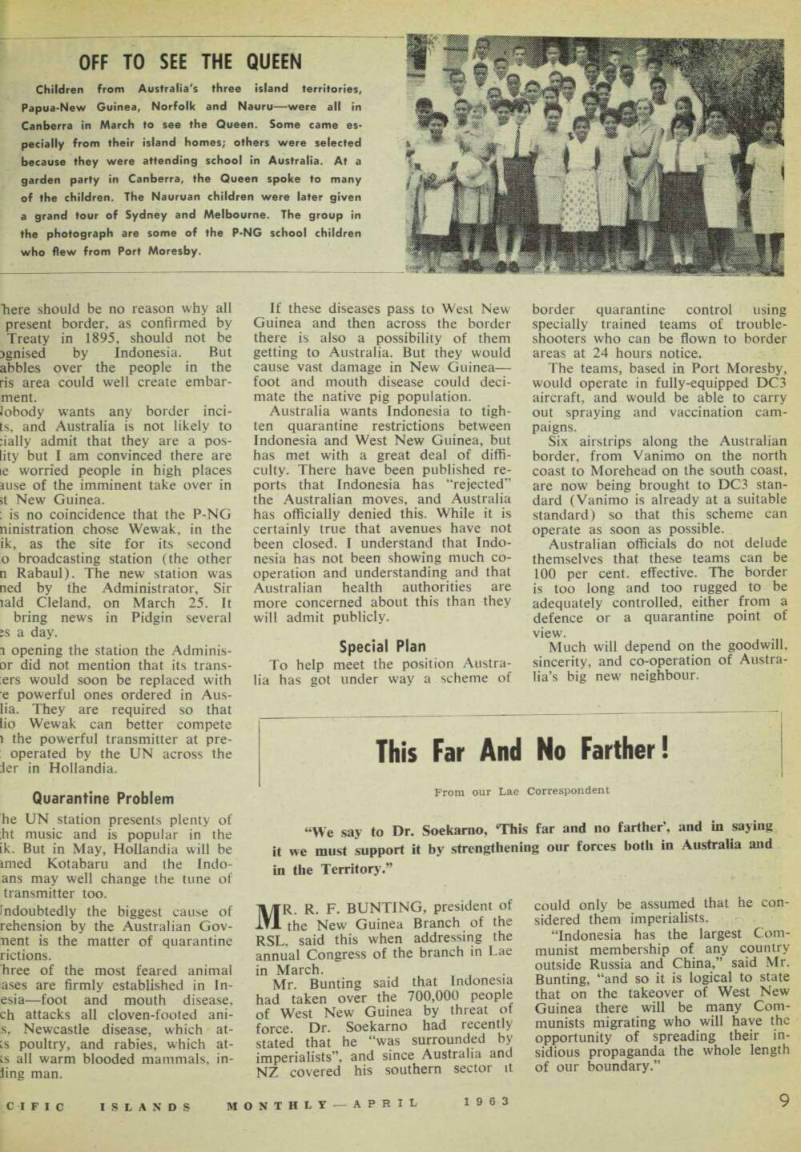
Children from Australia's three island territories, Papua-New Guinea, Norfolk and Nauru—were all in Canberra in March to see the Queen. Some came es pecially from their island homes; others were selected because they were attending school in Australia. At a garden party in Canberra, the Queen spoke to many of the children. The Nauruan children were later given a grand tour of Sydney and Melbourne. The group in the photograph are some of the P-NG school children who flew from Port Moresby.