Swift, Fundamental Changes To
pp. 7-9 · Read in the full issue
Fit P-Ng For 1964
From Judy Tudor, in Port Moresby One way and another 1964 will probably turn out to be the momentous year in Papua-New Guinea’s history. For the first time it will have a legislative body removed from Port Moresby or Canberra domination and it will have, as well, new judicial and administrative machinery that will completely change the fundamental principles of government as they have been known there since the 1880’s.
TO this extent 1963 is a year of preparation. The bills already before the present Legislative Coun cil and postponed for debate later this year will, when passed, lay the foun dation for far-reaching and funda mental changes and provide a basis upon which some form of self government could be erected long be fore the 10 years now envisaged by most people in Papua-New Guinea.
The most important of the bills in
dicating the shape of things to come are those seeking to set up local and district courts. There is also the Land (Tenure Conversion) Bill and enab ling legislation still to come for set ting up the new legislative body to be called the House of Assembly.
Another fundamental change in the 1963-64 period will probably be the demise of the Department of Native Affairs, as such [see p. 21]. Although long the glamour department (under this or other names), in both Terri tories, the very heart and core of ad ministration in primitive and more sophisticated areas alike, its powers and functions are already being whittled away and distributed else where. Concurrently in this period there will probably be changes in the areas and functions of the districts— six in Papua and nine in New Guinea —as they are now known.
Battle For The Native Members The new House of Assembly will have 10 official members, 44 mem bers elected from open electorates— which means they will all be native— and 10 non-indigenous members elected from reserved electorates. In the present Legislative Council of 37 there are 12 native members—half of them elected. Of the 12 only four or five have been of value to Council deliberations; the rest have such limited horizons as to be useless; or they are virtually inarticulate.
It is just a matter of mathematical calculation then, to arrive at the con clusion that of the 44 native members in the new House of Assembly, about 30 of them will find their first term of office in parliament bewildering and at best educational; and it is also pretty obvious that control of the House will early develop into a mat ter of whether it will be the 10 offi cial members or the 10 non indigenous elected members who will control the native members and carry them along.
In the past, the interest of the ex
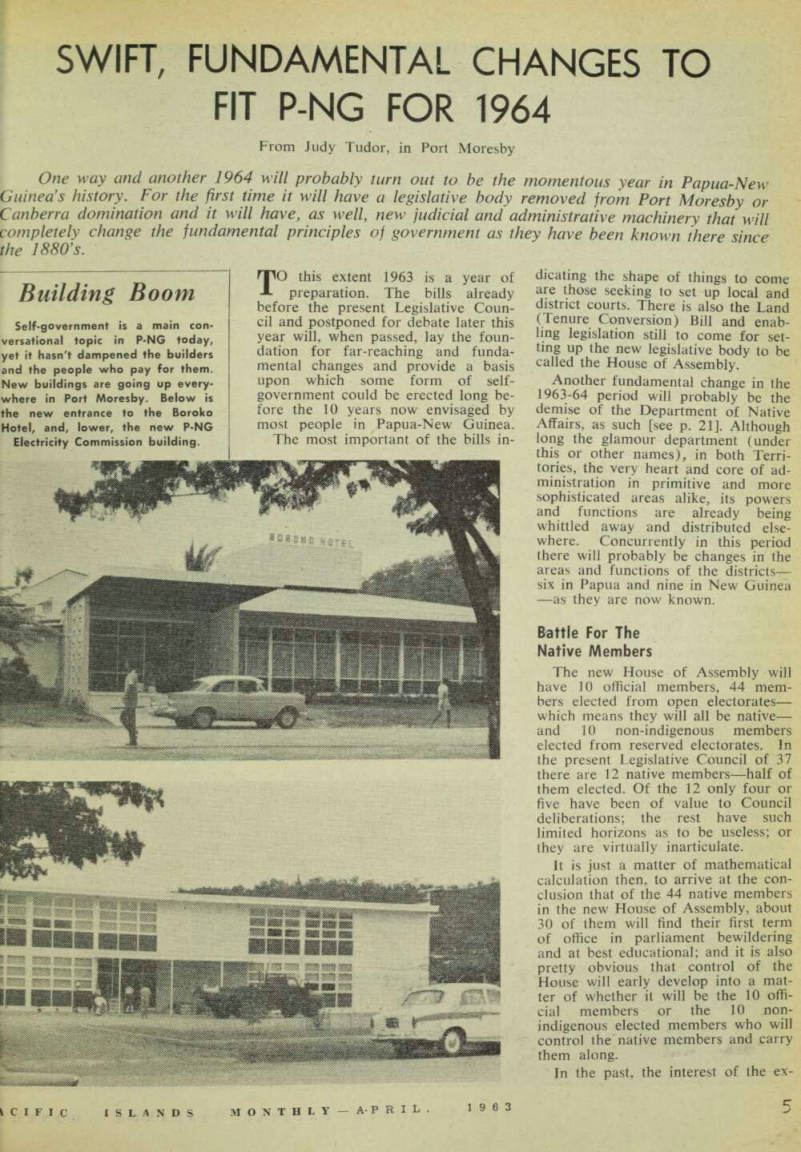
Building Boom
Self-government is a main con versational topic in P-NG today, yet it hasn't dampened the builders and the people who pay for them.
New buildings are going up every where in Port Moresby. Below is the new entrance to the Boroko Hotel, and, lower, the new P-NG Electricity Commission building.
patriate residents of Papua-New Guinea in local politics has been pathetically weak, to the extent that although thousands were eligible to vote, only hundreds elected to do so.
Part of this apathy was due, of course, to the fact that the Council was dominated by official members, and as a reflection of this, it has also been difficult to interest Europeans in standing for the elected seats In 1964 Europeans will have to find candidates for 10 seats, and they will have to be men who not only represent European interests but who have influence and prestige amongst the native people.
Possible Candidates A challenge of this sort usually throws up the right people and already there are whispers in the Ter ritory that certain high-placed Gov ernment officers near retiring age, whose mana is high with the natives, may resign to contest the elections as private members. If past experience is any guide, this could be a good thing— two of the most vigorous elected members of the present Legis lative Council, lan Downs and Lloyd Murrell, are both ex-Administration officers converted to private enter prise.
If the P-NG Administration appre ciates the fact that the new House of Assembly can be led only through the native members, there could be a
new line-up of talent on official benches, also. If, however, it relies, as in the past, in a solid phalanx of departmental heads it could find itself left for dead in the battle for the native mind.
Although they may be technica talented in their own line of count: departmental heads do not ha direct contact with the natives in t districts as do the District Comm sioners, District Officers and Ass tant District Officers.
But whatever may be the outcon of this struggle for influence, there: nothing more certain than that t new legislative set-up will allow Ni Guinea, by sheer weight of numbe; to get its own back on Papua—ai in particular on the galloping grow that is Port Moresby, Although all the foundations a being laid for the painless severan of the Territory from Australia, wh and if it is expedient, the Admin tration continues to build in P» Moresby as though it intended to sti a thousand years.
The suburb of Boroko, whi houses the bulk of European pulx
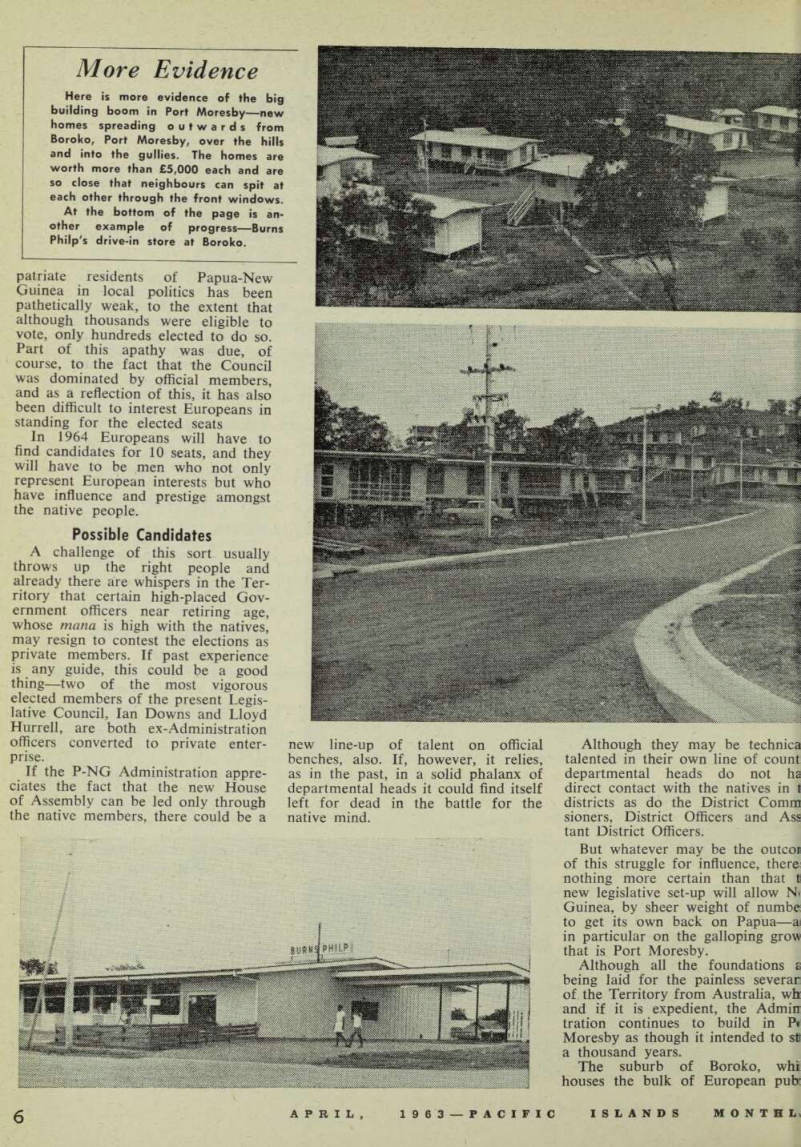
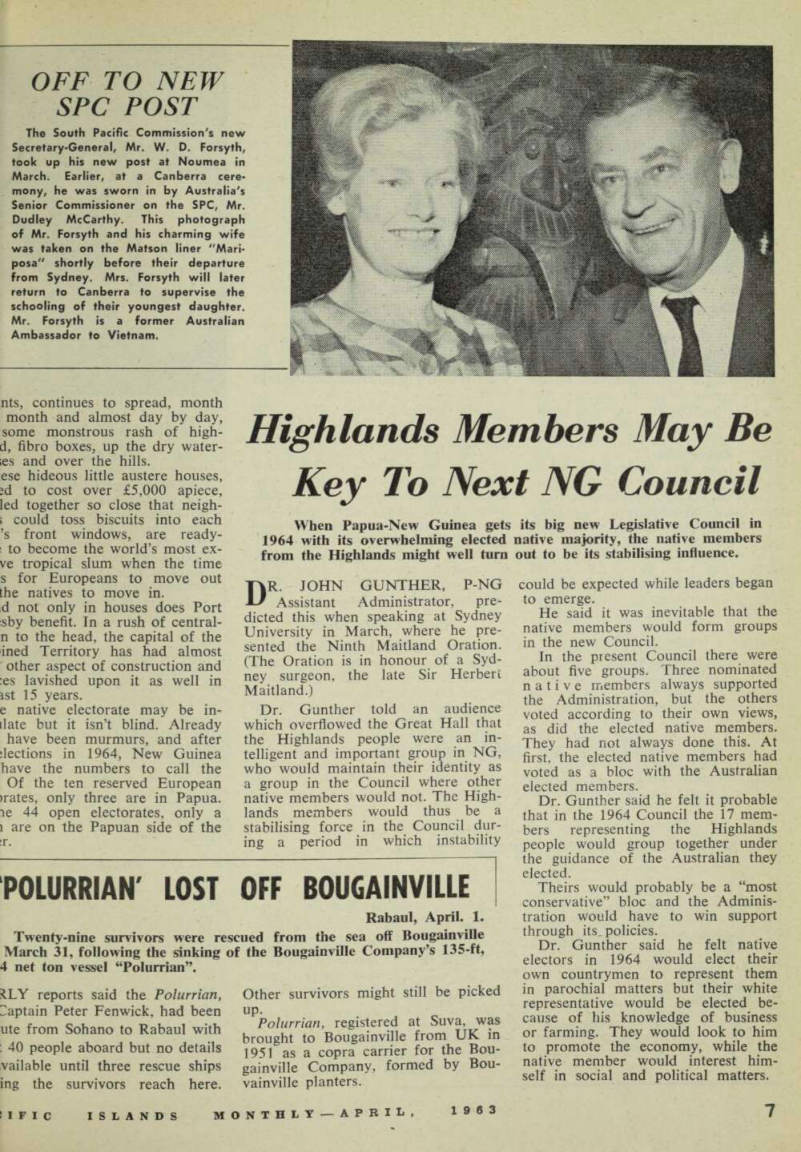
More Evidence
Here is more evidence of the big building boom in Port Moresby—new homes spreading outwards from Boroko, Port Moresby, over the hills and into the gullies. The homes are worth more than £5,000 each and are so close that neighbours can spit at each other through the front windows.
At the bottom of the page is an other example of progress—Borns Philp's drive-in store at Boroko.
nts, continues to spread, month month and almost day by day, some monstrous rash of high d, fibro boxes, up the dry water es and over the hills, ese hideous little austere houses, d to cost over £5,000 apiece, ed together so close that neigh could toss biscuits into each s front windows, are ready to become the world’s most ex ve tropical slum when the time s for Europeans to move out the natives to move in. d not only in houses does Port sby benefit. In a rush of central n to the head, the capital of the ined Territory has had almost other aspect of construction and :es lavished upon it as well in ist 15 years. e native electorate may be in ilate but it isn’t blind. Already have been murmurs, and after elections in 1964, New Guinea have the numbers to call the Of the ten reserved European >rates, only three are in Papua, le 44 open electorates, only a i are on the Papuan side of the ir.