Native Ketch From Shipwreck
pp. 132-133 · Read in the full issue
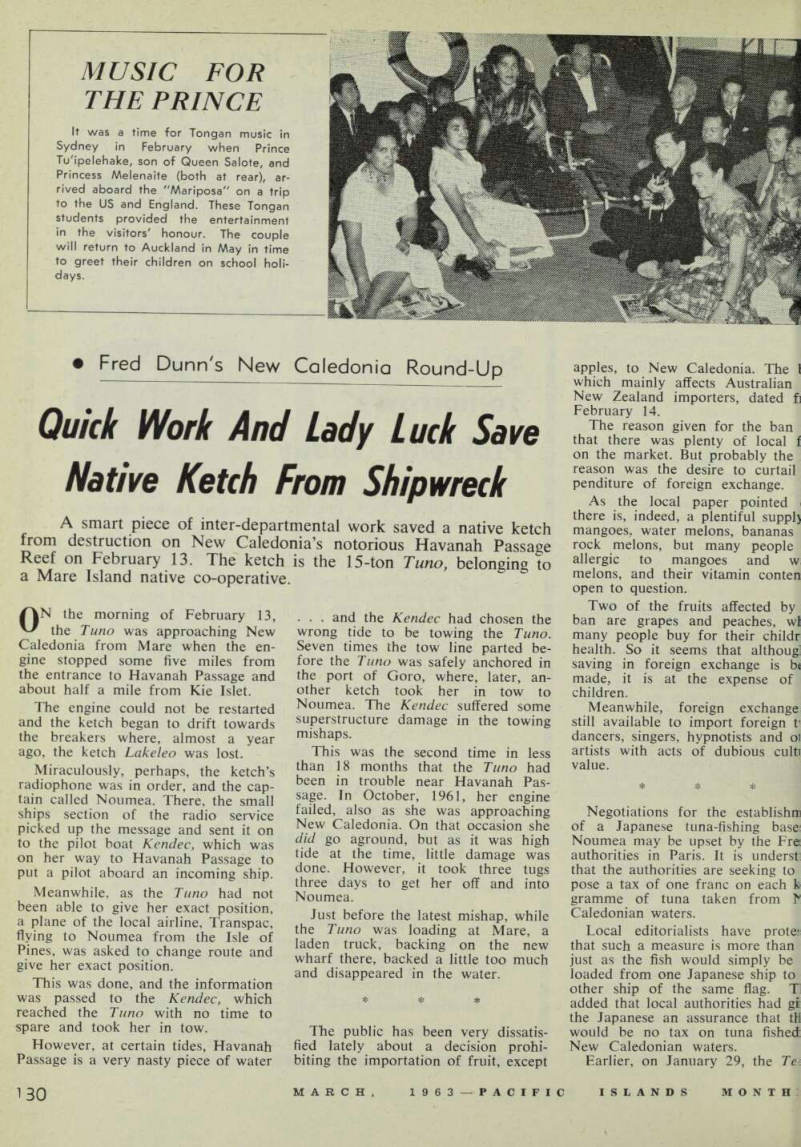
• Fred Dunn's New Caledonia Round-Up
Quick Work And Lady Luck Save Native Ketch From Shipwreck
A smart piece of inter-departmental work saved a native ketch from destruction on New Caledonia’s notorious Havanah Passage Reef on February 13. The ketch is the 15-ton Tuno, belonging to a Mare Island native co-operative.
/\N the morning of February 13, ” the Tuno was approaching New Caledonia from Mare when the en gine stopped some five miles from the entrance to Havanah Passage and about half a mile from Kie Islet.
The engine could not be restarted and the ketch began to drift towards the breakers where, almost a year ago, the ketch Lakeleo was lost.
Miraculously, perhaps, the ketch’s radiophone was in order, and the cap tain called Noumea. There, the small ships section of the radio service picked up the message and sent it on to the pilot boat Kendec, which was on her way to Havanah Passage to put a pilot aboard an incoming ship.
Meanwhile, as the Tuno had not been able to give her exact position, a plane of the local airline, Transpac, flying to Noumea from the Isle of Pines, was asked to change route and give her exact position.
This was done, and the information was passed to the Kendec, which reached the Tuno with no time to spare and took her in tow.
However, at certain tides, Havanah Passage is a very nasty piece of water
• . . and the Kendec had chosen the wrong tide to be towing the Tuno.
Seven times the tow line parted be fore the Tuno was safely anchored in the port of Goro, where, later, an other ketch took her in tow to Noumea. The Kendec suffered some superstructure damage in the towing mishaps.
This was the second time in less than 18 months that the Tuno had been in trouble near Havanah Pas sage. In October, 1961, her engine failed, also as she was approaching New Caledonia. On that occasion she did go aground, but as it was high tide at the time, little damage was done. However, it took three tugs three days to get her off and into Noumea.
Just before the latest mishap, while the Tuno was loading at Mare, a laden truck, backing on the new wharf there, backed a little too much and disappeared in the water. * * * The public has been very dissatis fied lately about a decision prohi biting the importation of fruit, except
apples, to New Caledonia. The I which mainly affects Australian New Zealand importers, dated fi February 14.
The reason given for the ban that there was plenty of local f on the market. But probably the reason was the desire to curtail penditure of foreign exchange.
As the local paper pointed ■ there is, indeed, a plentiful supply mangoes, water melons, bananas rock melons, but many people allergic to mangoes and w melons, and their vitamin conten open to question.
Two of the fruits affected by ban are grapes and peaches, wl many people buy for their childr health. So it seems that althougl saving in foreign exchange is b« made, it is at the expense of children.
Meanwhile, foreign exchange still available to import foreign t’ dancers, singers, hypnotists and ol artists with acts of dubious culti value. * * * Negotiations for the establishm of a Japanese tuna-fishing base: Noumea may be upset by the Fre: authorities in Paris. It is underst: that the authorities are seeking to pose a tax of one franc on each k gramme of tuna taken from I* Caledonian waters.
Local editorialists have prote:; that such a measure is more than just as the fish would simply be loaded from one Japanese ship to other ship of the same flag. T added that local authorities had gi the Japanese an assurance that tH would be no tax on tuna fished New Caledonian waters.
Earlier, on January 29, the Tei
u, mother ship of some 50 Jap e trawlers operating near New idonia, arrived in Noumea to sship fish to the Banshy Mam. )tal of 435 tons were transferred shipment to Japan. The Tenyo u then took on fuel oil and food svictual the trawlers at sea. le Tenyo Mam has two crews, of 58 to run the vessel, and an r to look after the fish. She also ies two policemen to maintain r and represent the Japanese eminent. be ship was in mourning when docked at Noumea, as, a few s off the New Caledonia coast, a r member was caught up in a :h and was killed instantly, arlier, at Santo, New Hebrides, a f member was bitten by a shark :h had been hoisted on deck and her man got a big fish hook in leek. Both men were left in hospi n Santo. * * * igh Chief Naisseline, of Mare, jd the question of equal treatment New Caledonian natives in a re debate in the Territorial As bly. He said that natives should * the same rights as other French
citizens, particularly as they now had to do the same military service as Frenchmen.
High Chief Naisseline asked that the Native Affairs Bureau be abolished and that native affairs be handled through the same channels as those of other citizens.
He also pointed out that whereas civic marriages, essential under French law, are conducted by the mayors of each centre in the case of white citizens, natives still have to appear before the local gendarme to be married. This, according to the high chief, is discrimination.
Another point he made was that whereas a white citizen is issued with a livret de famille when he marries for the recording of births and deaths, a native citizen does not get one.
Following High Chief Naisseline’s speech, the question of allowing natives access to all types of liquor came up for discussion.
The Government promised to take up this prickly subject later. As for the weddings, it promised that a changeover from gendarmes to mayors would be made as soon as
possible.
Calling The
Cooks
A visitor to Australia in February was Temangi Moerua, now with the Cook Islands radio station as an announcer, but well-known in Wellington where he was with the Department of Island Territories and for some time the man be hind the popular radio session "Calling the Cook Islands". Moerua Visited Sydney and Melbourne on vacation.