Bitter Attack On New Tax
pp. 127-129 · Read in the full issue
“The Smell Of Dictatorship"
Bitter Attack On New Tax Law For American Samoa
From a Pago Pago Correspondent The president of American Samoa’s Chamber of Com icrce, Mr. Douglas (“Mike”) Knuebuhl, has made a bitter ;tack on a new income tax bill, passed by the territory’s mate and Legislative Assembly in late January.
E bill provides for a 2 per cent, tax on wages that are too low to □vered by the graduated scale of ne tax, and imposes the regular ed States tax on all higher ies and income, and on corpora r. Knuebuhl attacked the bill a special meeting of the Cham of Commerce. He described the as “unjust, unsuited to American aa, and harmful to the economic social growth and development of rican Samoa”. j said the chamber had chosen and High Talking Chief Mulita ele to go to Washington to :nt the chamber’s views on the Ve believe that the manner used resenting this bill in the legis e and the methods used to ram bill through are undemocratic,” aid. ts a citizen of the United States, mot bring myself to believe what seen happen here in the past weeks. t has the resemblance of colonal
ism and the smell of an ugly dictator ship. The people of the United States and their elected representatives in Congress and leaders in the Federal Government would not condone this if they knew about it.
“We intend to let them know what has happened. We are convinced that justice and a democratic government can exist here in American Samoa.
“I’m ashamed at this point that I’m a citizen of the United States, and I’m sure that every other citizen of the United States would feel the same if they knew what has happened here.” , , .
The tax bill was passed by the Senate by 12 votes to two, and by the Assembly by 11 votes to 5 after a week-long debate.
Government Concerned
When Governor H. Rex Lee intro duced the bill, he said the US Con gress had expressed considerable con cern over Samoa’s tax system.
Congress realised that import duties in Samoa on food, clothing and other items created a substantial
burden for many Samoan people and that many people and a corporation or so were making big money and could afford to pay taxes but were not doing so.
Governor Lee said he had been directed to have a study made and to take steps immediately to remedy the situation.
A tax expert had come to American Samoa to make this study and had later made the proposals in the bill with other officials in Washington.
“The bill will increase the taxes of people with large incomes,” Gov ernor Lee said, “but a large share of the Samoan people will actually be paying less, as the bill eliminates im port taxes entirely on food and other necessities and places a tax on luxury items.
“The goal is to make this a free port eventually so Samoa can trade freely and build up industries and en courage trade in this part of the Pacific.
Other Bills “US citizens in Samoa who now pay income taxes will continue to do so, but their money will be returned to the Samoan treasury in due course.
“If this tax bill is approved, the land tax will be repealed and also the current head tax. All wage earners will be assessed a flat 2 per cent tax.”
Governor Lee introduced four other bills at the same time as the tax bill. The most important, the Industrial Bill, is designed to en courage more industries to American Samoa by granting tax privileges during the formation of new busi nesses.
After introducing the five bills, Governor Lee said: “I would like to
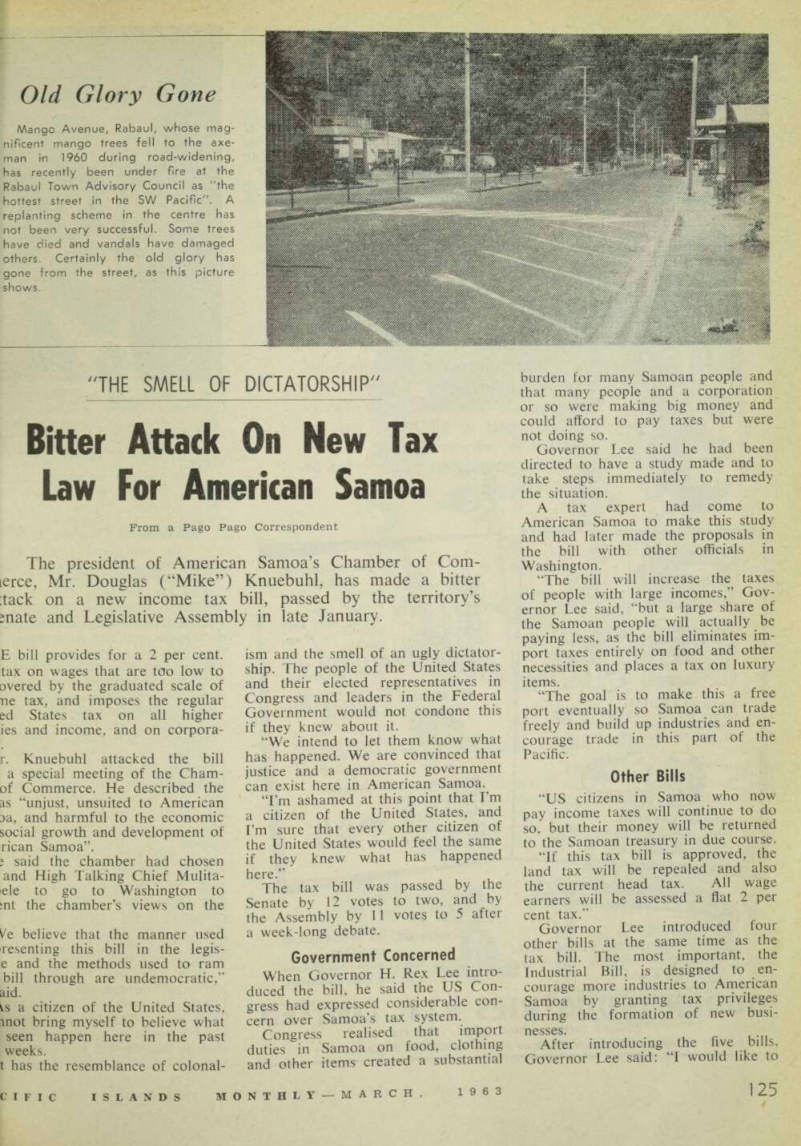
Old Glory Gone
Mango Avenue, Rabaul, whose mag nificent mango trees fell to the axe man in 1960 during road-widening, has recently been under fire at the Rabaul Town Advisory Council as “the hottest street in the SW Pacific". A replanting scheme in the centre has not been very successful. Some trees have died and vandals have damaged others. Certainly the old glory has gone from the street, as this picture shows.
re-emphasise that I think Samoa i the threshold of a very great deve ment.
“This island is going to h shining example in the South Pa —an example for all other is: areas.
“We need to have the laws, t ever, to implement this hope development. If we do not, this velopment means nothing.”
The tax bill was then placet; the hands of Senator Aumoeulac Committees on Ways and Means, during the next few days public h ings were held to get the opinion businessmen and others interested!
Several businessmen strongly posed the bill, claiming that it being rushed through the legislai without thorough study.
However, Mr. Gilbert Van Ca president of the Van Camp T Company, told the committee he thought the bill was a just < and that he would abide by it * his company would remain in opt tion in American Samoa if it vt passed.
Mr. Van Camp said that his c: pany had operated at a loss in its year in American Samoa and then graduated into the pi category. If the tax bill had been effect a year ago, American San would have collected half a mill dollars from Van Camp.
Later, Governor Lee addressed legislature on the tax bill a sec: time.
He said: “The bill has been c: cised because of its form. The c: cism is that the bill is incomplete cause it must be read together v
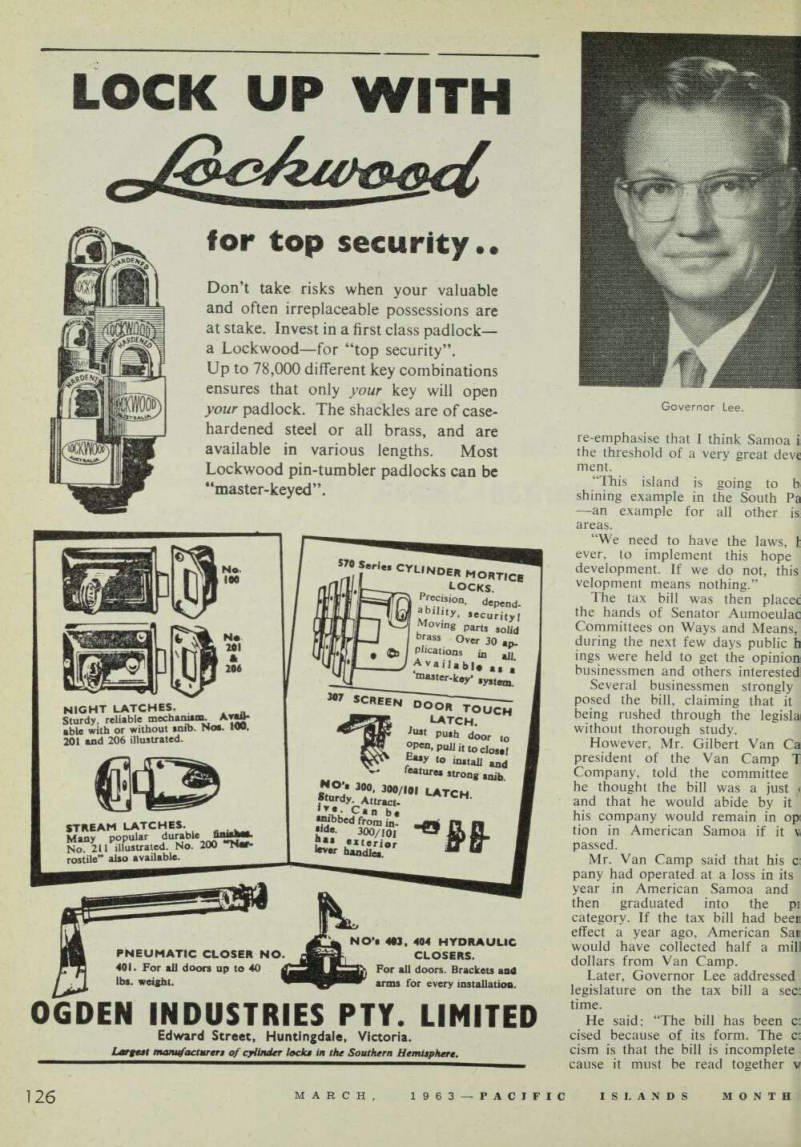
Governor Lee.
US Internal Revenue Code of 1. as amended. although this criticism is valid, it Id not be allowed to affect your ion about the merits of the bill— is, you should consider carefully the bill does, and not be in iced too much by the form of the mother criticism is that we Id not enact a tax bill now, but Id wait until a better bill can be ed. These critics say that some of income tax bill would be all , but not this bill, and, what is ; important, not now.” le Governor added that the bill [d not discourage new industry as would be exempted from all 5, including the new income tax, 10 years if that was necessary to I the industry to American aa. ffer the tax bill was passed, ;rnor Lee and his Specal Assis- Mr. James C. Flannery, left for hington to discuss the 1964 »et with the Congressional Ap riation Committee.