Rarotongan History
pp. 123-124 · Read in the full issue
New Zealand Expedition Revives Interest In Rarotongan History
Under the influence of an archeological expedition from New and’s Canterbury Museum, natives of Rarotonga spent seven cs in December and January busily delving into their history.
IS was the first time an archaeo logical expedition had carried out : in Rarotonga, which is of great est to scientists and historians be ; of its possible role as a staging t for the Maori migrations to Zealand. le expedition was led by Dr. ;r Duff. Other members were Duff’s two sons, Robin and lan, and Mrs. B. N, Norris, of the erbury Museum Archaeological :ty, and Mr. R. H. Parker, an rienced member of the Auckland 'ersity Archaeological Society, supervised the excavations, r. Duff preceded the main party Rarotonga to obtain the co ation of leading chiefs of the i main tribal areas, Au-Ki-Tonga, timu and Arorangi.
Co-operation
lie chiefs were afraid at first that archaeologists might desecrate the aes and other ancient places in ■ areas. But once Dr. Duff made sar that the expedition would con its operations to surveying and rding the history of these places, e was no limit to the co-operation he chiefs and their people, big band of local volunteers took in the investigation of the first —a house site at Arorangi. After n days of digging, the biggers re ed that a stone paepae, which had acted the attention of the ex itors, was probably of a house ted just before or just after the Dduction of Christianity to the
Arorangi tribal area in the 1820’s.
Just before Christmas, the post holes outlining two side walls and one end wall had shown up, and it was reported then that further digging would probably show the method of house construction used before the missionaries introduced the new style of coral lime construction.
The top soil layers at the northern end of the site revealed evidence of a house occupied by the owners of the property until a few years ago.
This evidence was an iron axe-head
and a broken pounder of calcite im ported from Mangaia.
Below and inland from the paepae, traces of one or two houses of the pre-Christian period were found.
Among the finds there were three broken adzes under the ground and several on the surface.
However, the museum party was mainly interested in tracing back the successive stages of disturbance of the soil. In this, they were greatly helped and impressed by the local volunteers who showed great skill in detecting when one soil layer changed into another.
While this work went on, Dr. Duff and another expedition member
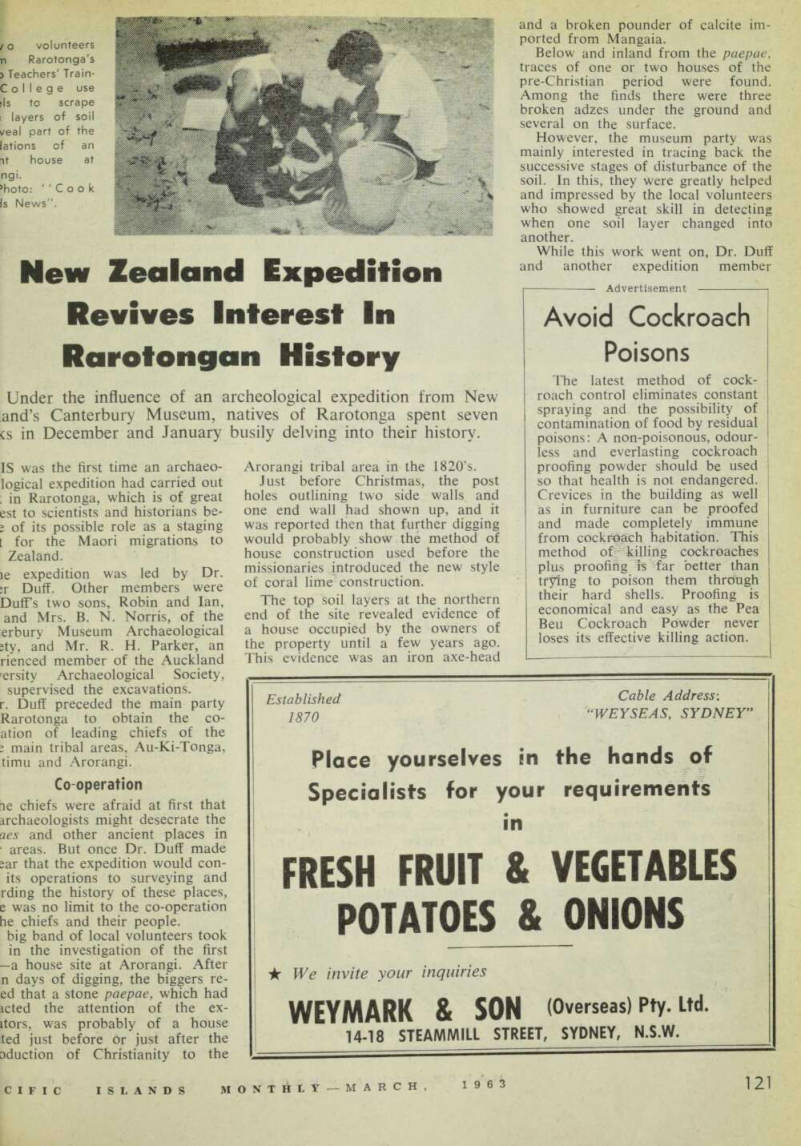
[?] o volunteers [?] Rarotonga's [?] Teachers' Train [?] College use [?]ls to scrape [?] layers of soil [?]veal part of the [?]lations of an [?]t house at [?]ngi.
Photo: ''Cook [?]Is News".
visited other districts to inspect locate well-known maraes and ko in co-operation with leading chid Dr, Duff said on his return New Zealand that pre- and f Christianity houses that had been vealed bore no resemblance to Maori houses in New Zealand.
“One result of our visit,” Dr. 1 added, “was a revival of into among the Rarotongan Maoris their history. Through the activ of the expedition, the Maori pe learnt the value of their old artifi which were formerly thrown a or given away. The nucleus c valuable collection was given to expedition to hand over to museum.
“Although finds of artifacts \ chiefly confined to stone adzes, visit made known the existence more varieties than had been viously reported. As older cult levels are reached on later e: ditions, it should be possible to a date the different adze types t different cultural periods.”
Dr. Duff said that because the Rarotongans apparently made t fish hooks of wood, none was seei found, and stone pounders were prisingly rare.
First of a Programme He said that the expedition’s v, was New Zealand’s first contribu to an archaeological programme Topical Polynesia requested at 1 acific Science Congress in Hono in 1961. Under that programme, Bishop Museum in Honolulu asked New Zealand institutions collaborate in archaeological inv* gations of the Cook Islands, Pitc; Island and Western Samoa.
“Expeditions are planned later year by Otago University to Pitca and by the Auckland University Western Samoa,” Dr. Duff said. 8 these expeditions have been finar through a grant from the Ameri National Science Foundation.”
FOOTNOTE: A paepae is a c* or open space round the house c chief or any person of note, o< defined by stones set in the gro; or by a raised platform of stones coral. A marae is a sacred pi usually consisting of an area of If enclosed by four straight sides nr ing almost at right angles. A ka is the seat or royal court of a 11 chief. Some koutus had one or m maraes within their confines.