"Rags To Riches" Building
pp. 119-122 · Read in the full issue
Firm May Soon Move To The Solomons And Fiji
By Robert Langdon
A French building construction company, which has grown phenomenally from small beginnings in New Caledonia since the war, expects to open a branch in the Solomons later this year and it may also move into Fiji. The company already has branches in the New Hebrides and French Polynesia.
THE parent company in New Cale donia is called the Societe Cale donienne d’Enterprises et de Travaux, commonly known as SCET. In the New Hebrides, the firm is known as SHET—the word “Hebridaise” being substituted for “Caledonienne”; and in French Polynesia it is called SPET —the “P” standing for “Poly nesienne”.
A Frenchman, Mr. R. Faure, founded the parent company 12 years ago. He started with literally nothing, beautifying the servicemen’s cemetery at Bourail, New Caledonia, for the War Graves Commission.
Now his organisation is the biggest building firm in the South Pacific, em ploying more than 1,000 people.
Among the bigger works it has carried out are the enlargement and reconstruction of Tontouta Airport, Noumea, the construction of the air port at Faaa, Tahiti, and Le Nickel s wharf at Noumea.
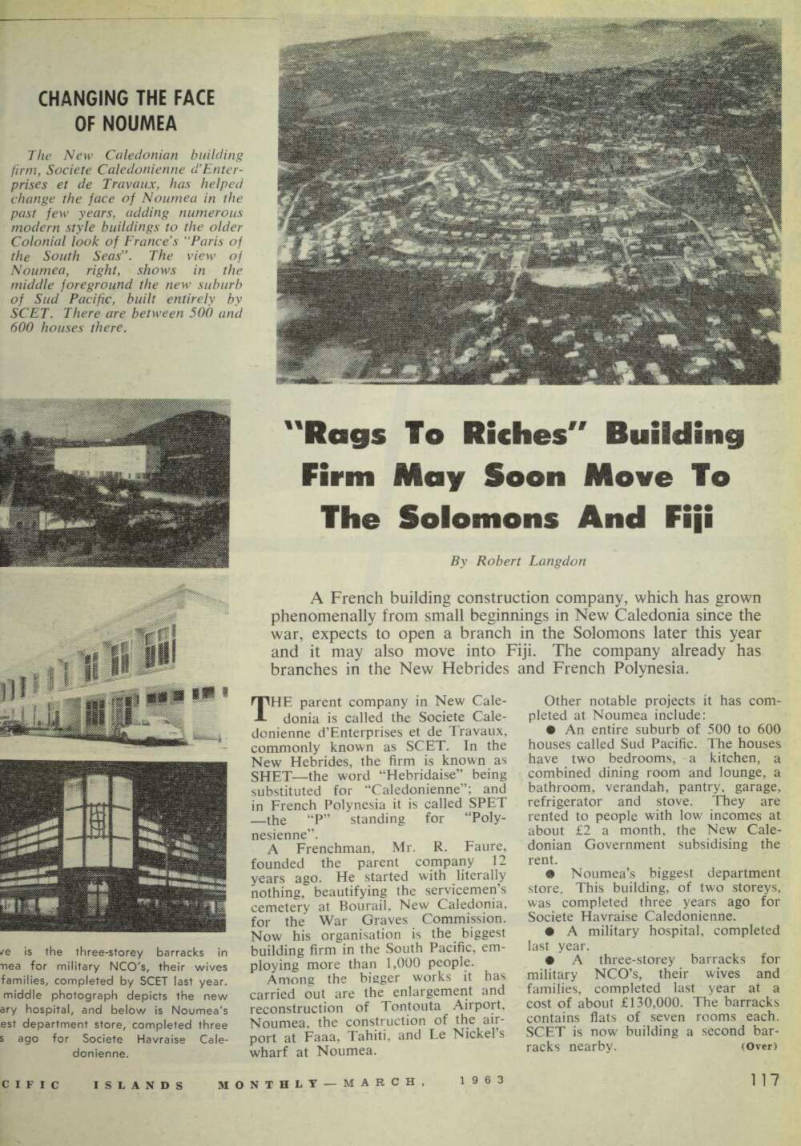
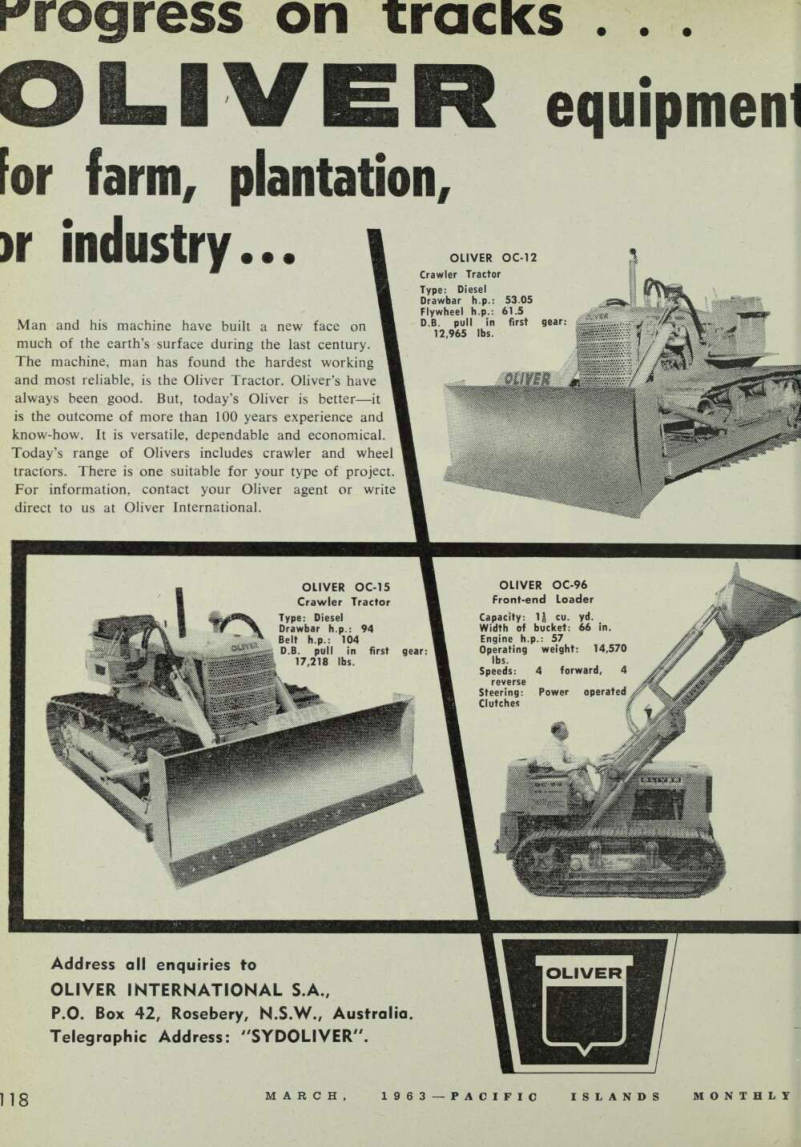
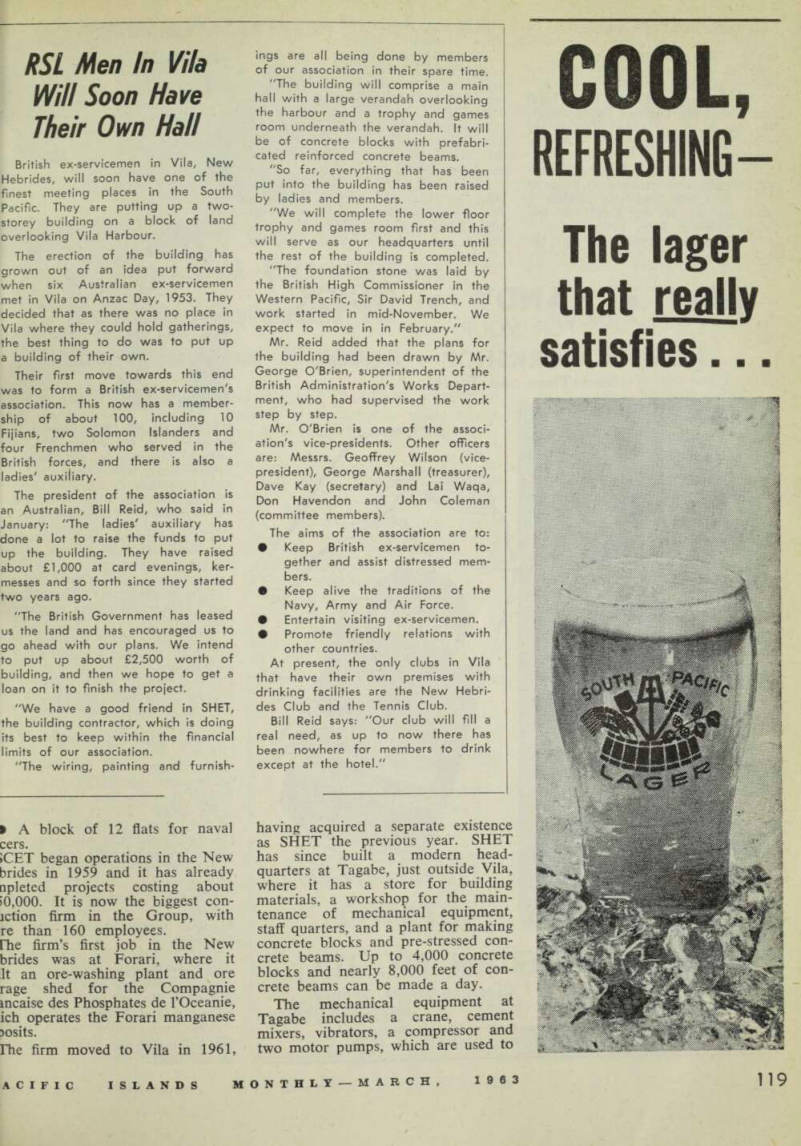
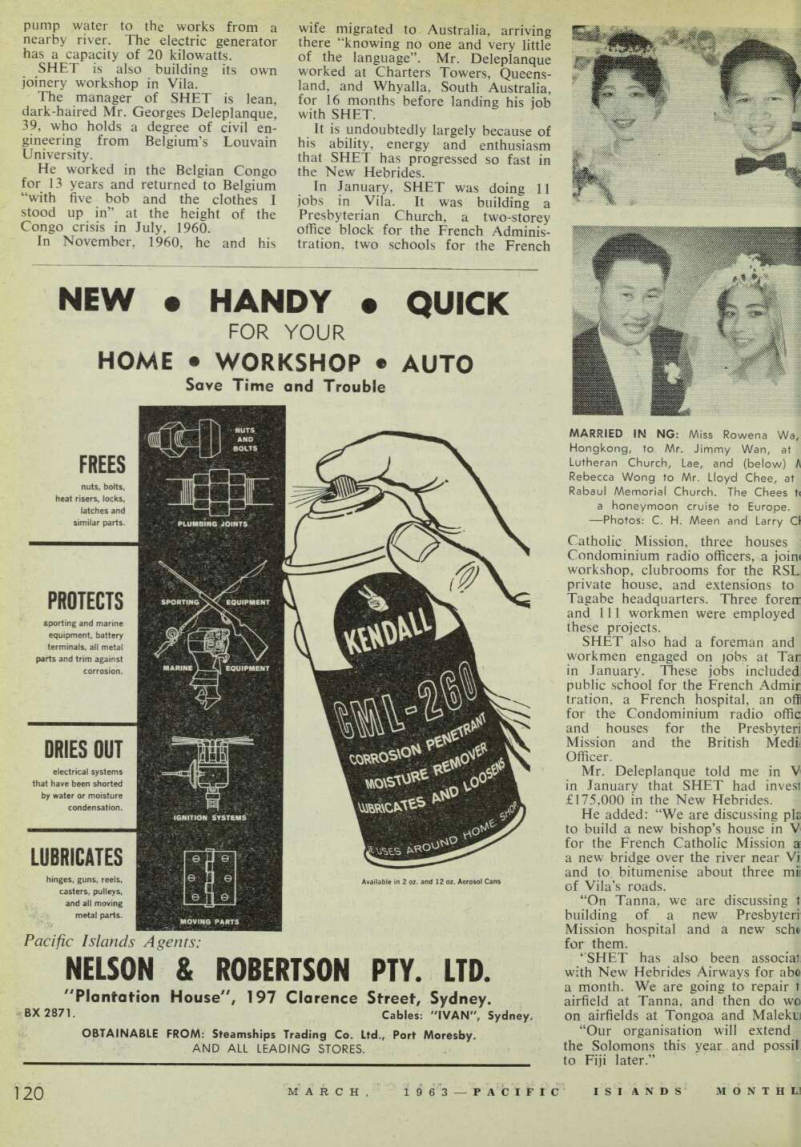
Other notable projects it has com pleted at Noumea include: • An entire suburb of 500 to 600 houses called Sud Pacific. The houses have two bedrooms, a kitchen, a combined dining room and lounge, a bathroom, verandah, pantry, garage, refrigerator and stove. They are rented to people with low incomes at about £2 a month, the New Cale donian Government subsidising the rent. » Noumea’s biggest department store. This building, of two storeys, was completed three years ago for Societe Havraise Caledonienne. • A military hospital, completed last year. • A three-storey barracks for military NCO’s, their wives and families, completed last year at a cost of about £130,000. The barracks contains flats of seven rooms each.
SCET is now building a second bar racks nearby. (Over)
I A block of 12 flats for naval cers. ;CET began operations in the New brides in 1959 and it has already npleted projects costing about >O,OOO. It is now the biggest con iction firm in the Group, with re than 160 employees, fhe firm’s first job in the New brides was at Forari, where it It an ore-washing plant and ore rage shed for the Compagnie mcaise des Phosphates de I’Oceanie, ich operates the Forari manganese josits.
Fhe firm moved to Vila in 1961,
having acquired a separate existence as SHET the previous year. SHET has since built a modern head quarters at Tagabe, just outside Vila, where it has a store for building materials, a workshop for the main tenance of mechanical equipment, staff quarters, and a plant for making concrete blocks and pre-stressed con crete beams. Up to 4,000 concrete blocks and nearly 8,000 feet of con crete beams can be made a day.
The mechanical equipment at Tagabe includes a crane, cement mixers, vibrators, a compressor and two motor pumps, which are used to
pump water to the works from a nearby river. The electric generator has a capacity of 20 kilowatts.
SHET is also building its own joinery workshop in Vila.
The manager of SHET is lean, dark-haired Mr. Georges Deleplanque, 39, who holds a degree of civil en gineering from Belgium’s Louvain University.
He worked in the Belgian Congo for 13 years and returned to Belgium “with five bob and the clothes I stood up in” at the height of the Congo crisis in July, 1960.
In November, 1960, he and his
wife migrated to Australia, arriving there “knowing no one and very little of the language”. Mr. Deleplanque worked at Charters Towers, Queens land, and Whyalla, South Australia, for 16 months before landing his job with SHET.
It is undoubtedly largely because of his ability, energy and enthusiasm that SHET has progressed so fast in the New Hebrides.
In January, SHET was doing 11 jobs in Vila. It was building a Presbyterian Church, a two-storey office block for the French Adminis tration, two schools for the French
Catholic Mission, three houses : Condominium radio officers, a joim workshop, clubrooms for the RSL private house, and extensions to Tagabe headquarters. Three foreir and 111 workmen were employed these projects.
SHET also had a foreman and workmen engaged on jobs at Tan in January. These jobs included' public school for the French Admir tration, a French hospital, an ofl3 for the Condominium radio offic and houses for the Presbyteri Mission and the British Medk Officer.
Mr. Deleplanque told me in V in January that SHET had invest £175,000 in the New Hebrides.
He added: “We are discussing pis to build a new bishop’s house in V for the French Catholic Mission a a new bridge over the river near Vi and to bitumenise about three mii of Vila’s roads.
“On Tanna, we are discussing t building of a new Presbyteri Mission hospital and a new scho for them. ‘ SHET has also been associat with New Hebrides Airways for abo a month. We are going to repair t airfield at Tanna, and then do wo on airfields at Tongoa and Malekrj “Our organisation will extend the Solomons this year and possil to Fiji later.”
MARRIED IN NG: Miss Rowena Wa,[?] Hongkong, to Mr. Jimmy Wan, at[?] Lutheran Church, Lae, and (below) [?] Rebecca Wong to Mr. Lloyd Chee, at [?] Rabaul Memorial Church. The Chees t[?] a honeymoon cruise to Europe.
Photos: C. H. Meen and Larry CH[?]