Cruising Yachts
pp. 101-111 · Read in the full issue
Pacific Shipping And
The well-known island trading vessel Charlotte Donald ank in 30 minutes after striking a rock in the Marquesas jroup on Saturday, February 2. No lives were lost, but the hip was a total loss.
IE Charlotte Donald, of 307 tons, was owned by Etablissements laid, Tahiti, a branch of A. B. laid Ltd., of Auckland, which also a branch and runs vessels in the L Islands. be was on a voyage from Tai-o- Nukuhiva, to Akapa, another quesan port, when she struck the : and sank. /hen the first reports of the ship’s were received, the parent firm in kland did not know who was in imand or what passengers and ;o were carried. Nor did the firm w whether the rock the ship ck was charted. he Charlotte Donald was iched in Fremantle in 1945. She 125 feet long, had twin screws was built of jarrah. •onalds bought her in Singapore 949. She was then named Kina mgan and had been trading in them Borneo waters, ecause of high rates of insurance the hazardous Islands trade, lalds carry their own risk. Her acement value is about £35,000. he loss of the ship leaves Don with three ships, the Taporo, eel motorship of 500 tons added the fleet last year, and the >oners Tiare Taporo and Vaitere. fhe Tiare Taporo, which under t a refit in Auckland recently, ran trouble on December 14. Her nmast broke at the main deck
collar when she encountered heavy seas north-west of Aitutaki when bound for Pukapuka.
However, the schooner reached Rarotonga safely four days later and the damaged mast was removed.
• Japanese Fishing Vessel
CATCHES FIRE: A 90 ft Japanese fishing vessel burned and sank at Pago Pago, American Samoa, on January 26. One crew member, Takeshi Kato, 22, lost his life. He is believed to have been trapped in the vessel.
The ship was receiving diesel fuel at the Government oil dock when some oil apparently spilled on a hot pipeline in the engine room and caught fire. When a Fire Department truck was unable to put the blaze out, a landing craft towed the vessel to the shallow end of Pago Harbour in an attempt to sink it in shallow water. The ship sank with its stern resting on the bottom, but 10 ft of the bow, held up by trapped air, re mained above the surface. It was hoped that the vessel could be re floated and repaired.
This was the third Japanese fish ing vessel operating out of Pago Pago to come to grief in just over a month.
Two others were lost at sea in a violent storm, 200 miles south-west of Samoa, in late December.
O Russian Ship In Apia:
People in Apia took a lively interest
in the Russian three-masted auxiliary schooner Zarja when she visited that port early in February. The Zarja „ which is making a study of the earth’s magnetism at sea and the incidence of cosmic rays at sea level, is the first Russian ship to visit Western Samoa for many years.
The ship, built in 1952, is mainly of wood and various bronze and brass alloys to eliminate the effect of iron.
She was in Suva early in January for an engine overhaul.
The Zarja is under the command of Captain B. Visiljevich Veselov and carries a crew of 24, plus nine scien tists and two stewardesses. Twelve of the Russians played volleyball against two Samoan teams at Vailima. One Russian team won and the other lost.
The local sportsmen decided that the Russians were a very pleasant crowd.
The Zarja has been at work in the Pacific since August, 1962. On leav ing Apia, she sailed for Papeete.
Another visitor to Apia during February was the French frigate Francis Gamier, en route from Wallis Island to Aitutaki and Tahiti.
• Third Time Unlucky: A
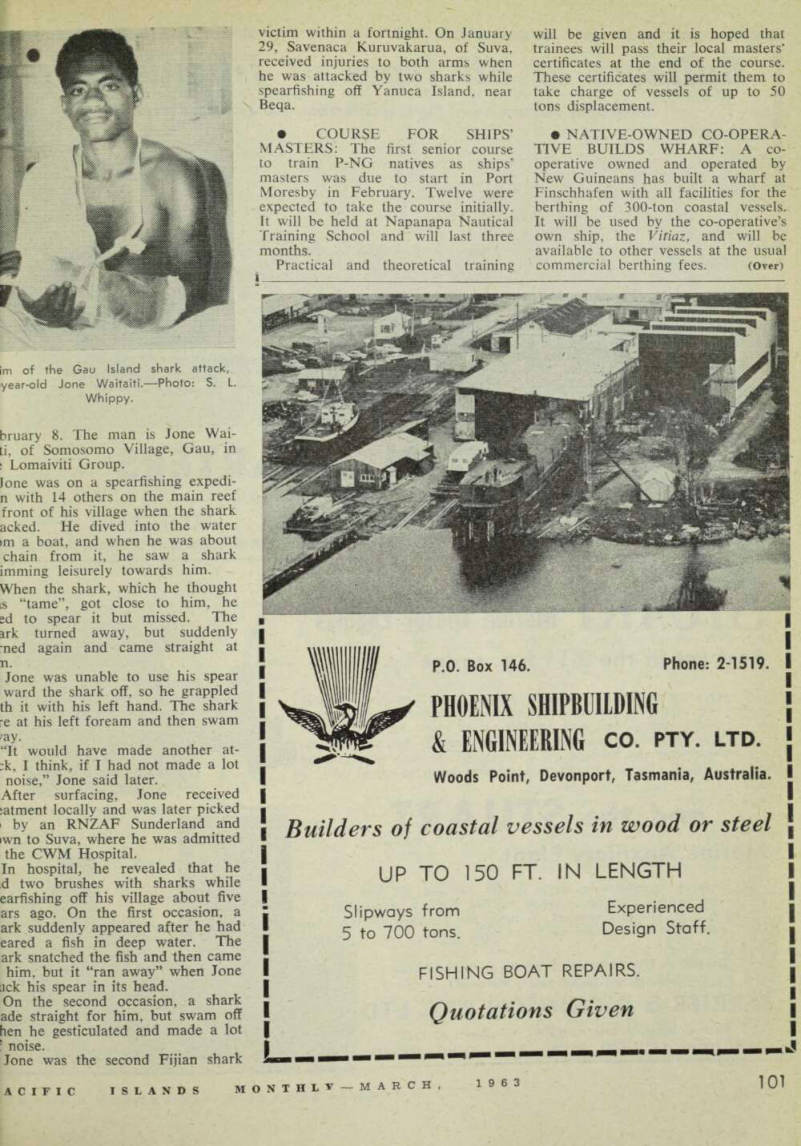
28-year-old Fijian, who had emerged unscathed from two previous en counters with sharks, had his left forearm torn when a shark attacked him while he was spearfishing on
The ill-fated "Charlotte Donald", formerly the "Kinabatangan", was launched in Fremantle in 1945. She was 125 ft. long and was built of jarrah.
bruary 8. The man is Jone Wai ti, of Somosomo Village, Gau, in : Lomaiviti Group, lone was on a spearfishing expedi n with 14 others on the main reef front of his village when the shark acked. He dived into the water un a boat, and when he was about chain from it, he saw a shark imming leisurely towards him.
When the shark, which he thought is “tame”, got close to him, he “d to spear it but missed. The ark turned away, but suddenly ned again and came straight at n.
Jone was unable to use his spear ward the shark off, so he grappled th it with his left hand. The shark -e at his left foream and then swam ray.
“It would have made another at :k, I think, if I had not made a lot noise,” Jone said later.
After surfacing, Jone received satment locally and was later picked i by an RNZAF Sunderland and iwn to Suva, where he was admitted the CWM Hospital.
In hospital, he revealed that he d two brushes with sharks while earfishing off his village about five ars ago. On the first occasion, a ark suddenly appeared after he had eared a fish in deep water. The ark snatched the fish and then came him, but it “ran away” when Jone nek his spear in its head.
On the second occasion, a shark ade straight for him, but swam off hen he gesticulated and made a lot : noise.
Jone was the second Fijian shark
victim within a fortnight. On January 29, Savenaca Kuruvakarua, of Suva, received injuries to both arms when he was attacked by two sharks while spearfishing off Yanuca Island, near Beqa.
• Course For Ships’
MASTERS: The first senior course to train P-NG natives as ships’ masters was due to start in Port Moresby in February. Twelve were expected to take the course initially.
It will be held at Napanapa Nautical Training School and will last three months.
Practical and theoretical training
will be given and it is hoped that trainees will pass their local masters’ certificates at the end of the course.
These certificates will permit them to take charge of vessels of up to 50 tons displacement.
• Native-Owned Co-Opera
Tive Builds Wharf: A Co
operative owned and operated by New Guineans has built a wharf at Finschhafen with all facilities for the berthing of 300-ton coastal vessels.
It will be used by the co-operative’s own ship, the Vitiaz, and will be available to other vessels at the usual commercial berthing fees. (Over)
[?]im of the Gau Island shark attack, [?] year-old Jone Waitaiti. Photo: S. L.
Whippy.
ie co-operative is the Finschhafen keting and Development Society ted which has nearly 7,000 New lea shareholders, and is chiefly ged in collecting and marketing sholders’ primary produce. Its lal turnover is around £30,000. ie new wharf, built of concrete steel, is at Buki, about two miles i Finschhafen where the co ative has also built storage sheds, ts, and provided transit accom ation for New Guineans. The rf is designed for all-weather fling of cargo, and overhead gear lifting heavy cargo will be in ;d soon. ie co-operative can also refill s’ water tanks, re-fuel vessels and ide a stevedoring service. The perative employs a wharf clerk 24-hour supervision of wharf ities is maintained.
New Vessel For Us
Ist Territory; The Mv
>h Star sailed from Portland, ;on, on February 6 for the US t Territory of the Pacific Islands Guam. The vessel is being ight to Guam by the Pacific Navi m Company (Jones & Guerrero) :r a special agreement with the ,t Territory Government, n arrival in Guam, the North will be registered in the Trust itory with home port at Saipan, ianas District. She will be re ed the MV Pacific Islander as Indian Bureau, from which the was acquired, wishes to retain name North Star for use on an r vessel. tie vessel is of 3,500 gross tons, will join the Trust Territory fleet it the Pacific Micronesian Line ation, and will serve as a logistic ily vessel to the Trust Territory ict centres from Japan and m. The Pacific Islander is
scheduled to leave Guam about March 15, probably for the Yap and Palau Districts.
• Almost Salvaged: The
nine month-long struggle to get the stranded Japanese fishing vessel Asahi Mam No. 8 from its prison on the Sigatoka Reef, Viti Leyu, Fiji Isles, was reaching a climax in Feb ruary.
The Asahi Maru went aground on February 14, 1962, and was aban doned and later sold by its Japanese owners to a local syndicat.e The syndicate, principals of which are Fiji businessman Barry Philp and Public Works engineer Graham Dewes, with a small team of local workman, has laboured con tinuously since to move the ship from the reef-edge toward a deep lagoon which opens to the high seas through a narrow channel.
At the period of high tides in mid- February, it was moved more than half a mile towards the lagoon and was then sitting within 150 ft of deep water.
Hundreds of empty drums, tyre tubes, glass floats (left on board when the ship was abandoned), and
tons of bamboo logs, have been used to float her along as wind and tide favoured.
In excellent condition, and worth many times her purchase price of £1,610 to her present owners, the ship has already been offered for sale by the syndicate and attracted several inquiries from overseas interests.
With intact engines and ancillary equipment, all in full working order, it is not anticipated she will lie long at her destined moorings in the Sigatoka Lagoon before she is once more in active work.
• Cable Layer Returns To
UK: The Cable and Wireless Ltd. cable-laying ship Mercury left Papeete to return to the United King dom on February 6, after having laid the first section of the new COMPAC cable between Suva and Honolulu.
The cable is being put down in three sections.
The Mercury began laying the first section on January 22 and fin ished the job on January 31—1,170 nautical miles of cable having been put down. In the UK, the Mercury will pick up a new supply of cable for the second stage of the Suva- Honolulu link. She is expected to re turn to the Pacific in May.
Meanwhile, the cable ship Monarch is laying the Vancouver-Honolulu section of the COMPAC cable.
• Big Grog Cargo For
WNG: The Dutch vessel Karossa lifted a cargo of between 7,000 and 8,000 cartons of beer from Port Moresby for West New Guinea ports early in February. The cargo was consigned by Port Moresby’s South Pacific Brewery and was worth about £lO,OOO. It was the largest consign ment the brewery had ever made.
The manager of the brewery, Mr.
W. H. Johns, said his company had
Courtesy Call:
Seen recently on a three-day visit to Rabaul was the French frigate "La Perouse". A crew of all races proved popular in town.
Various sporting events were arranged for them.
Rescue Ship: The
"Elizabeth Helen" (formerly the Army ship "Vasey") was on the scene shortly after the coastal vessel "Inaha" sank off the New Britain coast on January 19.
She rescued all crew members and took them to Rabaul. (PIM, Feb., p. 145.)
n exporting beer to Marauke for ut two years. Previously consign its had averaged about 1,200 car 5. He thought the reason for the •a demand was that other over -5 countries had stopped exporting r to West New Guinea. > boatbuilding instruc
Ts Visit To Spc Head
ARTERS; Mr. C. R. Fisher, the ;ctor and instructor of the boat [ding course at Auki, BSIP, from iO-1962, was due to visit Noumea m February 13 to 23 for talks ti South Pacific Commission staff.
Fisher has been reappointed as ictor and instructor for the next irse due to open in Auki in early rch. In Noumea, Mr. Fisher was iccted to visit Nouville where a ond boatbuilding course will be iducted for French-speaking inees simultaneously with that at ki.
• Talks On Wharf For
LA; Mr. D. V. Buck, senior part • of Wilton and Bell, consulting pneers of London, who designed : Suva Wharf reconstruction pro t, visited Vila in late January to cuss the modified Vila wharf pro t. Vila has no wharf at present During his visit, Mr. Buck obtained ther information on the nature of ; harbour bottom in the area which s been selected as the best site for • wharf and had talks with rep icntatives of the Joint Administra n.
Mr. Buck also attended a Vila barf Committee meeting at which confirmed that it was feasible to ild a wharf on the site selected,
irther pile-driving trials which
>uld now be carried out would able the best method of construc m to be decided, he said.
He showed the committee a revised an for a wharf, likely to be within e financial reach of the Condomin m. This wharf plan would not [able two overseas ships to be arked at one time, as in his original an, but it would enable all holds ! the biggest ships calling at Vila to : worked at one time.
• For Savusavu Tourists:
landing stage is to be built at akama Wharf, Savusavu, Fiji, so iat tourists can land from cruise ners. P and O—Orient liners are to ;gin calling at Savusavu soon.
Fiji’s Standing Finance Committee as approved the spending of £l,OOO n the landing stage. This follows a irvey at Savusavu by officials of the and O—Orient Line and the Suva [arbour Master, Captain E. L.
James. The existing wharf was found to be unsuitable for the landing of tourists from liners anchored in the bay.
• Tolai Wharfies Back At
WORK: Tolai wharf labourers, employed by Burns Philp (New Guinea) Ltd., returned to work on February 11 after a three-day stoppage. The New Guinea Times-Courier reported that the Tolais had resigned en masse after Burns Philp discovered that the company’s acting stevedore was planning a stevedoring company of his own employing Tolai labour. The acting stevedore was reported to have
been dismissed by BP’s Rabaul manager, Mr. Monty Stobo.
However, a Press release issued by the P-NG Administration said that the cause of the stoppage was a dis ’
P u * e ov . e f wages, It said that an agreement, ending the dls P ut u e ’ was Sl B ned at ? meeting tended by 60 wharf rep resentatives of BP, and Mr. D. Par <? f th e Department of Labour, an J d i h , at thls eo ntamed a new wage schedule for BP wharf labourers, The agreement is for 12 months from February 11. The new wage rates, with old rates in brackets, are:
linary labourer, 15/- per shift /-); winchman, 17/6 (14/-); g boss, 20/- (16/-). omamia, a Tolai leader, said at meeting that he had not heard a move by any other group of Hirers to form a co-operative, vever, the Administration Press ase said it had been reported that ii labourers were still considering idea of a co-operative, he Assistantant Administrator, John Gunther, said after the ement that the Administration been worried at one stage of the e that "good sense would not ail”. He added: “But we are sed that the dispute has been aoniously resolved.” uring the strike, the Deputy ler of the Opposition in the Aus an Parliament, Mr. E. G. Whit who was visiting P-NG, attacked Administration radio station in ml for not mentioning the strike s programmes. j said that the ABC had used itrike as its lead news item, and the Administration’s radio silence le trouble was one of the strike’s disturbing aspects, he silence of the Administration i station will undermine the con ze of New Guineans who were ing,” he said. “They would know ervice was not comprehensive in ct to Administration radio re of Legislative Council debates.”
Mission Ship Repaired;
Melanesian Mission’s ship 'em Cross, which went aground Auki, BSIP, in October and was ted in November, was slipped lagi recently. Only the false-keel bout 30 pieces of copper sheath ad to be replaced, ile on the slipway she was sur and found to be structurally . She was ready for sea after minor repairs were done at niara.
Fewer Ships Call At Pit-
N: Only 39 ships called at Pit- Island in 1962 compared with i 1961. This meant that the ers had fewer opportunities to ouvenirs—their only source of e. : island’s roneoed newspaper, 71 Miscellany, said in its issue nuary that the reduction in the ir of visiting ships was serious self, but the situation was led by the fact that the ships were no longer calling were ;w Zealand Shipping Company’s Rangitiki and Rankitata. Also, Villem Ruys made only two
196 S 1 laSt yCar COmpared with four in The paper added; “The regular callers, Athenic, Ceramic and Gothic, which together over the year visit us about 22 times, each carry a maxi mum of between 70 and 80 passen gers. There have, however, been sev eral occasions when the passenger ac commodation in one or other of these ships was less than half full.”
• Collier In New Role;
The 900-ton Fijian Trader, trading on Australia’s east coast and in the Islands for her new owners, the Fijian Shipping and Trading Com pany, of Suva, made her first visit to Newcastle early in February. She was well known there previously as the coal collier Dunmore.
The ship was built at the end of World War II as a tanker for the United States Army. She was later converted to take general cargo and until 1953 sailed under the Dutch flag as the Nassau. For the next nine years, as the Dunmore, she carried blue metal to Sydney from Kiama on the south coast of NSW, and coal from Newcastle.
Her skipper. Captain C. Wheeler, was formerly master of the Tung Feng which plied between Australia and Japan. Eleven Fijian crewmen were flown to Sydney to join the ship {PIM, Jan., p. 101.)
• For Islands Run; The New
motor cargo vessel Slitan arrived in
Australia recently on her maiden voy age from Las Palmas and the UK. {PIM, Feb. p. 105.) The Slitan will trade between Australian east coast ports, New Guinea and the Solomon Islands for the Karlander New Guinea Line Ltd., of Lae.
After loading cargo in Melbourne, Sydney and Brisbane, the ship was due to leave in early March for Port Moresby, Samarai, Rabaul, We-
Madang, Lae and Honiara. She ider the command of Captain Oftedal, a newcomer to Aus-
Death Of Well-Known
T: Captain Albert Lefevre, a mown pilot who had boarded reds of ships at the entrance to lea Harbour and had brought safely through the maze of reefs eir berths, died in Sydney on iry 18, aged 39. He had gone ydney for medical treatment, body was brought back to lea in the Caledonien and 1 in Noumea cemetery on Feb -13. ?tain Lefevre was a member of few Caledonian Pilots’ Associa- Despite his comparative youth, as a highly skilled member of ofession. He had had experience ost oceans of the world both icer and master, went to France some years ago ring the Nickel Co.’s ship i te to Noumea. For some years ptained units of the Nickel Co.’s and was well known on the lea-Pt. Kembla run. 1956 he passed his pilotage nation and started service in lot Syndicate of New Caledonia, as highly rated by masters of 5 using New Caledonian waters, •tain Lefevre came from a ’ whose tradition was the sea. ather, who died a few years was Captain Lucien Lefevre, a reputed to have salt water i veins. He was one of the Cape Horners”. He used to sailing vessels around the Horn lio, New Caledonia, to load ore. He married in New )nia, settled there, entered the Syndicate and finally became n of the Port (harbour master) umea. The old “Cap” had the ction of seeing two of his sons e New Caledonian pilots, tain Albert Lefevre leaves a , formerly Miss Michelle Daly, young daughter. His elder r Lucien is still in the pilot
Replacement For
iWAI\ The Manutai, replace for Burns Philp’s 434-ton trader mi, which was wrecked off near Santo, last March, was [ Vila, New Hebrides, on Feb -16 from Fiji. The Manutai )rmerly the London Missionary fs ship John Williams VI. vill operate in the northern i of the New Hebrides, and onnect with every visit of the Accommodation for up to assengers in two cabins is sle. Fares are £2 a day.