Magazine Section
pp. 85-86 · Read in the full issue
Pacific Islands Monthly
Britain’s First South Seas’
Colony Is 175 Years Old
From Merval Hoare, on Norfolk Island Norfolk Island, Britain’s first island settlement in the South Pacific, will celebrate its 175th nniversary on March 6. The island’s first settlers were eight officers and men and 15 convicts rom New South Wales, who had arrived at Botany Bay six weeks earlier in Governor Arthur ffiillip’s First Fleet.
)VERNOR PHILLIP’S instruc tions from King George 111 of il 23, 1787, contained an explicit :r concerning the island.
Norfolk Island,” Phillip was told, ng represented as a spot which hereafter become useful, you as soon as circumstances will it of it, to send a small estab nent thither to secure the same Js, and prevent it being occupied he subjects of any other European er.” lillip chose Philip Gidley King, second lieutenant of HMS Sirius, :arry out the onerous task of ing Norfolk Island, ing was told that after he had ided shelter for his little com ity and their supplies he was to cultivating indigenous flax and t seeds given him by the ernor. 2 would be furnished with a four d boat, but was prohibited from ling any boat whose length of exceeded 20 feet; and, if any 1 should be driven to the island,
he was to make it unserviceable pend ing instructions from Phillip.
Provisions for six months were to accompany him, and more were pro mised before that time expired, but strict economy in the matter of food was to be exercised.
Convicts were to labour for the public benefit; prayers for the Church of England were to be read every Sunday; and, finally, trading with visiting ships was forbidden.
King’s title was Superintendent and Commandant of Norfolk Island. With his 23 companions, he left Sydney on February 14, 1788, in HMS Supply, under the command of Lieutenant Henry Lidgbird Ball.
King’s companions were Thomas Jameson, surgeon’s first mate of HMS Sirius; John Altree, assistant to the surgeon; James Cunningham, master’s mate of the Sirius; Roger Morley, weaver; Charles Heritage and John Batchelor, marines; two seamen; and nine male and six female con victs.
Besides provisions and the four oared boat King also took a few do-
mestic animals and fowls, tents, con victs’ clothing, tools and other equip ment.
On the way to Norfolk, the little expedition passed an unknown island which Lieutenant Ball named Lord Howe Island. Nearby, they saw a jagged needle of rock thrusting out of the sea which received the name, Ball’s Pyramid.
At 11 a.m. on February 29, they sighted an island south of Norfolk which King called Phillip in honour of the Governor, and at 1 p.m. the Supply was close in to Nor folk.
During the next five days King, with Lieutenant Ball and other com panions, landed here and there on the coast in the hope of finding a suitable place to disembark the people and stores in safety; but the rugged pre cipitous coastline baffled them at every point.
Landmarks Named As King sailed along the coast he gave names to certain landmarks; others he named later.
Nepean Island was called after Evan Nepean, the Under Secretary of the Home Department; Point Howe was named in honour of the First Lord of the Admiralty; Cook’s.
Rocks, in memory of Captain Cook; Point Hunter after Captain John Hunter; Ball Bay after Lieutenant Ball; Anson Bay after the Parliamen tary representative for Litchfield; and Duncombe Bay after the member for Yorkshire. Mt. Pitt, Sydney Bay, Point Vincent and Collins Head were named after other prominent persons.
The search for a suitable landing place went on until March 5, and King almost despaired of finding one.
“I have nearly made a circuit of (the island),” he wrote at this time, “and found no place where there is a possibility of landing.
“The only prospect which remained
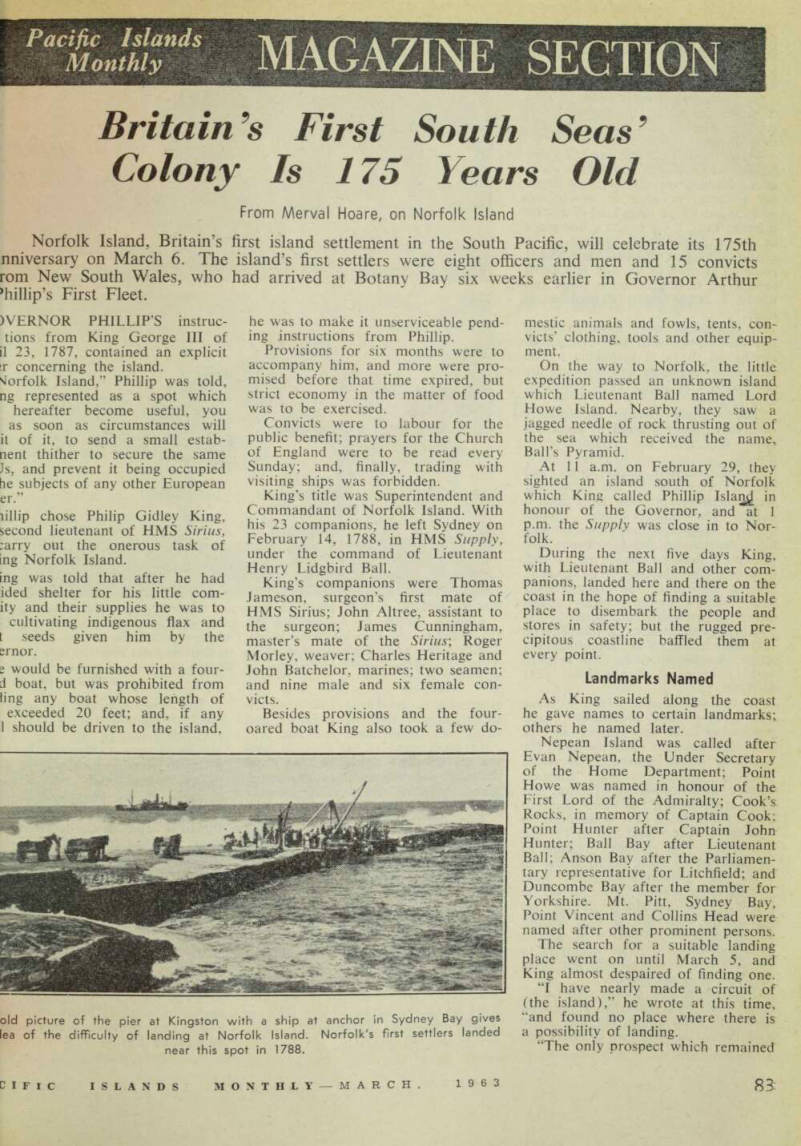
[?] old picture of the pier at Kingston with a ship at anchor in Sydney Bay gives [?] lea of the difficulty of landing at Norfolk Island. Norfolk's first settlers landed near this spot in 1788.
was to search if a passage could be found through the reef which runs along Sidney Bay (which is ye name I give to the bay on the S. W’t side of ye isle.)”
The Supply’s master was sent to examine this place and reported that such an opening did exist. King and Ball hurried to the spot.
“We landed in a fine sandy bay or beach without any difficulty what ever,” King wrote. “Above this beach lay a bank, ye edge of which was surrounded by ye large kind of iris; on piercing thro’ it we found a fine piece of ground; altho’ well wooded (as is every other part of this isle) here I resolved at once to fix, and felicitated myself on having found a place out where I could make a commence ment.”
At daybreak next morning King left the Supply with two boats con taining all the men belonging to the settlement, the tents and some of the provisions and tools. They made an easy landing.
The people were immediately ordered to clear ground to erect the tents on, and the colours were hoisted.
“Before sunsett every thing and person belonging to the settlement were on shore and their tents pitched before the colours were hauled down,” King reported. “I assembled all ye settlement and Lieutenant Ball present. I took possession of ye isle, drinking ‘His Majesty’, ‘The Queen’, ‘Prince of Wales’, ‘Governor Phillip’ and ‘Success to ye Colony’, after which three cheers were given.”
King served two terms of office on the island. He was Superintendent and Commandant from 1788 to 1790 and Lieutenant-Governor from 1791 to 1796.
He worked hard and long to carry out his superiors’ instructions, keep peace and foster his little colony. In 1794 he became seriously ill. “My health is much impaired,” he wrote to Evan Nepean that year, “constant anxiety and uneasiness of mind has done more than a ten years’ continu ance at sea would have occasioned.”
King left the island late in 1796, a sick man. After a spell in England he returned to New South Wales in 1800 as Governor-designate and shortly after became Governor of the Colony. He remained deeply in terested in Norfolk, his first respon sibility and the birthplace of several of his children, and never failed to put forward its advantages whenever its utility was questioned.
Meanwhile, the colony prospered.
After onlv five years the population had risen from 24 to just over 1,000 with the arrival of more convicts and
free settlers. In 1793, 2,000 bushels of wheat, 50 tons of potatoes and many other crops were produced.
In 1806, most of the convicts hav ing served their sentences, the Gov ernment decided to close the settle ment because the convicts were wanted as settlers in Australia.
For the next 20 years, Norfolk Island ran to waste. Then in 1826 another penal colony was established there, but the happy prosperity of the first settlers was not achieved by the second lot.
The new convicts were men of the worst type and many of the officers were no better. Murders, attempted mutinies and many executions took place.
The second penal experiment lasted until 1853 when all the inhabitants were again withdrawn—this time to Tasmania—and Norfolk was again left to the sea birds.
This time, however, the island quickly resettled, for in 1856 ne 200 descendants of the 80, mutineers were transferred there fl Pitcairn Island, which was in of overpopulation.
Some of the Pitcairners, suffe from home-sickness, later returne: Pitcairn. The descendants of t; who remained form the bulk of I folk’s present population.
Until recently, many of the b< ings of Norfolk’s convict eras been allowed to fall into neglect, the Commonwealth Works Dei ment is now restoring them hopes to have its work compl by June.
The occupied buildings are ti restored almost completely. * sufficient work is being done onr others to prevent them from teriorating further.
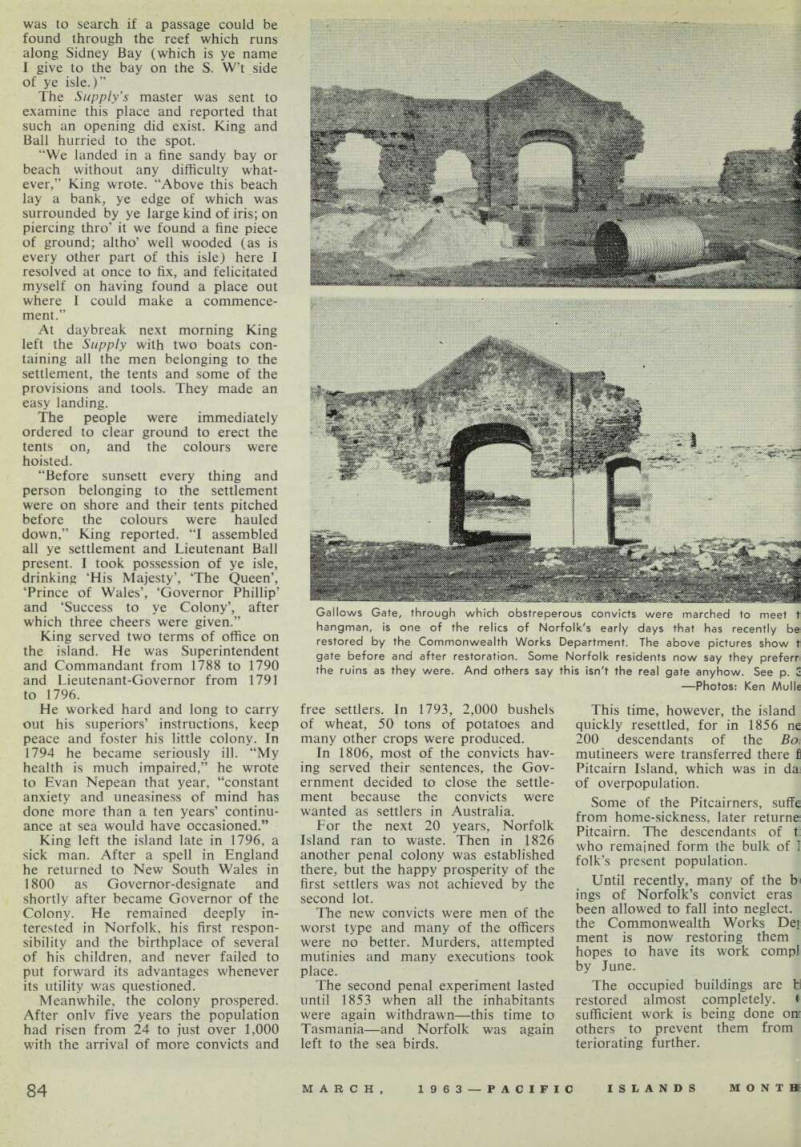
Gallows Gate, through which obstreperous convicts were marched to meet t [?] hangman, is one of the relics of Norfolk's early days that has recently be [?] restored by the Commonwealth Works Department. The above pictures show t [?] gate before and after restoration. Some Norfolk residents now say they prefer [?] the ruins as they were. And others say this isn't the real gate anyhow. See p. 3 Photos: Ken Mulle [?]