New Guinea's Future
pp. 73-77 · Read in the full issue


Political Charades On
From a Port Moresby Correspondent
The week February 3-February 10 should long be re membered in Papua-New Guinea as one of the most dramatic and most important in the political development of the Terri tory. The Minister for Territories, Mr. Hasluck, and a Labour Party delegation led by the Deputy Leader of the Federal Opposition, Mr. Whitlam, were working their way on con centric courses around the Territory (but in opposite direc tions), and Mr. John Guise was emerging as the elder states man of Papua-New Guinea.
rHE people were being told, more or less simultaneously (but by lilferent people), that Australia had 10 hope of retaining political control iver Papua-New Guinea beyond the Sixties, and that Australia would not bree independence on the Territory, >r withdraw its support and finances >efore the people asked it to leave.
The slumbering proposal of a uni ersity for the Territory was jolted iwake by the announcement of a Jniversity Commission to examine all spects of tertiary education.
The week got off with a bang on lunday, February 3, when John Juise, MLC, broadcast as the Aus ralian Broadcasting Commission’s Juest of Honour to an Australia-wide udience. Speaking “for my people, nd not only for myself”, Mr. Guise fibred Australia the future friend hip of Papuans and New Guineans in eturn for “greater effort . . . action ow . . . and ... a great deal f . . . policy making . . . trans srred from Canberra to Port loresby”.
Bold Expansion
Pleading that the young people of -NG were no less able than those f Fiji or the Cook Islands or the ritish Solomons, but had not been iven the same opportunities, he ointed out that not a single one had et graduated from university.
He went on to ask for a “bold ex ansion of education at every level”, nd particularly an expansion of the :aching of English as the doorway ) higher education. He described as jsential, more rapid progress in agri alture. He hoped for the develop ient of soap and sugar, and the can ing of fish.
He asked the Australian Govern lent for a declaration that it in :nded to preserve the unity of P-NG, nd not allow the Territory to be
come a mere pawn in international politics.
There was a sting for Australia in the tail of his speech—“. . . I be lieve it is in Australia’s interests to help us along the lines I have sug gested. If you fail to do so, those of us, who are taking the lead, Christians, democrats, friends of Australia, may be unable to check the sense of disillusionment which our people may feel. In the modern world, as we all know, there are other nations, the holders of other beliefs, who are only too ready to cash in on the opportunities provided by discontent”.
Cynics throughout the Territory were soon busy asking who had helped Mr. Guise with his speech, but found no ready answer.
Whether he had help or not, the simple fact remained that overnight John Guise had emerged from ob scurity, had become a national figure and a (self-appointed?) spokesman
for his people, with political prestige and power immeasurably enhanced.
It came as a shock to many in the Territory, as it must have to many in Australia, to find a man of Papua (not a Papuan—he is of mixed race), speaking on behalf of the two million people of the Territory, preparing to deal with governments, and discuss the price of the future.
In Port Moresby they’re saying
. . . former policeman, ex-govern
ment clerk, John Guise has arrived, and will be making much of the political running in the coming years.
Before people could get their breath again after this speech, Mr.
Gough Whitlam and Minister Paul Hasluck were on them with state ment and counter-statement. Much of the heat was directed towards education, or the lack of it.
The main purpose of the Minister’s visit had been to assess educational trends and needs, and ne refused to speak about the problems or plans when he first arrived. Just 10 days later he was wishing he hadn’t, when the Deputy Leader of the Opposition said, “We have been unable to find out what is happening about tertiary education. We can find no evidence of plans about it this year or next year, or the year after”.
Hurriedly in Rabaul, Mr. Hasluck dictated a statement to reporters, an nouncing the appointment of a Com mission to enquire into higher educa tion. Its main job: To study re quirements and prospects tor tertiary education.
It was let slip that Mr. Hasluck could have made this announcement when he arrived in the Territory, but had chosen to delav it until just be fore his departure, on'y to have the wind taken out of ms political sails.
In Port Moresby, Mr. Whitlam was bland. “It is gratifying that the Minister has at last come round to prepare steps to carry out projects
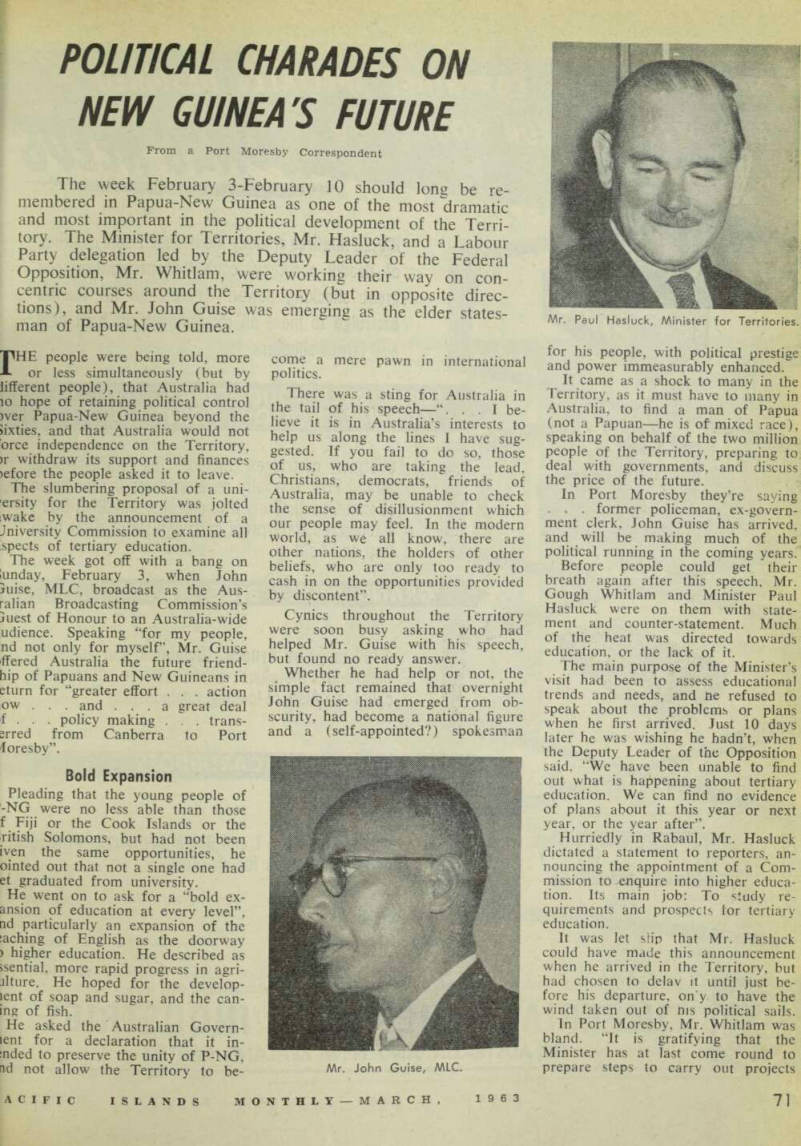
Mr. John Guise, MLC.
Mr. Paul Hasluck, Minister for Territories.
in tertiary education, on which the Labour Party instituted debate in the House of Representatives in April last year.”
Mr. Whitlam also had a few sug gestions to make about the reconsti tution of the Legislative Council, and gave the first indication of what the Labour Party’s attitude would be to the enabling legislation soon to come before the House of Representatives. ; “Forty-four seats are not enough to ensure adequate representation for the two million native people of the Territory,” he said, “when the dual communications, problems of transport and language are con sidered.”
He pointed out that each of the 44 nembers would represent 45,000 con itituents, far more than the average nember of a State Parliament in Australia. Twice as many seats were teeded, he said, thus echoing the vords of lan Downs, Highlands 7 armers and Settlers’ President, peaking in Legco in mid-’62. Downs, n calling for a majority of Papuans ind New Guineans in the Council, uggested one member to about ;0,000 people.
The week in question saw the pub ication in Australian newspapers of n article by Osmar White, currently oving the South Pacific colonial and x-colonial world.
Had Blessings
Representative self-government by 968 and complete political indepen ence by 1972 at the latest, were the irgets for Papua and New Guinea, aid Osmar White, leaning heavily on usually reliable sources”.
White had let it be known in Port loresby that he had come to the erritory with blessings from some nportant quarters in Canberra, to remote the idea of a quick Aus alian withdrawal from Papua-New luinea.
White certainly had got on to a few oints about the reforms under the of Legco, not gener lly known. For example, native nder-secretaries are to be appointed ext year, for the first time.
White had indicated that powerful lements within the Menzies Govern lent were behind the move for haste, dding that he had no reason to be eve Mr. Hasluck approved of the metable he mentioned.
It was four days before the linister came back on this one. He escribed the report as “sheer specu ition”, repeated oft-repeated assur nces about no target dates for olitical advancement, and said again, . . . we will stay in Papua and
New Guinea as long as the people of the Territory need our help. No one other than the residents of the Territory can tell us when to go.
“I ask the inhabitants of the Terri tory to cast from their minds the false and mischevious gossip that Canberra is planning early with drawal. I assure them that it is not.”
He was clearly concerned at the implication of a split in Cabinet over
Png.
the strongest support for White’s story came, perhaps surpris ingly, from the speech that the Deputy Leader of the Opposition de
livered to an Apex-Rotary-Lions- Junior Chamber of Commerce- Contact Club dinner in Port Moresby on February 8. The urgency behind his speech was lost on nobody there.
“There will not be many more years when masters and overseers are required in New Guinea . . . every position in the Territory should be open to the indigenous people . . . every company that hopes to survive more than 10 years will take steps to see that indigenous people are given an opportunity to share in both management and ownership . . . the airline companies should be training
native pilots . . . now is the time to explore a merger with the British Solomons and the New Hebrides.”
To questions (“Why don’t we tell the UN to get out?” and “Papua is an Australian possession, isn’t it?”) Mr. Whitlam gave replies (“Why should we, when almost every person in this room, for example, agrees with the recommendations it made last year?” and “It is, but it is also a non-self-governing-Territory, and the UN might well decide to interest it self in its future”).
His replies indicated he felt Aus tralia was in no position to “go it alone” in this corner of the world, and would have to get out quickly and gracefully, for the sake of her position in Asia.
In frank off-the-record pieces, he told what he thought to be the rea sons why Australia must fix a short timetable for self-government and why it would not countenance P-NG as a seventh State. Even the big businessmen seemed sobered.
The Minister departed for Canberra in a RAAF Dakota on Saturday, Mr. Whitlam returned to Australia in the regular DC6 on Sunday morn ing.
John Guise went home to his house in Lalaura village in a powered canoe.