Explosion Is Becoming A
pp. 39-43 · Read in the full issue


South Pacific’s Population Explosion Is Becoming A Bigger And Bigger Headache
By a Staff Writer
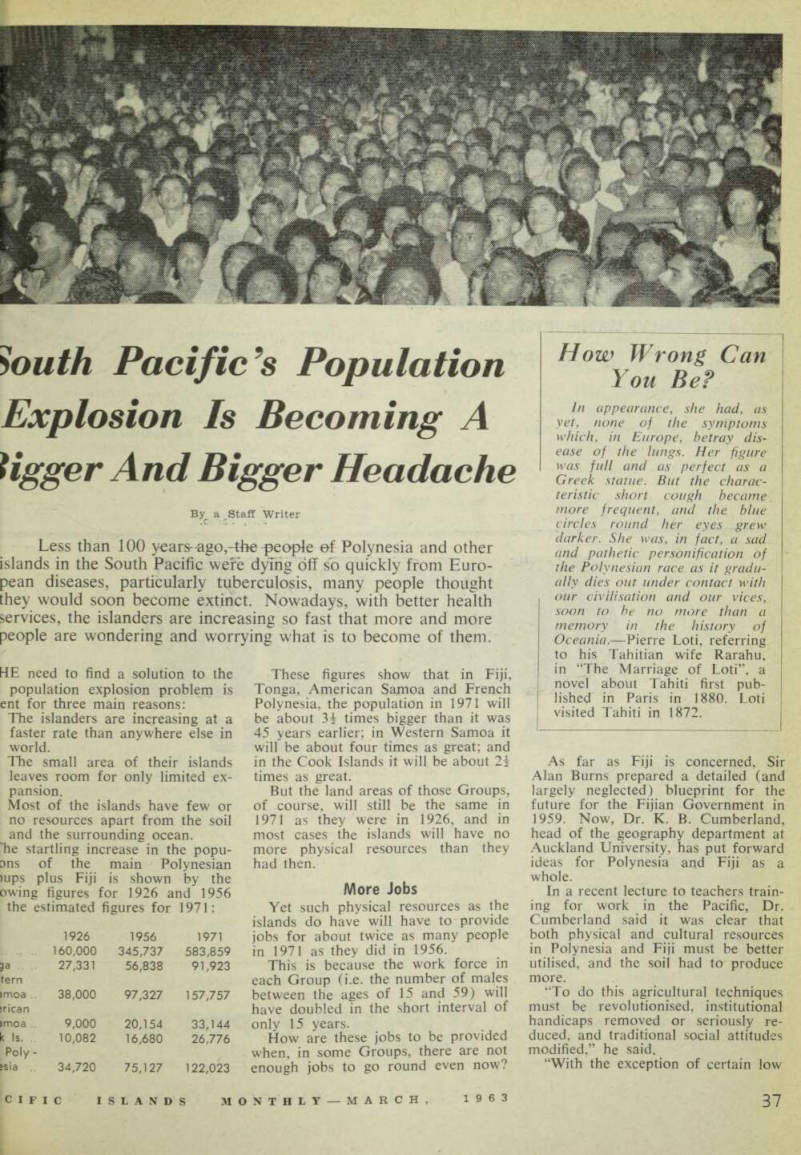
Less than 100 years-ago,-the-people ef Polynesia and other islands in the South Pacific were dying off so quickly from Euro pean diseases, particularly tuberculosis, many people thought they would soon become extinct. Nowadays, with better health services, the islanders are increasing so fast that more and more people are wondering and worrying what is to become of them.
HE need to find a solution to the population explosion problem is ent for three main reasons: The islanders are increasing at a faster rate than anywhere else in world.
The small area of their islands leaves room for only limited ex pansion.
Most of the islands have few or no resources apart from the soil and the surrounding ocean.
Tie startling increase in the popu ons of the main Polynesian )ups plus Fiji is shown by the owing figures for 1926 and 1956 the estimated figures for 1971:
These figures show that in Fiji, Tonga, American Samoa and French Polynesia, the population in 1971 will be about 3i times bigger than it was 45 years earlier; in Western Samoa it will be about four times as great; and in the Cook Islands it will be about 2i times as great.
But the land areas of those Groups, of course, will still be the same in 1971 as they were in 1926, and in most cases the islands will have no more physical resources than they had then.
More Jobs Yet such physical resources as the islands do have will have to provide jobs for about twice as many people in 1971 as they did in 1956.
This is because the work force in each Group (i.e. the number of males between the ages of 15 and 59) will have doubled in the short interval of only 15 years.
How are these jobs to be provided when, in some Groups, there are not enough jobs to go round even now?
As far as Fiji is concerned, Sir Alan Burns prepared a detailed (and largely neglected) blueprint for the future for the Fijian Government in 1959. Now, Dr. K. B. Cumberland, head of the geography department at Auckland University, has put forward ideas for Polynesia and Fiji as a whole.
In a recent lecture to teachers train ing for work in the Pacific, Dr.
Cumberland said it was clear that both physical and cultural resources in Polynesia and Fiji must be better utilised, and the soil had to produce more.
“To do this agricultural techniques must be revolutionised, institutional handicaps removed or seriously re duced, and traditional social attitudes modified,” he said.
“With the exception of certain low
1926 1956 1971 160,000 345,737 583,859 ja 27,331 56,838 91,923 tern imoa 38,000 97,327 157,757 irican imoa 9,000 20,154 33,144 k Is. 10,082 16,680 26,776 Poly tsia 34,720 75,127 122,023
•ral atolls, the land can probably pport the growth of population at msiderably improved standards of come until the close of the century, oviding only that these technical id social changes can be made.”
According to Dr. Cumberland, ese changes can only be made by s island people when, “independent d responsible for their own fate, ey come fully to appreciate the le and significance; of traditional ititutional handicaps”.
“So long,” he said, “as misguidedly nevolent administering powers are spared to meet budgetary deficits lich arise from inherent deficiencies indigenous institutions and tech logy, the real difficulties are but iden, masked and avoided.”
Dr. Cumberland said that popula n pressures could also be relieved the development of secondary in stries such as the processing of :ally-produced, and imported, raw fferials.
“The pressing, refining and hydro nation of coconut oil, the manufac e of cigarettes, the brewing of sr and the manufacture of cement Suva comprise a good example,” said.
“Rarotonga’s clothing and juice d fruit-canning industries are an ler. And the remarkable growth the tourist industry . . . has be me a matter of long - term )nomic significance.”
Dr. Cumberland said tertiary in stries would also employ greater
numbers of local people. “With the withdrawal of the administering powers,” he said, “government ad ministration and the operation of social services will become greater avenues of employment for is landers.”
Despite the possibilities for in dustrial employment Dr. Cumberland said that nine out of 10 Pacific Is landers must continue to rely on tropical agriculture.
“This agriculture may become in creasingly commercial and less sub sistence in form and character; it may be vastly improved in technique and efficiency; but it must continue to de pend upon seriously prescribed soil resources,” he said.
“In the last century these soil re sources have frequently been misused.
Disruption of traditional forms of agriculture, and the undermining of chiefly authority in land use practices, the cultivation of commercial export crops, the abbreviation of bush fallow intervals through growth in numbers of village communities, the con version of forest to troublesome tropical grasses by immigrant com munities, and the ruthless exploitation of unstable tropical soils by Chinese market gardeners both on the Rue des Maraichers at Papeete and on the soapstone hills at Nasinu—all these have in recent decades seriously re duced the soil and vegetational re sources available to support today’s and tomorrow’s growing numbers and needs.
“Per capita volumes of agricultural production have often declined over a period of 50 years. This is true of Tahiti, the Cook Islands, Western Samoa and Fiji. Per capita volumes of exports have also fallen. (Over)
‘The disastrous nature of this momic fact has been masked by rise in prices for export com dities, especially from 1941 to 16, and by the mounting subsidies, ;ct an indirect, provided in the in by taxpayers in the administer countries.”
Dr. Cumberland said that the tropolitan administrations must e the blame for the “often hidden erioration in the economic circum ices of the island territories,” and t New Zealand’s approach to its ninistrative problems was a good mple of how things had gone mg.
In the southern Cook Islands,” he 1, “the dozen years or so of British sensibility (1888-1901) was one lively economic development and cessful exporting. Chiefs had :ngth, power and prestige— itical, economic and social. This i a period of native agricultural commercial enterprise when ive - owned schooners provided ir-island transport on a scale not iwn since.
"Costly Policy"
After New Zealand annexation in 1, the Resident Commissioner imed greater powers, native :ials were dismissed, chiefly lority over land and in the or isation of production was under ed, tribal production ceased and ve transport came to an end.
There followed for half a century increasingly costly policy of mis led humanitarianism and an :ial attitude of passive indifference :conomic development.” )r. Cumberland said that New land had made errors which pro ed similar results in Western 10a.
Ie went on: “It is a sad com itary on the results of the New land administration’s economic cies—or lack of policy—that the v Zealand taxpayers’ contribution year to the welfare of the people is £5O for every man, woman child; that the subvention for 2-63 to Cook Islanders amounts £4O a head; and that direct sub es in the past decade to Niue ie amount to £3OO per capita and die Cook Islands £250 per capita.
In addition, of course, there have n indirect forms of assistance nigh New Zealand’s participation the South Pacific Commission, High the government’s uneconomic ration of island trading vessels, . in other ways. )espite his criticism of New land’s economic policies, Dr. nberland said the future of Poly ia depended “in very considerable isure on New Zealand”.
“Asia may be Australia’s ‘Near North’,” he said. “The Pacific Ocean is ours . . . Polynesia itself looks increasingly to New Zealand; and the world’s powers —including distant ad ministering powers—expect New Zea land to have an increasing influence in the future of the South Pacific.”
"Triumph"
Dr. Cumberland said New Zealand had furnished some firm evidence in the last decade of its increasing ability to cope with this important period of its Pacific destiny.
The closing phase of its responsi bility for Western Samoa was “a triumph”, and recent policies in the Cook Islands had brought about “the first significant economic development in 70 years”.
“Polynesia must be prepared to stand on its own feet and accept re sponsibility for its own political, economic and social future knowing it can turn elsewhere, and to New Zealand more especially, for technical assistance, administrative know-how, expert personnel and financial aid, Dr. Cumberland said.
He said that the changing political situation also made it urgent to over haul the form and functions of the South Pacific Commission. There was a strong case for having its technical, research and advisory ser vices strengthened and reinforced.
But if these services were to be made effective, they should be operated by the Pacific island tern
torial administrations and not re motely by administering powers.
Dr. Cumberland said that the mem ber Powers of the South Pacific Com mission should seriously consider re placing the Commission with a South Pacific counterpart of the Colombo Plan.
If Australia and New Zealand were to take the lead in formulating and operating such a plan, they could ensure that the political and economic changes that would inevitably take place in the Pacific would broadly ac cord with their own interests.
The £1 million which New Zealand now spent annually on the Colombo Plan would be much better spent in the South Pacific.
“Why not New Zealand-supported, mechanised hill-country land develop ment ip Viti Levu?” he asked. “Why not expand and bring together all the existing academic and technical train ing facilities in the south-west Pacific —including the Central Medical School—and establish, possibly in Suva, a South Pacific University or University College under the aegis meantime of one of the universities in New Zealand?
“New Zealand now has eight higher educational institutions for a popula tion of less than 2i millions. If a university is justified in the Waikato, the case for one for Polynesia (plus Fiji), with three-quarters of a million people today, a million in less than a decade, and three millions by the century‘s end, is even stronger.”