South Pacific's Oldest Weather
p. 33 · Read in the full issue
Station Has Bright Future
From R. F. Rankin, in Apia For almost 60 years a solitary observatory in mid-Pacific tas been making vital contributions to science. The observatory, it Mulinu’u, near Apia, has been in existence so long that its r alue has probably been overlooked by the layman, who is in lined to take the place for granted.
JT local people were re minded again of the part the jrvatory plays when in January >rmer director of the observatory, Andrew Thomson, made a return ; for the first time in 32 years.
Fhe equipment is splendid,” he . “People should know that the irds maintained by this observa are really excellent, and are a •ce of information about the ;ral Pacific for geographical re ch at leading research centres •ughout the world.
Samoa is a vital centre of observa with great research possibilities terrestial magnetism, seismology meteorology.
My only regret is that more staff time cannot be given for on-the t research here.” )r. Thomson said that with in ised scientific interest in the Pacific i it was likely Apia would be the tre of a number of discoveries in next three years. )r. Thomson was director at linu’u from 1920 to 1930. le recently retired as director of Canadian Meteorological Service, that position he supervised an ex diture of $20,000,000 a year.
Tie observatory was established at
Mulinu’u in 1905 by the German University of Gottingen. It was the first meteorological station in the South Pacific.
Under the successive directorships of Drs. F. Linke, K. Wegener and G.
Angenheister, it gained world-wide attention for the valuable information gathered and research undertaken.
In 1920 Dr. Angenheister returned to Germany, and New Zealand took over the observatory together with the civil administration. However it proved to be too heavy a financial strain for NZ and in 1922 financial support was gained from the Carnegie Institute and the British Admiralty.
Dr. Thomson, who then arrived, was associated with the Carnegie In-
stitute. During his time the German research programme was re-instituted and additional work undertaken.
Extensive investigations were made into the height of the trade and anti trade winds; on atmospheric electric conditions in tropic regions; and on the amount of solar radiation able to traverse the atmosphere.
With independence New Zealand is still running the observatory under an agreement with the Samoan Govern ment, but Samoa will take over more and more responsibility until a Samoan can be placed in charge.
Until recently, a New Zealander, J.
Gordon Keys, was observer-in-charge.
The position has now been taken by an Australian, Tasmanian geo physicist P. J. Milne. Mr. Milne was previously at Port Moresby and on Macquarie Island. Two Samoan ob servers on the staff have been trained in New Zealand.
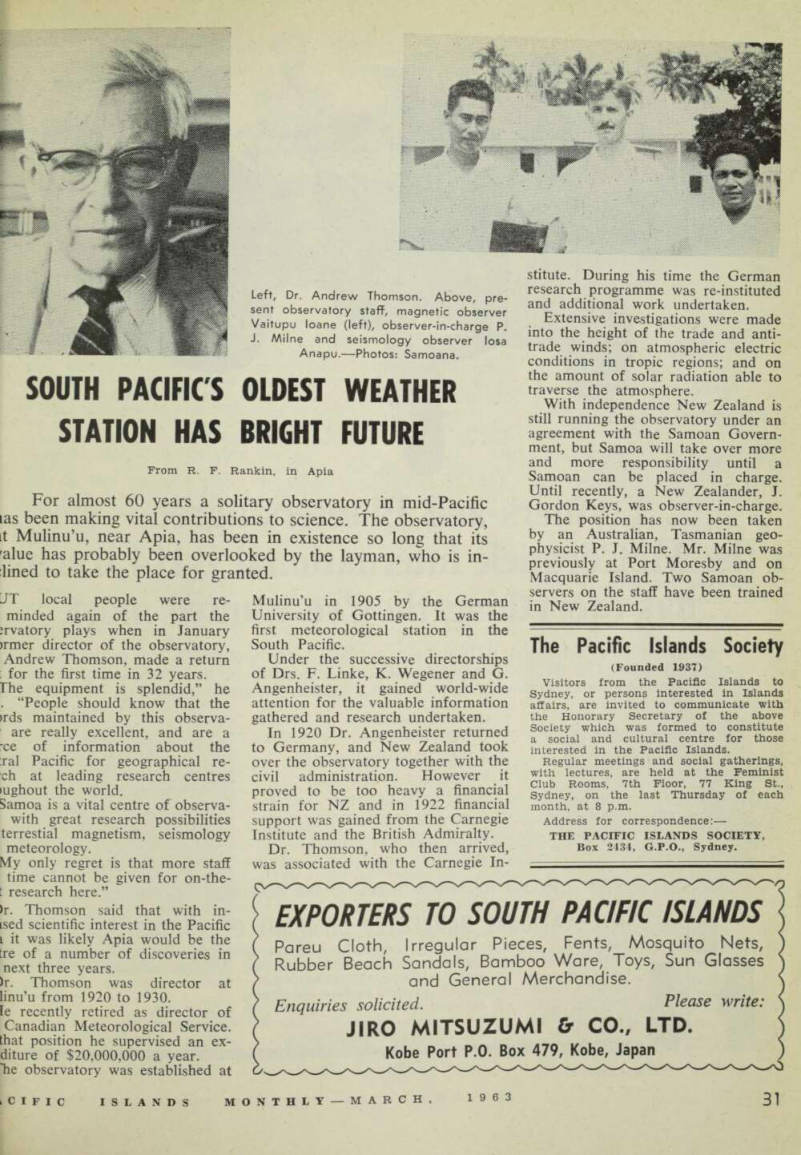
Left, Dr. Andrew Thomson. Above, pre sent observatory staff, magnetic observer Vaitupu loane (left), observer-in-charge P.
J. Milne and seismology observer losa Anapu. Photos: Samoana.