Tropicalities
pp. 23-29 · Read in the full issue
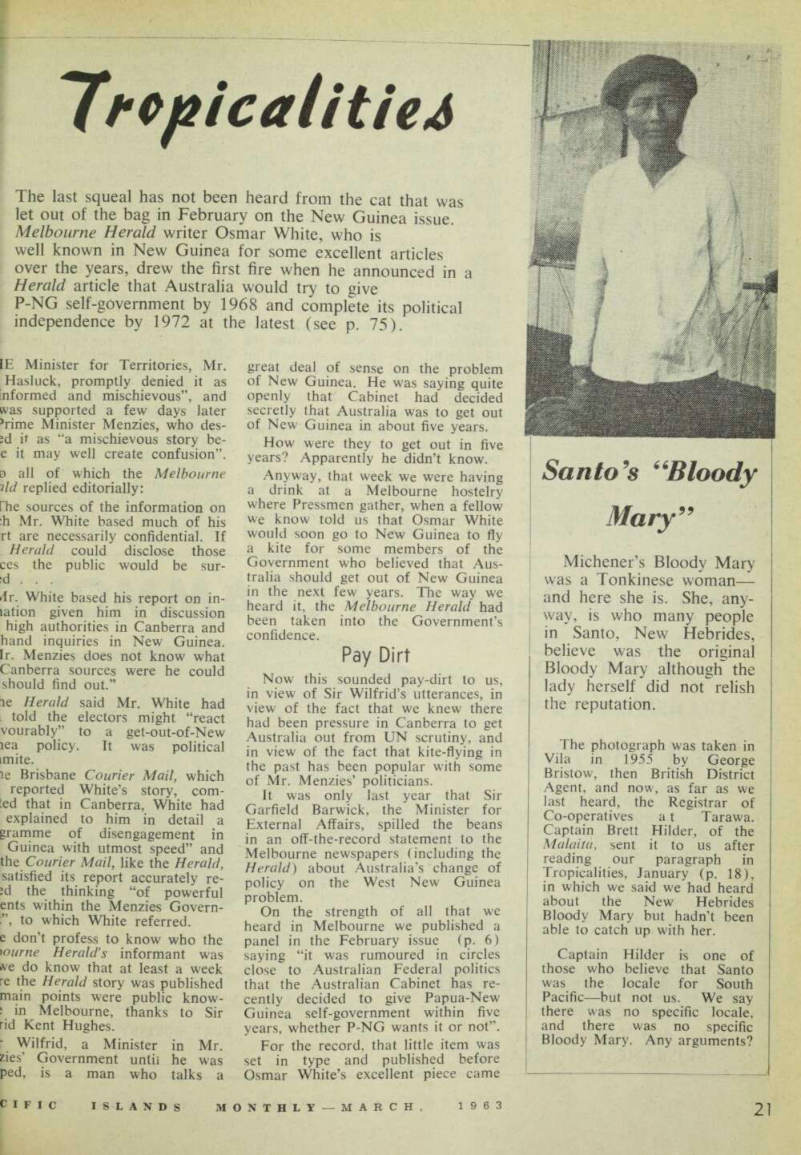

The last squeal has not been heard from the cat that was let out of the bag in February on the New Guinea issue.
Melbourne Herald writer Osmar White, who is well known in New Guinea for some excellent articles over the years, drew the first fire when he announced in a Herald article that Australia would try to give P-NG self-government by 1968 and complete its political independence by 1972 at the latest (see p. 75).
[E Minister for Territories, Mr.
Hasluck, promptly denied it as informed and mischievous”, and w as supported a few days later ’rime Minister Menzies, who des id it as “a mischievous story be e it may well create confusion”. d all of which the Melbourne ild replied editorially: fhe sources of the information on :h Mr. White based much of his rt are necessarily confidential. If Herald could disclose those ces the public would be sur :d . . . dr. White based his report on in »ation given him in discussion high authorities in Canberra and hand inquiries in New Guinea. lr. Menzies does not know what Canberra sources were he could should find out.” le Herald said Mr. White had told the electors might “react vourably” to a get-out-of-New lea policy. It was political imite. ie Brisbane Courier Mail, which reported White’s story, corn ed that in Canberra, White had explained to him in detail a gramme of disengagement in Guinea with utmost speed” and the Courier Mail, like the Herald, satisfied its report accurately re ;d the thinking “of powerful ents within the Menzies Govern to which White referred, e don’t profess to know who the wurne Herald’s informant was ive do know that at least a week re the Herald story was published main points were public know : in Melbourne, thanks to Sir rid Kent Hughes. * Wilfrid, a Minister in Mr. zies’ Government untii he was ped, is a man who talks a
great deal of sense on the problem of New Guinea. He was saying quite openly that Cabinet had decided secretly that Australia was to get out of New Guinea in about five years.
How were they to get out in five years? Apparently he didn’t know.
Anyway, that week we were having a drink at a Melbourne hostelry where Pressmen gather, when a fellow we know told us that Osmar White would soon go to New Guinea to fly a kite for some members of the Government who believed that Aus tralia should get out of New Guinea in the next few years. The way we heard it, the Melbourne Herald had been taken into the Government’s confidence.
Pay Dirt
Now this sounded pay-dirt to us, in view of Sir Wilfrid’s utterances, in view of the fact that we knew there had been pressure in Canberra to get Australia out from UN scrutiny, and in view of the fact that kite-flying in the past has been popular with some of Mr, Menzies’ politicians.
It was only last year that Sir Garfield Barwick, the Minister for External Affairs, spilled the beans in an off-the-record statement to the Melbourne newspapers (including the Herald ) about Australia’s change of policy on the West New Guinea problem.
On the strength of all that we heard in Melbourne we published a panel in the February issue (p. 6) saying “it was rumoured in circles close to Australian Federal politics that the Australian Cabinet has re cently decided to give Papua-New Guinea self-government within five years, whether P-NG wants it or not”.
For the record, that little item was set in type and published before Osmar White’s excellent piece came
out in the Herald, but poor old Osmar seems to have taken the full rap. (Osmar, no doubt, is not weep ing about it.) The big question now is—just how accurate is Mr. Hasluck’s denial?
We publish it in full on p. 75, and when you read it we respectfully draw your attention to the following: • The Minister does not deny that Australia could get out of New Guinea in a few years. • He says that Australia will stay there while it is the wish of the people, and that Australia “looks to the legislature of the Territory to express the will of the people”. • Since in 1964 the P-NG Council will have a native majority, who is to say it won’t decide on self government—especially if Australia goes in for some pressure-lobbying on the native members, as the Nether lands did on members of the West New Guinea Council when it was in a similar spot.
Mr. Hasluck is deservedly famed for his skill at saying one thing but meaning another, and it seems to us the only way he is going to stop this cat from running is to announce some fairly firm target dates—as the Netherlands did in New Guinea, and as New Zealand did in Western
Samoa and recently in the Cook Islands.
If he doesn’t he’ll never convince anybody that there is no deep plot going on behind the scenes.
Down With the Hair THE sometimes socially-staid in habitants of Lautoka, Fiji’s second largest town and centre of the Colony’s sugar industry, let their hair down during the visit to the port of the Royal Yacht Britannia.
The ship, with a complement of more than 250 officers and men, arrived at the end of January to wait the arrival of the Queen and Duke of Edinburgh by air from the UK for their South Pacific tour.
With the pick of the Royal Navy aboard, the townsfolk decided the visit called for special measures in keeping with the honour bestowed on the town.
Exactly why it was that the Britannia was to spend its entire seven days’ leave in Fiji in Lautoka, instead of in the capital, nobody knew, al though it was a fact that Mrs. J.
Beatt, wife of a Lautoka police officer, had met the Flag Officer of the Royal yacht, Rear-Admiral J. C.
C. Henley, at a party in London when the Royal tour was being
planned and had painted a picture of sun-drenched Lautoks The Lautoka people, anyhow,, tainly enjoyed the thought that society had its nose put out of by the Britannia's decision, (a Lautoka man remarked to us: “ people are noted for grasping at e social straw”.) Long before the Royal shipc proached the Colony, planning Lautoka had reached a point of] fection, and it could be guarai that every man-jack aboard w have little or no time for i routine.
And so it turned out. The an chain had hardly gone down be the Mayor of Lautoka, Cr. F Ingleton, threw a monster civi« ception at a hotel to greet the ofl of the ship; a reception into v/ Able Seamen Smith and his patriots from the lower-deck man to infiltrate, and still find thems welcome (“Couldn’t have happen: Suva,” said the Lautoka people; kindly).
Having received the official s from the leader of the commu Lautoka townspeople thus proc© to tear-up the town, with no I excuse than “the Britannia’s in p There was a party-a-night, a dl a-night; with licensing hours ext©
over the place, much to the disgust the temperance movements in the trict; with general carryings-on for benefit of keeping the Royal htsmen out of the type of mischief t naval personnel are believed to into if not kept out of.
Homes not often seen even by ny a local resident were thrown le open to the visiting sailors, and ny were invited to move in for duration of their stay—a blessing disguise when they woke up the rning-after-the-night-before to find t Lautoka people have heavy ids in mixing cocktails, leach barbecues, island-night ices, sports fixtures, visits to Fijian ages, and a host of private parties, led up to the kind of hospitality ich, if placed on a regular tourist erary, would have them running k for more just as soon as they ild close off their business affairs home. lach new day saw the town mger in its purpose to leave the rk of hospitality on its visitors, and ship’s complement weaker in its eavour to keep up with the pace, lumming it up later, when the tannia was safely out of reach on high seas, bound for New Zealand a the Queen and Prince Philip ard, was a message from Rear aairal Henley to the Mayor thank him for the ship’s “memorable” t. ,autoka will certainly remember it. )ther Wright Behind the Camera [JI, of course, was loaded down with photographers and newsmen ering the Royal visit. There were least 80 of them there—but they en’t all after the same thing. One tographer, sent all the way from ;land, explained he wasn’t in sted in covering the Fiji tour— job was to get close-ups of the ;en that could be used anywhere any time. He had been sent to because there would be less com tion there from the Press pack i in New Zealand or Australia, mother man was on assignment to nothing else but colour shots of Queen in every change of frock wore. )n the job as usual was Fiji Pub- Relations Office photographer Rob ght, who is an old hand at cover- Royalty these days. He had the -appointed task of being every ;re at once, but he got a hand n an unexpected quarter—from 16-year-old son Rob Jnr., who ws satisfactory signs of following Dad’s footsteps. At present he al ls the Grammar School at Veiuto, a.
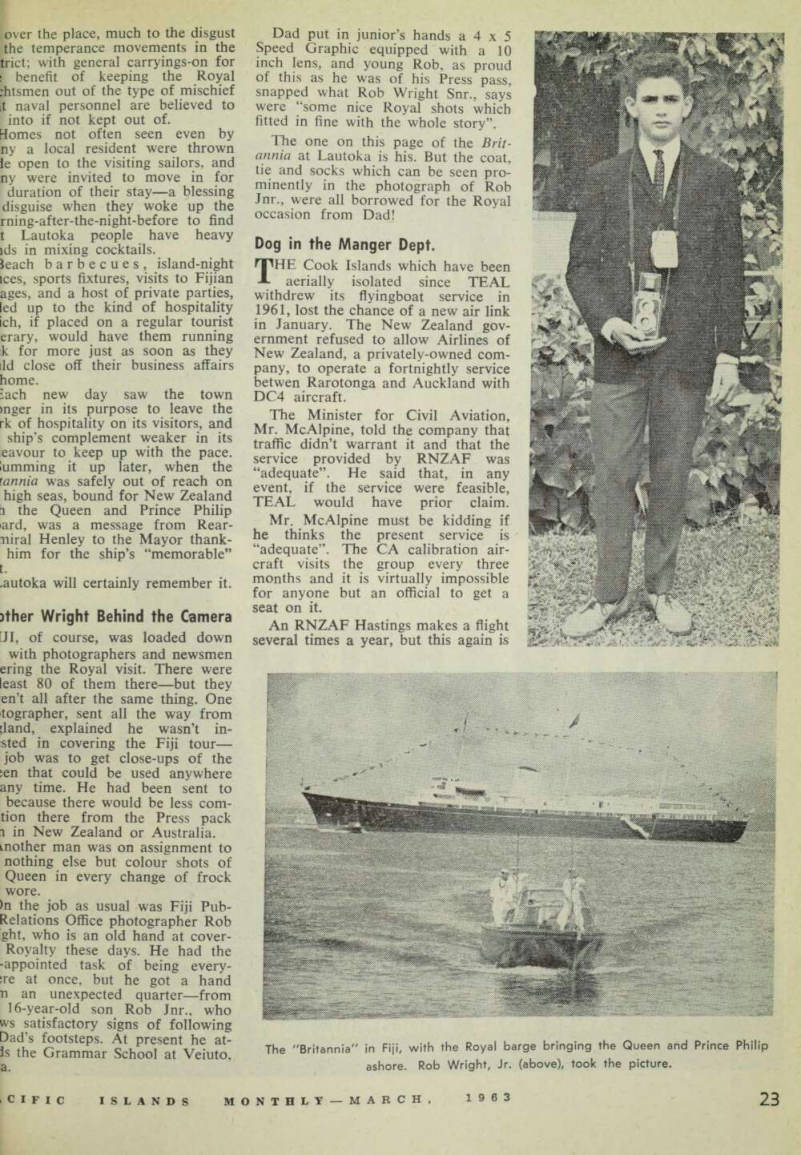
Dad put in junior’s hands a 4 x 5 Speed Graphic equipped with a 10 inch lens, and young Rob, as proud of this as he was of his Press pass, snapped what Rob Wright Snr., says were ‘‘some nice Royal shots which fitted in fine with the whole story”.
The one on this page of the Brit annia at Lautoka is his. But the coat, tie and socks which can be seen pro minently in the photograph of Rob Jnr., were all borrowed for the Royal occasion from Dad!
Dog in the Manger Dept.
THE Cook Islands which have been aerially isolated since TEAL withdrew its flyingboat service in 1961, lost the chance of a new air link in January. The New Zealand gov ernment refused to allow Airlines of New Zealand, a privately-owned com pany, to operate a fortnightly service betwen Rarotonga and Auckland with DC4 aircraft.
The Minister for Civil Aviation, Mr. McAlpine, told the company that traffic didn’t warrant it and that the service provided by RNZAF was “adequate”. He said that, in any event, if the service were feasible, TEAL would have prior claim.
Mr. McAlpine must be kidding if he thinks the present service is “adequate”. The CA calibration air craft visits the group every three months and it is virtually impossible for anyone but an official to get a seat on it.
An RNZAF Hastings makes a flight several times a year, but this again is
The "Britannia" in Fiji, with the Royal barge bringing the Queen and Prince Philip ashore. Rob Wright, Jr. (above), took the picture.
Government only—including visit- Cabinet Ministers.
Tie only other way to visit Cooks is to go down from liti on a Matson ship and spend minimum of three weeks there ting for the next; or try to get the Moana Roa from NZ, which a waiting-list a mile long, lone of this encourages anyone to t the Cooks —but if there were a ible air service, the traffic Mr. Mc ine feels is now missing, would i materialise. drlines of New Zealand is ap ;ntly willing to take the risk—it died itself that the traffic was there r being approached by Cook Is is’ interests last year. Money was - found in NZ to increase the jmmodation needs on Rarotonga, olynesian Airlines, of Western 10a, also thinks there is traffic table and has suggested a service yeen the Cooks and Samoa, link up with the regular air-routes iugh there. Details of this were n in PIM in February (p. 125). re is possibility of TEAL being of this deal, n interesting point about ANZ’s :tion is that one of the men with !ose interest in ANZ is Mr. Reg ett, the big kite of Australian tion. A few years ago, when he still empire building, Mr. Ansett le a great song and dance in Aus a at being refused rights to fly New Guinea against the then lopoly of Qantas. e stuck to his guns, with the un acted result that Qantas eventually turfed out of New Guinea en y, and Mr. Ansett went in, ider whether he might be pre id for a similar fight against some time? n Ansett-inspired service between kland and the Cook Islands Id mean that Mr. Ansett need fight his way into the air across Tasman (via Norfolk Island, per ;) to have an aerial network that Id take him north almost to the dor, and eastwards half-way across Pacific. But if he provides better ices—or services that didn’t exist re—who cares?
World and Insect Pests b Come to Pitcairn LCAIRN ISLAND, home of the descendants of the Bounty ineers, has long been renowned me of the most isolated, uncom fialised, fertile and away-from-it slands in the world. But times 5 changed. is no longer isolated, for >ugh fewer passenger ships are ng there than formerly, Japanese
Pitcairn's chief magistrate John Christian was visiting Suva in February for talks with the South Pacific Office on some of the island's problems. He had been wanting to do this for some time but shipping difficulties always seemed to make it hard for him. —Photo: Rob Wright, fishing trawlers are now operating so close to the island that the islanders can see them night after night.
Nor is it any longer uncommercial.
Recently the island got an order from an organisation in the United States for $6OO worth of curios and handi crafts. This was the first time in 173 years of history that the island had found an export market for its pro ducts.
It is no longer as fertile as it was.
After seven generations, Pitcairn’s 1,200 acres have become worked out.
There has also been an increase of blights and insects. So each year it is becoming harder and harder to obtain a living from the soil.
It is no longer away-from-it-all.
The possibility of France establishing a nuclear testing ground at Manga reva, 300 miles away, has brought the danger of radio-active fall-out, and this, in turn, has brought such things as cables from Australian As sociated Press asking for the islanders’ reaction to the French pro ject.
An editorial in the February issue of the island’s roneoed newspaper points out with some foreboding that although the sale of curios and handi crafts will be “of wonderful benefit to our island, one’s enthusiasm for making money when it is so readily available can have its dangers.
“The making of curios,” the editorial goes on, “takes time, and the more curios a man makes, the less time he has for other things such as gardening.
“There are very few who can honestly say they would sooner push their barrow up to their garden and spend the day toiling in the heat of the sun than sit in some pleasantly shady spot carving a fish, bird or any
one of the variety of articles pro duced, using the money thus earned to purchase food.
“And yet is this attitude to the best advantage of Pitcairn? As it is, we have to maintain a constant battle against weeds and insects. To reduce the time so spent by too great an amount is going to give the advantage over to the garden pests.
“It is essential therefore that a balance must be struck between time for carvings, etc., and time for the other tasks which have to be carried out if our island is going to keep its present state.
“Remember, we are not the last generation to live on Pitcairn. In what condition are we going to leave our land to our children?”
A Resort to "Knock 'em Cold"
Development of land for a new tourist resort on the south coast of Fiji’s main island, Viti Levu, was started recently by Barry Philp. Philp is the man who built the New Mocambo Hotel at Nadi’s inter national airport. He is also Fiji’s super salesman of the tourist trade.
The mercurial Philp has already spent 13 years in the Colony pro moting tourism and developing hotel accommodation despite the many problems he’s faced.
He says his latest venture will result in a resort that will “knock ’em cold”. The resort will be few miles on the Sigatoka side of the famous Korolevu Beach Hotel, where Philp has bought a coastal stretch of 400 acres from the late J. P. Bayly.
On it he plans to put everything the tourist will need—from grass huts, for those wanting to go native, to a popcorn machine especially for the American tourist who wants to keep in touch no matter how remote
Mr. Barry Philp.
his holiday venue is. The grass hi of course, will be equipped \i plumbing.
There will be “on the beach” lo tions for those who want to wrig their toes in the sand from their fn door and “bush” shacks linked o by a jungle track to the main reso concourse.
For the conventional tourist, Pi' plans the usual nine-hole golf con a swimming pool built into a sh«j line grotto, a riding stable for tb who wish to break a leg trying thij they ought to have given away y< ago, and general facilities guarant to while away the time with compc lack of boredom.
To be able to devote his em attention to this latest venture, P‘ has sold his Korotogo property,, which he has farmed and raised cs for some time.
Philp’s brother, Tasmanian an tect Colin Philp, is responsible getting Barry’s ideas on to the dn ing board. He has been with Bj: in Fiji for the past few months.
Barry’s biggest problems, as he it, are petty regulations and the 1 of drive of certain govermr officials reputed to be falling o backwards to stimulate tourism.
Relic of the "German Time"
THE Papua and New Gm Museum, Port Moresby, was cently given an interesting relic the “German time” in New Guii It is a red, white and blue flag T a lion rampant in the centre.
The flag is claimed to have If the original flag of the Neu Gm Kompagnie zu Berlin, the Gerr chartered company which admr tered German New Guinea be 2 1900.
Many years ago, the flag was to Mr. R. W. Robson, of Pen Islands Monthly, by Mrs. Helen I ton, of Melbourne. She said thsj was given to her father, in the e part of this century, by a Gen resident of New Guinea. Mr. Roll has now sent it to the museum.
The Neu Guinea Kompagnie formed before 1880 by a Berlin merchants to advocate thea nexation and development of 1 Guinea—a plan to which the Diei that time was opposed.
After the abortive attempts Australian Colonies to annex Guinea in 1873 and 1883, the man annexation took place in It Bismarck then gave the companj charter to administer and develop? colony. In 1889, Germany boughir Marshall, Caroline and Manj groups, in Micronesia, from Sp< revoked the New Guinea charter, t
■nceforth administered the New uinea, Bismarck and Micronesian •chipelagoes in one organisation, ith headquarters at Herbertsohe SCokopo), in New Britain. The capi- J was moved to Rabaul a few years {fore World War I broke out in >l4.
After World War I, the New uinea colonies were given to Aus alia to administer under mandate, id the Micronesian archipelagoes to pan. Japan lost them in World War , and they now are a United States ist.
icial Changes
r is music while you work in Fiji’s cane-fields and native holdings ese days since duty was abolished i January 1, on radio sets imported to the Colony.
The move followed strong pressure im commercial firms to reduce or olish duty on a wide variety of ms sought by tourists. Duties were ;o dropped on cameras, watches, 3e-recorders, and TV sets.
Tourists are certainly buying them, t there has also been a rapid up rge in sales of transistors to local iidents on the lower incomes, for cellent transistors can now be ught for as little as £6 each, duding the cost of an annual re ving licence.
It’s a common sight to see the Jian farmer driving off to his fields his tractor, carrying his lunch-pail is his transistor radio.
Likewise the Fijian, who, disappear ; from his village for the day to
work in his small holding, will often be found reclining in some shady spot with his transistor going full bi ast Nor do they buy just any set at the price they can now afford.
Many insist that they have a good short-wave range, as some say local broadcasting through the Fiji Broadcasting Commission’s transmitters is poor in country areas, and Fijians especially have developed a strong affinity to Radio Australia—received in most parts of Fiji with exceptional c l ar ity Suck It and See IF a speed-boat is going to sink, then much better for it to happen right alongside the wharf as a “controlled experiment”.
That’s what Sub-Inspector Max Hayes, of the Rabaul Police, thought the other day when he decided to find out whether his 14 ft speed-boat really was unsinkable as a result of all the foam material built into it.
He removed the outboard, put in 200 lb in weight to make up for it, and got the men on the local fire truck to fill the boat with water, which they did merrily, as you can see Result- Even with two adults standing in the flooded boat it didn’t sink. Experiment ended.
Doing the Rounds , ..
Captain Cook visited the ” New Hebrides 189 years ago, he noted that the women of Malekula (whom he unflatteringly described as members of “an ape-like nation ) wore hogs tusks bent circular round their right wrists, Nowadays, in Vila, it seems to be the ambition of every European woman to wear hogs tusks bent circular” not only around the right wrist, but around the left one, too.
Such ornaments are expensive and not easy to come by. When we did the roun ds of the Chinese and Tonk inese stores seeking a couple for our own wife (fashion being hard to re sist!), we found only half a dozen rather unsatisfactory specimens re tailing at £3 or £3/10/- apiece.
There was also a whole jawbone, complete with two rather poor tusks and evil-looking teeth for £lO.
The trouble with most of the tusks that come to market is that the pigs that grew them did not manage to get the points to curl round neatly to their starting points and thus form bangles attractive for milady’s wrist, There must me a moral here some where. Maybe it’s this: If Europeans want to ape the old Malekulan women, they ought to teach the pigs to do the rounds!