Defence Base For
pp. 19-21 · Read in the full issue
Suva Could Be Vital Air Defence Base For Australia , New Zealand
Australia and New Zealand could do a valuable job for themselves and Fiji by taking a greater interest in Suva as a forward air defence base, says the writer of this article, Mr.
L G. Usher. He says now is the time for a decision to be made. Mr. Usher is editor and publisher of the daily Fiji Times.
From L. G. Usher, in Suva New Zealand newspaper stories that the RNZAF (flying toat) base at Laucala Bay is to be closed shortly have caused ilarm and despondency in Fiji—as well they might.
IE base gives direct employment for 400 Suva people. Some have ked there for 20 years and have wn no other jobs. Most of them )ort families. Some have seen r sons find jobs also at “The Bay”, he base puts between £f million £1 million a year into circula at Suva each year, for goods, ices and rents. rom Laucala Bay, the RNZAF ates the international air-sea □e service, covering thousands of ire miles of the South Pacific, he removal of the survivors of wrecked Tongan yacht Tuaikae from Minerva Reef, was an nple of this work, he principal military role of the is training in anti-submarine : are, but there are many inci al additional advantages in its itenance. is good that hundreds of young ' Zealanders and their families ild have a chance to live and c for a while in another countrv, get to know at first hand people places of the South Pacific, ercy missions that have saved lives of critically ill people from : ar away as the Cooks or the erts; help after hurricanes; trans in emergency; the casual frienc s of the New Zealand airmen— these things have added to per -1 friendships made between the :ala Bay men and their families, the people of Suva, to create a ng of goodwill for New Zealand le tropical South Pacific, here is much more to Laucala than just an overseas Air Force ooked at in all its aspects, it 1 U P to an operation of the )mbo Plan type—but one much e practical and fruitful than most. r hy, then, the proposal to close base? he answer is that nobody is build military flying-boats any more, the Sunderlands now in use at
Laucala Bay are coming close to the end of their useful life.
Plea for Suva Point Field New Zealand proposes to replace them with land-based aircraft— probably Hercules—and at present there is no field near Laucala Bay from which such planes could operate. But there could be.
There are two alternatives.
At Nausori, 15 miles away, there is an airfield, which was built during the war and has since been in regular use in Fiji’s internal air services as the airport for Suva, and, to a lesser extent, for some of the Pacific re gional services.
Nausori airfield is on former cane land in the Rewa delta. It is subject to flooding, and there are drainage problems to be met. Nevertheless, that airfield could be expanded and developed—at a cost.
So could the second alternative— an airfield reclaimed from the sea
along the Suva Harbour foreshore— in the style of Kai Tak airport at Hongkong, or Faaa airport at Tahiti.
The site proposed is at Suva Point —less than two miles from the centre of Suva city, and about the same distance from the ready-made Laucala Bay base, on which New Zealand has spent millions of pounds, and which is in every way a going concern as an air fqrce operational and resi dential centre.
Suva’s airport needs have been recognised for a long time; and in 1961 Dr. K. N, E. Bradfield, Assistant Director General of the Australian Department of Civil Aviation, and Mr. A. S. Reiber, chief roads and aerodromes engineer of the Australian Department of Works, examined the relative merits and engineering prob lems of the Nausori and Suva Point projects. Nausori is 14 miles from Suva, while Suva Point is on the edge of the town.
The investigators were concerned
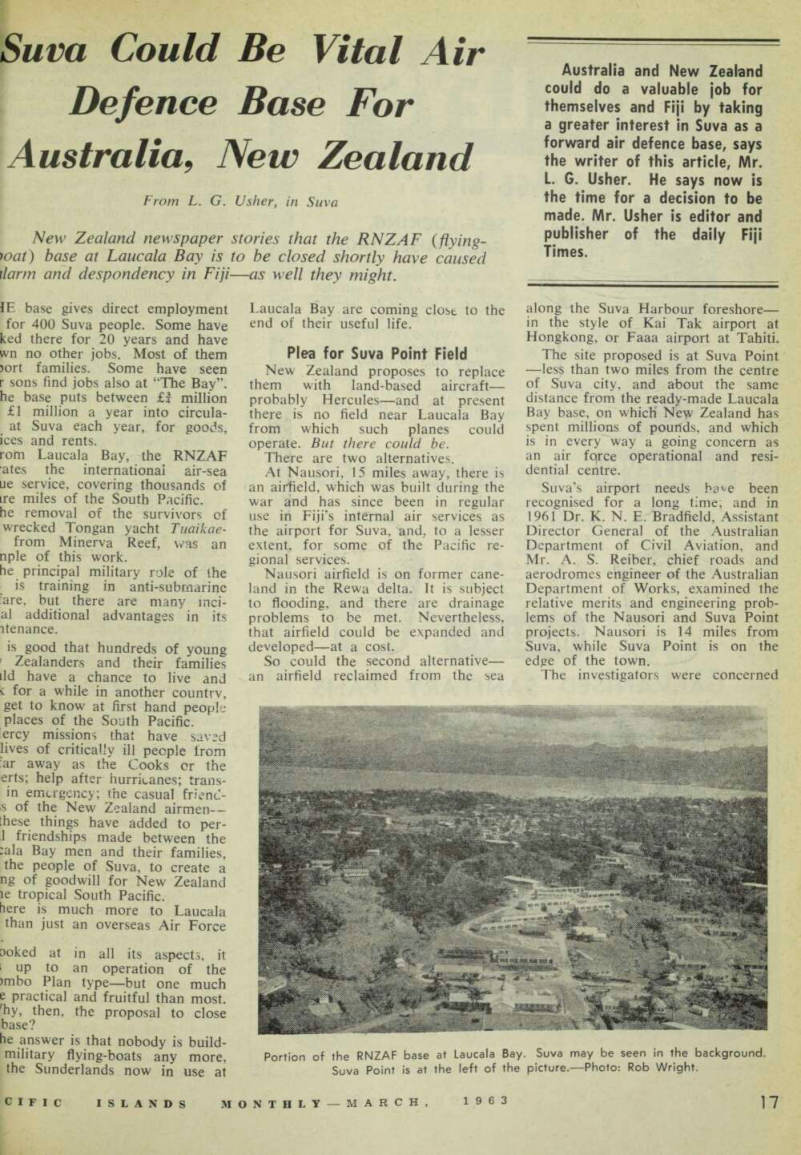
Portion of the RNZAF base at Laucala Bay. Suva may be seen in the background.
Suva Point is at the left of the picture. Photo: Rob Wright.
primarily with the development oc airport for civilian air traffic, they fixed the approximate cosi. building a field at Suva Poinu £500,000, while Nausori could! brought to a similar standard about £300,000.
They expressed no definite ference, realising that there T considerations other than cost volved; but they suggested, aE practical approach, that some m« be spent on improving the run surfaces at Nausori so that the port could continue to be used! the present, and that a start be rr on reclaiming the proposed siu Suva Point.
They pointed out that the reels tion would be useful, anyhow, i if the airport were not built.
The first part of this suggej: was adopted; and from Colonial velopment and Welfare Funds United Kingdom provided moneys sealing the main Nausori rum and for night-flying navigational most of which could be transfe to Suva Point if an airfield were tablished there.
Defence Point of View The matter of a Suva airport ii no means just a local Fiji affair..
From a defence point of view, Zealand and Australia are dirr concerned.
A forward base in so strategic placed a spot as Fiji has obv defence value; and at Laucala the installations for such a bae from houses, messes and recres; facilities to workshops, administn buildings and a capacious hang are already built and in use.
Anti - submarine activities, patrols to keep a watchful eye Soviet and other “research” i and the like, are of great and gs ing importance, and the Pacific is so vast that an operations c«: 1,000 miles or more out aheau home Australia or New Zealand If is of special value.
Submarine tracking does not : for high-speed aircraft, and the e tive area of search could be gn reduced if all South Pacific ain fence operations were to be t drawn to bases on the New Zes or Australian mainland.
There have been suggestions military operations should be grn on to those at Nadi InternatiJ Airport, 130 miles from Suva,, this would put all defence eggs < one basket, and would mean meo the cost of new base cause those at Laucala Bay woulli much too far away to be of anyv Australia, New Zealand andt
ted Kingdom have an interest in aod airport at Suva, quite apart i defence considerations, hrough membership of the South fic Air Transport Council, they 5 spent millions of pounds on i and on airfields and air traffic ities in British and associated lories in the South Pacific.
Base For Fiji Tirways
hrough Qantas, TEAL and BOAC own Fiji Airways Ltd., which s primarily to cater for Fiji’s ring internal air service needs, which is reaching out increasingly regular services into the South fic regional area (Tonga, Samoa, ' Hebrides, Solomons). •eparations are well under way i service to the Gilbert and Ellice ids, and flights to Tarawa, via afuti, are expected to start this le natural base for Fiji Airways t Suva; and an airfield at Suva, file for day or night flying by aft on the short internal services he longer (but not so long as equire the big and highly costly national air-route jets) South fic regional services would open way to expansion, tpansion would strengthen and olidate the air position of the imonwealth in the South Pacific, benefit all the partners in Fiji rays, as well as aiding the pros y of Fiji and her peoples, le Bradfield-Reiber report was erned only with an airport for ities on the Fiji Airways scale; the situation brought about by need for the RNZAF to change from flying-boats to land planes for a close look at the possibility Dmbining this with a defence base, g the Laucala Bay facilities in :h New Zealand has already in ;d so much. tie Fiji Government, which should ; been forcing the pace—but cer y hasn’t—now shows some signs icing stirred to interest, and is ng of “holding discussions” with r Zealand.
Dr the families of men who will thrown out of work, and the fie who will suffer from the effect Suva’s economy of taking close to nillion from annual circulation if Laucala Base base is closed, the ition is more urgent, and the ibility of personal tragedy more or Australia and New Zealand, is an opportunity to make a contribution to an “under fioped” country, and at the same : bring clear and positive ad ages to themselves.