Japanese Fishing
pp. 11-12 · Read in the full issue
New Moves On Japanese Fishing Industry For Fiji
From our Suva Correspondent New moves have been made in
Fiji on the possibility of Japanese
capital and nationals coming to
the Colony for a fishing industry
at Levuka, Fiji’s old-time capital
on the island of Ovalau.
A PROPOSAL to establish such an industry has been in the air since 1961.
Recently, the Government and representatives of the Pacific Fishing and Canning Company, which has both Japanese and Fiji capital and directors, have had discussions.
According to an official statement released on February 20, the com pany has proposed that a fishing fleet of 30 vessels, each of 99 tons, be based at Levuka in the first instance.
This would rise to 105 vessels eventu ally.
A freezing and fish meat plant would be built at a cost of £lOO,OOO and this would give employment to between 50 and 60 local people.
The official statement went on: “The fishing fleet has sought permits
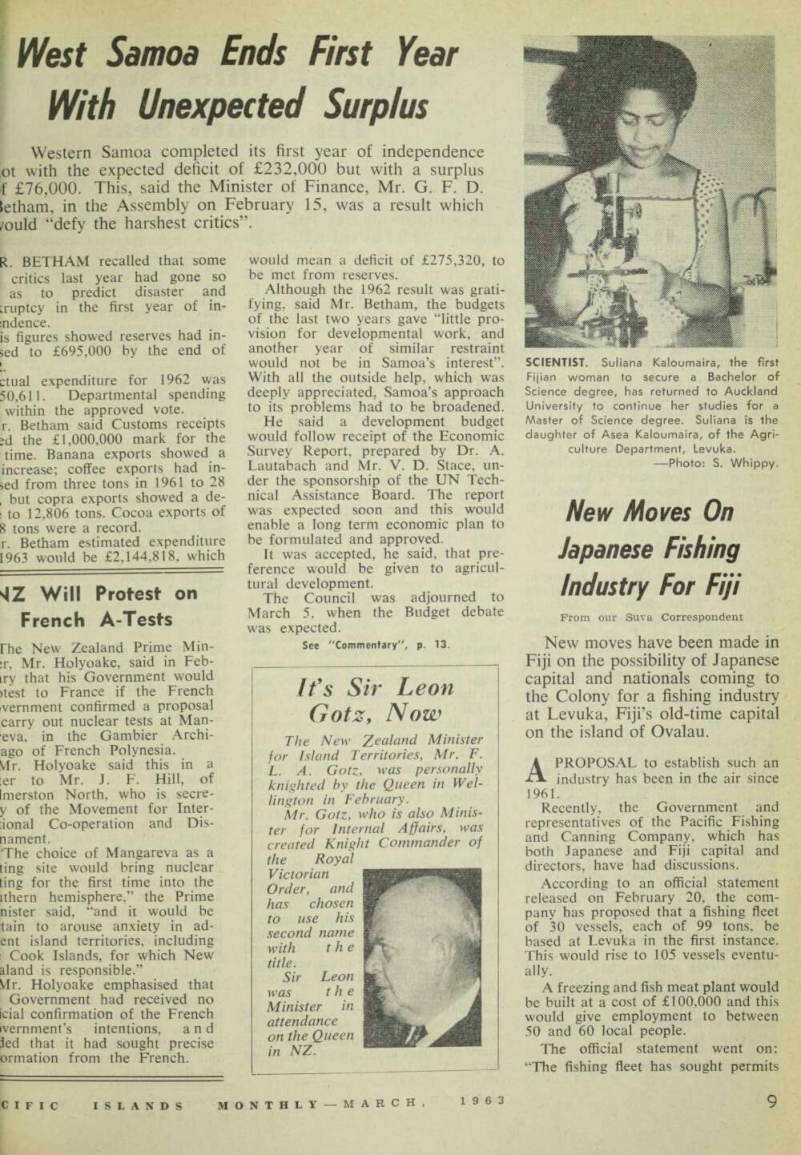
SCIENTIST. Suliana Kaloumaira, the first Fijian woman to secure a Bachelor of Science degree, has returned to Auckland University to continue her studies for a Master of Science degree. Suliana is the daughter of Asea Kaloumaira, of the Agri culture Department, Levuka.
Photo: S. Whippy.
at the rate of one family for every fishing vessel so that when there are 30 vessels, 30 family permits would be given; when there are 55 vessels, 55 family permits, rising to 105.
Families are expected to remain only four or five years and then return to Japan.”
The statement said decisions on these matters were expected to be made by the end of March, and added: “It is expected that the export of frozen fish from Fiji will earn a con siderable sum in foreign currency and will be of benefit to the colony.
“From the establishment of this industry the Colony will benefit in many indirect ways, and this industry can, undoubtedly, revive the town ship of Levuka as no other industry has been able to do in recent years.”
Some local people who have looked hard at the official statement fail to see how Fiji would benefit much from this industry if it is established.
They say that as all the frozen fish would presumably go to Japan, and as the lion’s share of the capital invested is Japanese, it would be Japan that would get the foreign currency and not Fiji.
Cooks' Scheme Plans to get a Japanese fishing in dustry started in the Cook Islands moved a little closer to reality in January when Mr. Toshiro Kagawa, representative in Pago Pago for Nippon Reizo Kabushiki Kaisha (Japan Cold Storage Company Ltd.) was in Rarotonga. The purpose of his visit was to investigate the har bour facilities and sea conditions at Rarotonga.
Mr. Kagawa’s company operates 40 fishing vessels from Pago Pago, many other fishing boats from such places as Trinidad, the Canary Is lands, Brazil and Sierra Leone, and whaling ships in the Antarctic.
Also in Rarotonga in January were Mr. Shoji Monuki and Mr. Norio Sumita, of the International Fisheries Co-operative, of Tokyo. They have been employed by W. Gregg and Co.
Ltd., of Dunedin, to give technical advice on tuna canning and to in vestigate tuna fishing in Cook Islands waters. I The Gregg company has a canning subsidiary in Rarotonga called Island Foods Ltd., which has been planning for some time to build a canning factory in Rarotonga to process tuna caught by Japanese boats.
(See “Commentary”, p. 13)