Increased Development, More
p. 10 · Read in the full issue
Taxes For The Solomons
There was good news and bad in the 1963 BSIP budget, introduced into the Legislative Council in February. Best news was that investment in the Solomons is growing and that the Financial Secretary, Mr. L. M. Davies, believes the country “is beginning to stir and wake up”.
WORST news is that the BSIP is still attempting to get a quart into a financial pint pot, with the result that income taxes are going up, liquor prices are going up and people will be paying more for other things.
It was a record budget. Estimated expenditure of ‘f 1,741,000, which is up 14 per cent, or £206,000 on last year, will be covered by an increased Grant-in-Aid of £625,000 so that the budget may balance. The Grant-in- Aid—biggest yet—is up £113,000, or 22 per cent., on last year.
Included in the expenditure is a whopping increase of £161,000 in Government salaries, bringing them to a total of £7oB,ooo—a state of affairs which came under fire by the unofficial members.
The members also protested against the increase in the number of expatriate officers, and also asked for an explanation of the amount allocated for travelling expenses and other allowances.
Mr. E. V. Lawson protested against a proportion of the money obtained from the sale of the Solomons Trading Corporation last year being included in general revenue. He said the money belonged
to the people and should be used for development schemes.
Under the new income ta?d changes, people in the lowest and highest brackets will pay less tax, but the middle group—which is the biggest—will pay more.
Import taxes were raised on beer, spirits and sugar, resulting in another 3d retail for a can of beer and 1/6 a bottle on whisky. The new rate on sugar is an extra farthing a lb but Mr. Davies said the retail mark up was “very large” and it was hoped the increase would be absorbed by the retailer.
New charges didn’t end there.
Private car licences will be doubled from £3 to £6 and other licences will also be increased.
Water and telephone charges, some court fees and medical charges were “put under review”—which obviously means they will go up. Broadcasting advertising charges are also to be in creased for the Government-operated Honiara Radio.
Concessions There were some concessions, in cluding an increase from £7/10/- to £l5 in the amount under which radio sets may be allowed in before attracting duty.
There were concessions for coconut plantings. Planters wi] able to choose for themselvo they want to offset the cost of plantings in one year or over s years.
Mr. Davies said he was sorn see the BSIP increase its relianc British grants but he was not: couraged.
“I believe we are on the edg more rewarding times,” he said.
“1 have no doubt we will event! succeed in our policy of paying way which is, after all, the honourable policy.
Five years ago there had doubt that large scale invest! would ever occur in the Solom but now those doubts were I dissipated, he said.
Earlier, the High Commissii Sir David Trench, also referred ti increased interest shown in Solomons by overseas business © prises, and said he felt the might at last “be on the brinr substantial economic developmem
Jap Agreement
He referred particularly t! recent agreement which gave Japanese timber cutting rights ! five-year period over Baga Islair the West Solomons.
However, in the budget d© Father Leonard Alufurai expn the concern of many when hes that although it was right that seas companies should be encoun to help the local resources should also be equal commti chances for the people of : Solomons, In other islands, he said, oin companies had taken over co of industry and he wouldn’t likes to happen in the Solomons.
Water Shortage
In Rabaul
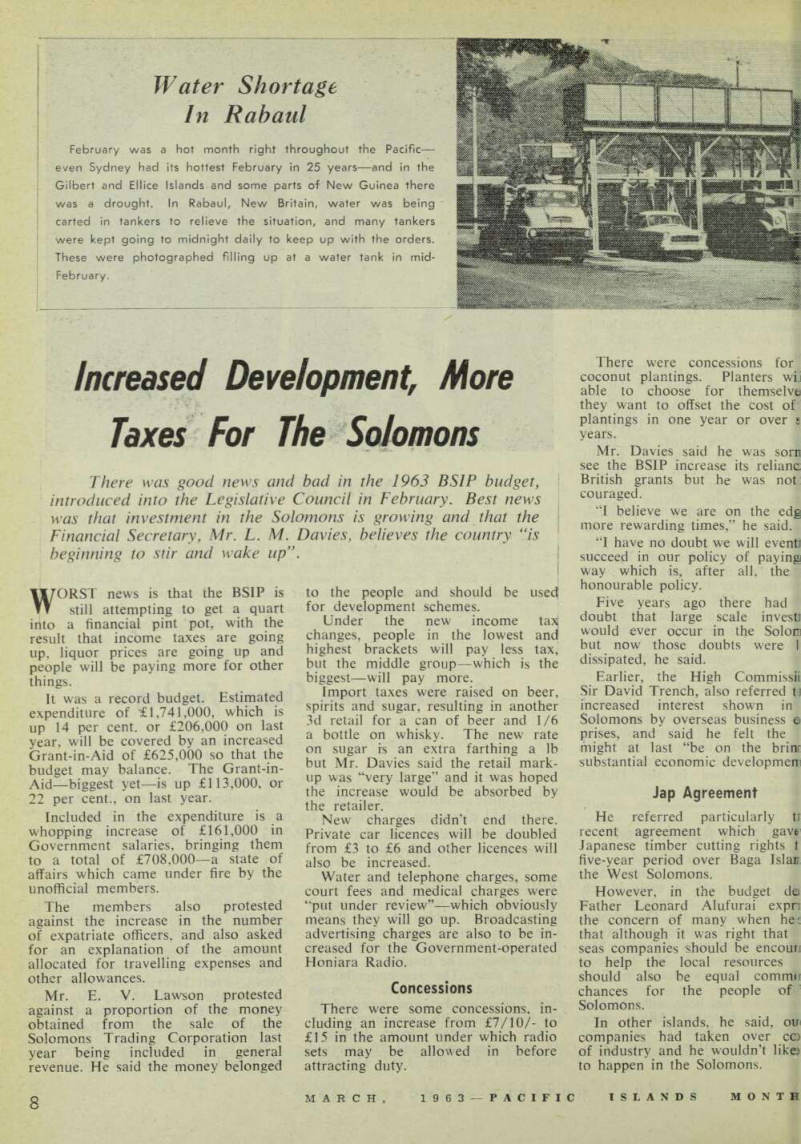
February was a hot month right throughout the Pacific— even Sydney had its hottest February in 25 years —and in the Gilbert and Ellice Islands and some parts of New Guinea there was a drought. In Rabaul, New Britain, water was being carted in tankers to relieve the situation, and many tankers were kept going to midnight daily to keep up with the orders.
These were photographed filling up at a water tank in mid- February.